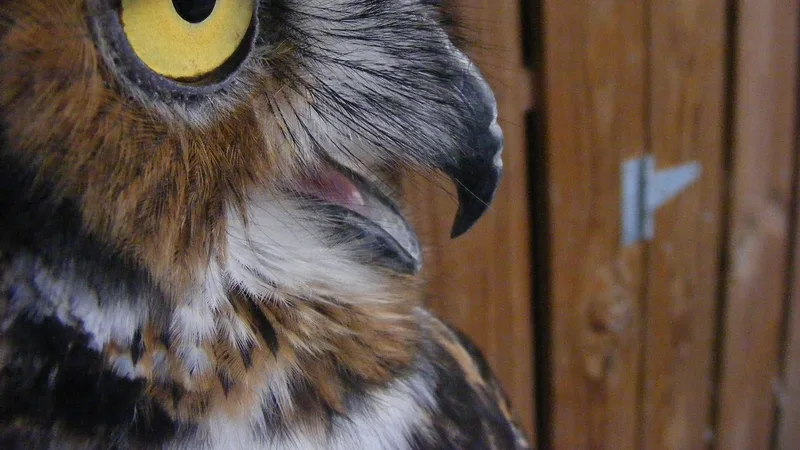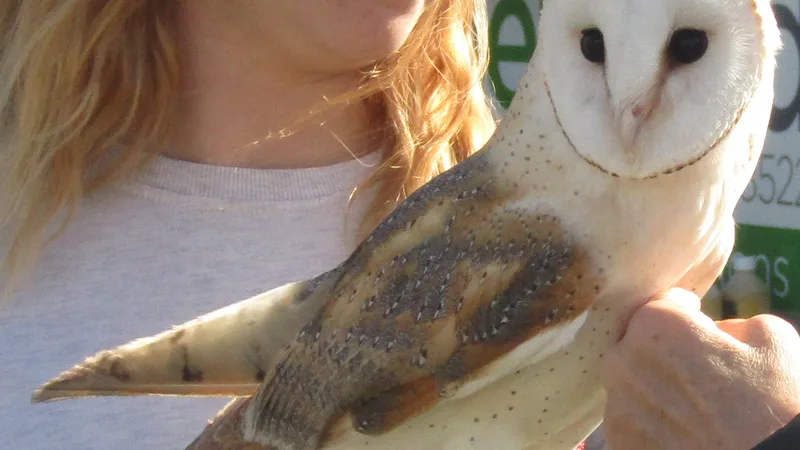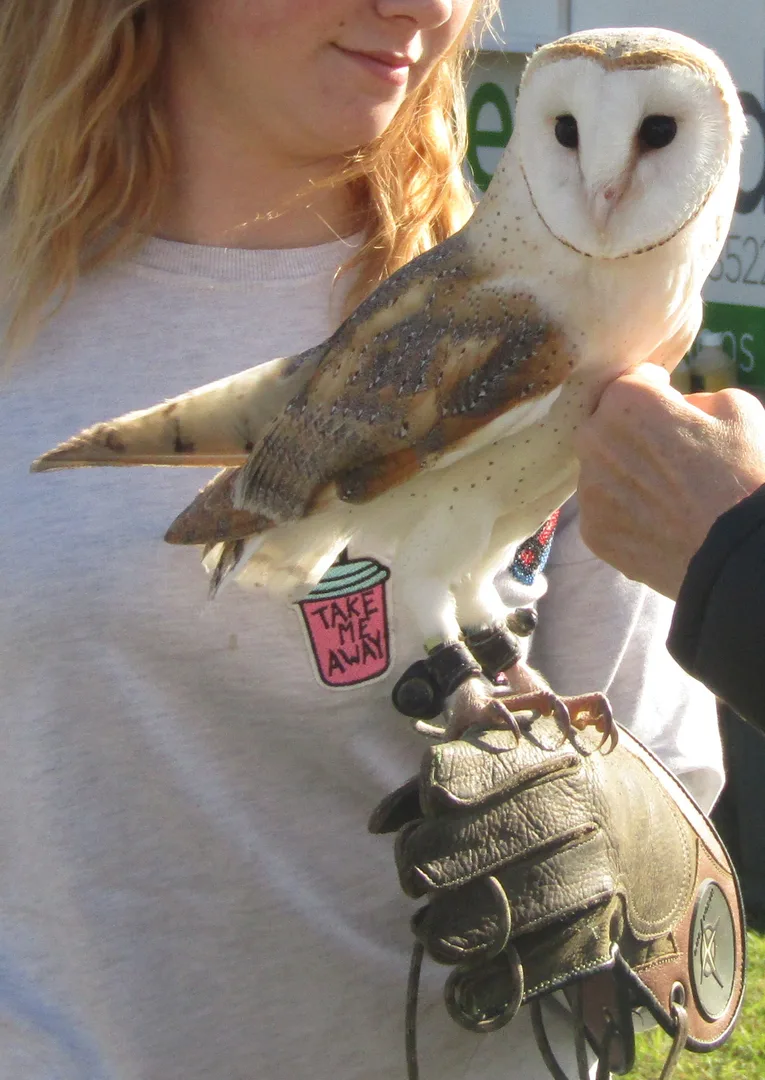
Western barn owl (Tyto alba) taking off from a fence, Scotland
Field
notes
A Sound Fix Under One Degree
The Barn Owl (Tyto alba) begins hunting alone after sunset, and in complete darkness it relies on its hearing. In a 1971 study, barn owls located prey in total darkness using only their ears, with an error of less than one degree both left-to-right and up-down. The study predates the three-way division described below, when Tyto alba still meant barn owls worldwide. Above 8.5 kHz each ear is highly directional, and the two ears are most sensitive in different directions, which matches the asymmetry of the owl’s external ears. Moving a flap of skin in front of each ear opening redirects where that ear is most sensitive. The study’s theory was that the owl may find a sound by turning its head until every frequency in it is loudest in both ears at once.
337 Grams on Average Live adult barn owls in the British Trust for Ornithology (BTO) data average 337 grams, and nine in ten weigh between 280 and 420 grams. Females are the heavier sex, averaging 354 grams to a male’s 312. Animal Diversity Web’s account, written when Tyto alba still meant barn owls worldwide, gives a body length of 34 to 40 cm for females and 32 to 38 cm for males.
Flying in Total Silence
Barn owls are completely silent on the wing, and they use that stealth to sneak up on prey. A barn owl attacks in a low flight and grabs its prey with its feet. It nips through the back of the skull with its bill, then swallows the prey whole, and brings up the bones and fur as an owl pellet.
A Short, Dangerous Life
Most barn owls die in their first year, which is why their average life expectancy in Britain is only 18 months. Starvation is thought to be the main cause of death. It strikes most often at nestlings, at inexperienced young birds leaving the place they hatched, and in severe winter weather. Many barn owls are hit by cars, lorries and trains, and some fly into overhead wires or drown in cattle troughs. Survivors do far better: ignoring first-year deaths, a Swiss study found an average life expectancy of 4 years, and the BTO gives a typical life expectancy of 4 years for a bird that reaches breeding age. The BTO’s longevity record for a ringed barn owl is 15 years, 3 months and 21 days, set in 2016.
Where It Hunts
Genetic studies in 2016 and 2018 found that the old, worldwide “barn owl” is really three lineages: the American Barn Owl, the Eastern Barn Owl of South and Southeast Asia and Australasia, and the Western Barn Owl, which keeps the name Tyto alba and lives in Africa and Europe. The 2016 study proposed treating the three as separate species. In Britain, barn owls live in open countryside and farmland and are often seen on roadside verges. They need a cavity to nest in, such as a hollow tree, a cliff, a church steeple or a barn loft. In the western Palearctic, where barn owls are much smaller than North American ones, golden eagles, red kites, goshawks, buzzards, peregrine falcons, lanners, eagle owls and tawny owls sometimes prey on them. The IUCN rates Tyto alba as Least Concern in its 2025 assessment.
Published Updated
Traits
Intel
& FAQ
Guess
first
How big is a Barn Owl, really? Slide, lock in, and see what the sources say. Every answer is a figure from this page, quoted from where it came from.
Sources
- 01Tyto alba (barn owl). Animal Diversity Web, University of Michigan.
- 02Barn Owl, Tyto alba: BirdFacts. British Trust for Ornithology.
- 03Barn Owl life expectancy. Barn Owl Trust.
- 04Barn owl (Tyto alba). Woodland Trust.
- 05Payne (1971). Acoustic Location of Prey by Barn Owls (Tyto Alba). Journal of Experimental Biology.
- 06Aliabadian et al. (2016). Phylogeny, biogeography, and diversification of barn owls (Aves: Strigiformes). Biological Journal of the Linnean Society.
- 07Uva et al. (2018). Comprehensive molecular phylogeny of barn owls and relatives (Family: Tytonidae), and their six major Pleistocene radiations. Molecular Phylogenetics and Evolution.
- 08Tyto alba. The IUCN Red List of Threatened Species 2025: e.T22688504A280909370.
What the sources say: 58 claims checked word for word against these sources →