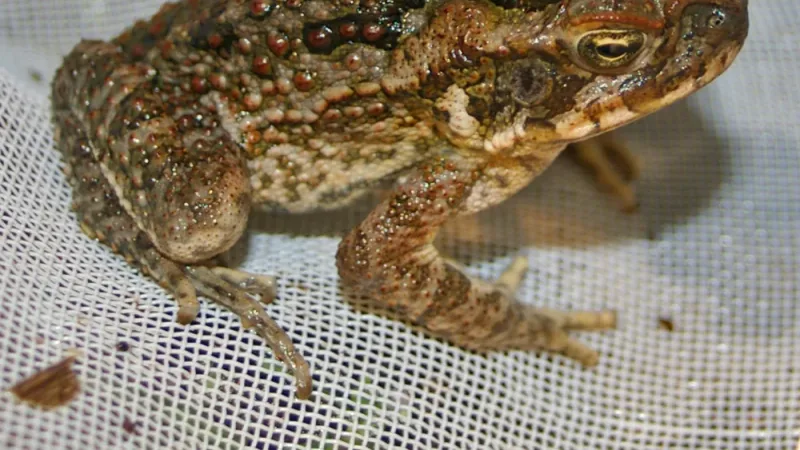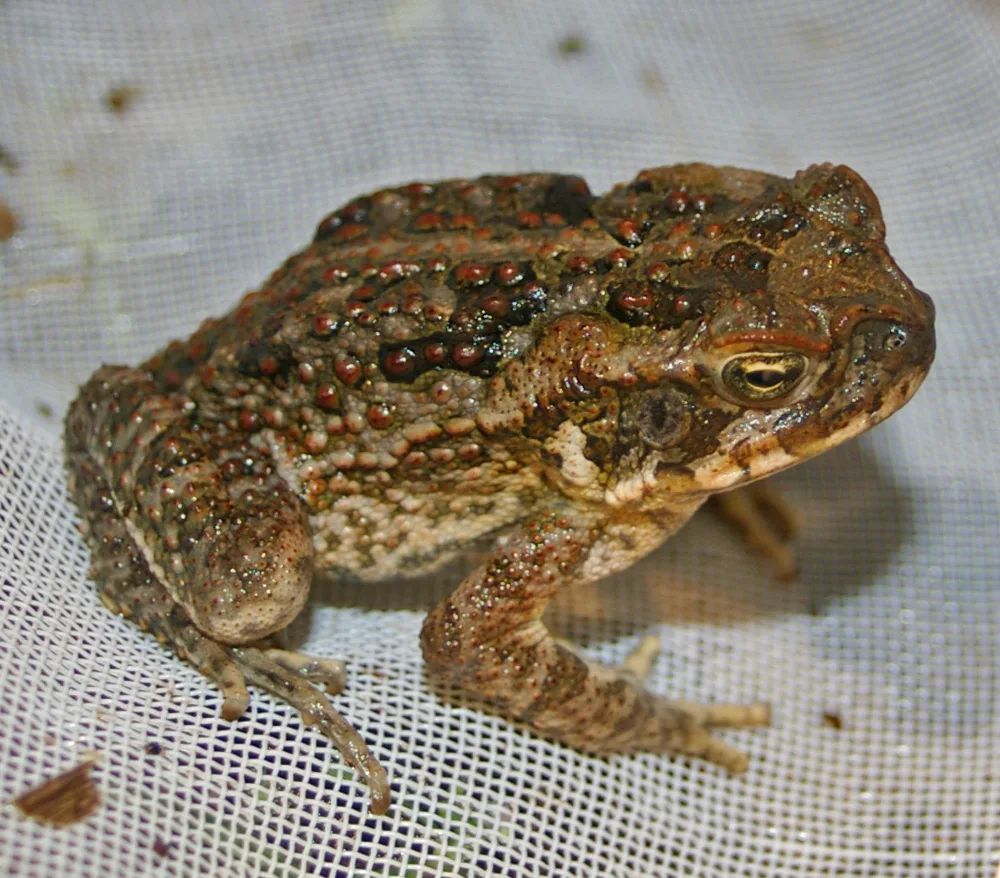
Young cane toad, Darwin, Northern Territory.
Field
notes
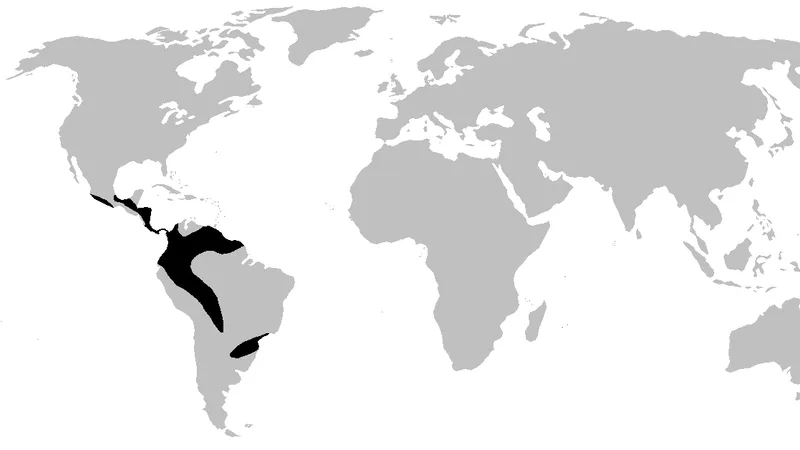
Heavy, warty and covered in poison, the Cane Toad (Rhinella marina) is native from Texas’s Rio Grande Valley south to the central Amazon and southeastern Peru. The Australian Museum calls it a very large toad, up to 15 centimeters in body length and occasionally 25; Animal Diversity Web gives an average mass of 106.25 grams. It forages at night, and a southern Florida study found ants, beetles and earwigs in its diet, along with crustaceans, snails and even dog and cat food. It lives at least 5 years in the wild, up to 15 in captivity.
Shoulder-Mounted Poison Factory A pair of huge parotoid glands stretches from each eardrum halfway down the toad’s back, oozing a thick white fluid when the toad is confronted by a predator. Animal Diversity Web says the toxin may cause profuse salivation, twitching, vomiting, shallow breathing and collapse of the hind limbs, and even death in some predators, including dogs.
A Failed Pest-Control Experiment
Australia’s Bureau of Sugar Experiment Stations imported about 100 cane toads from Hawaii to a research station near Cairns, hoping they would eat the cane beetles whose grubs chew the roots of Queensland’s sugarcane, the Australian Museum records. The toads bred quickly, and more than 3,000 were released into north Queensland’s cane plantations in July 1935. They proved ineffective, Business Queensland says, and Animal Diversity Web notes no evidence the toad has controlled any pest in Australia, where it is now considered a pest species itself. It has spread through most of Queensland, west into the Northern Territory and the Kimberley in Western Australia, and south to the mid-north coast of New South Wales.
Built for the Invasion Front
The invasion has sped up as it went: over an 80-year period the toads’ rate of invasion across tropical Australia rose from around 15 to 60 kilometers a year, one study found. Toads at the front disperse much faster and further than those in the range core, and are shaped differently. Three-dimensional analysis of their bones found wider forelimbs, narrower hindlimbs and more compact skulls at the front, changes that plausibly reflect more bounding, many short hops in quick succession, rather than separate large leaps.
The Toxic Nursery
A female lays up to 35,000 eggs in a single clutch, in long gelatinous strings, Business Queensland reports, and the danger starts before they hatch. A study of the Australian frog Opisthodon ornatus found that eating the toad’s toxic eggs reduced the native tadpoles’ survival, though survivors grew more rapidly and turned into larger frogs. The eggs hatch in two to seven days, and tadpoles can become toads in a month, or in ten days in warm shallow water, the Australian Museum reports.
Learning the Hard Way
Small-scale trials show vulnerable predators can learn to drop toads from their diets. In the remote Kimberley, researchers released more than 200,000 toad eggs, tadpoles and toadlets, too small to deliver a fatal dose, ahead of the invasion front. Camera surveys found large monitor lizards almost wiped out on control plots but abundant where the “teacher toads” had been laid out. Not every attempt works: a trial baiting northern quolls into avoiding toads backfired, with a 94% drop in quoll numbers at treatment sites against 65% at controls. Most animals, the researchers found, were no longer averse within 120 days of training.
Published Updated
Traits
Intel
& FAQ
Guess
first
How big is a Cane Toad, really? Slide, lock in, and see what the sources say. Every answer is a figure from this page, quoted from where it came from.
Sources
- 01Rhinella marina (Cane Toad). Animal Diversity Web, University of Michigan.
- 02Cane Toad. Australian Museum.
- 03Cane toad. Business Queensland, Queensland Government.
- 04Rhinella marina. The IUCN Red List of Threatened Species 2023: e.T100099625A2951416.
- 05Hudson et al. (2016). Constructing an Invasion Machine: The Rapid Evolution of a Dispersal-Enhancing Phenotype During the Cane Toad Invasion of Australia. PLOS ONE.
- 06Crossland, Alford & Shine (2008). Impact of the invasive cane toad (Bufo marinus) on an Australian frog (Opisthodon ornatus) depends on minor variation in reproductive timing. Oecologia.
- 07Ward-Fear et al. (2024). Teacher toads: Buffering apex predators from toxic invaders in a remote tropical landscape. Conservation Letters.
- 08Indigo et al. (2023). Can conditioned taste aversion be deployed at a landscape level to mitigate the impact of invasive cane toads on northern quolls? Wildlife Research.
What the sources say: 52 claims checked word for word against these sources →