Ambystoma mexicanum 1
Field
notes
The Peter Pan of Amphibians
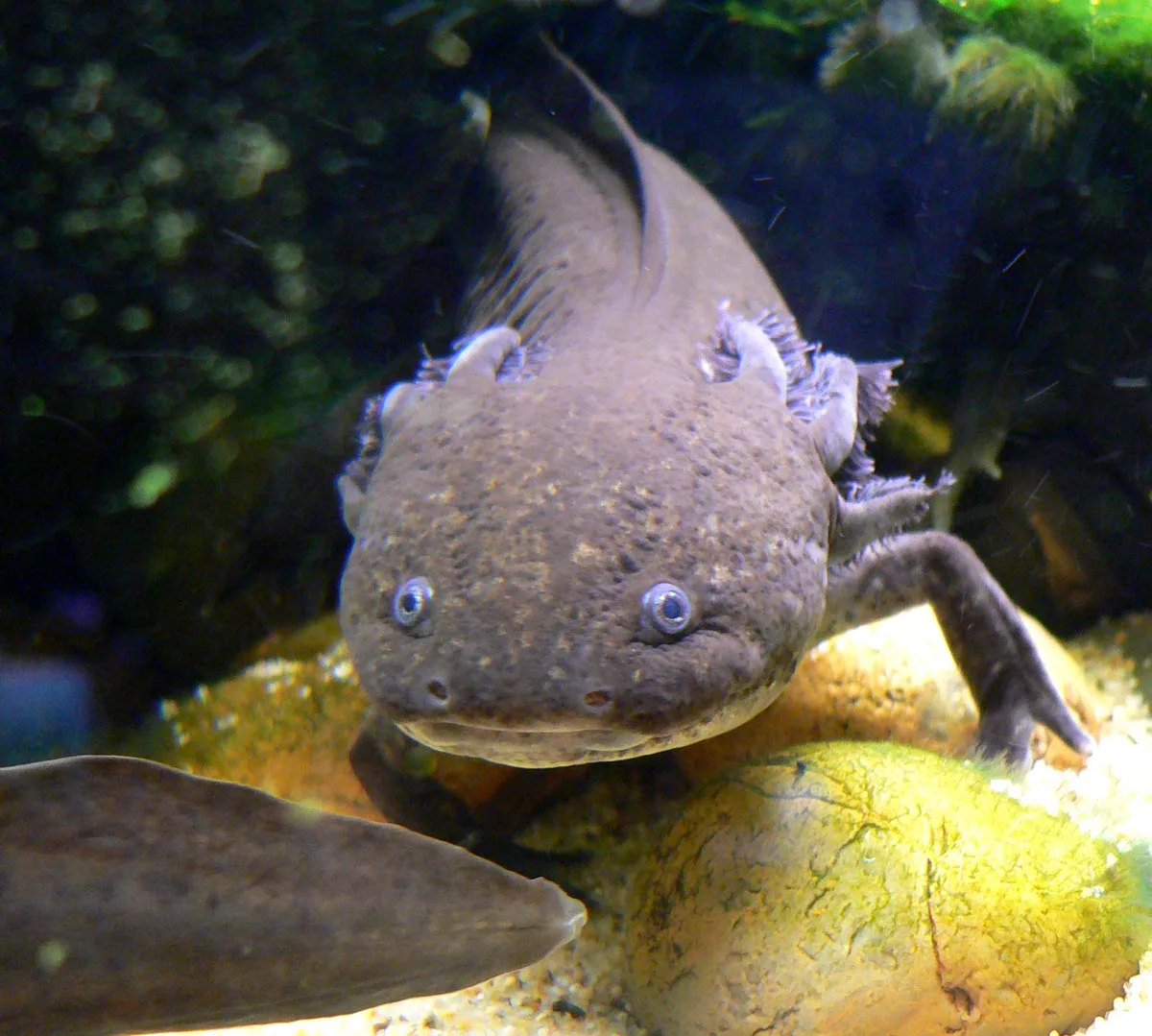
While its close relative the tiger salamander is known to always go through metamorphosis and head for a boring, mostly land-based adult life, the Axolotl (Ambystoma mexicanum) said “no thank you”. It usually keeps its larval features into adulthood and lives its whole life cycle in water, a condition called neoteny. In the wild it rarely, if ever, metamorphoses. It spends its days swimming around with feathery external gills that look like high-tech cybernetic antenna arrays.
Sixty days to a new leg In one lab study, most adult axolotls had regrown a complete front leg by 60 days after amputation. The new limb comes from a blastema, a mass of stem-like cells that grows, lays out the pattern and turns into the missing parts.
Wolverine-Level Regenerative Biology
The axolotl is biology’s ultimate cheat code. Mammals like us patch a deep skin wound with a permanent scar; an adult axolotl regrows the skin with no scar at all. Cut off a limb and cells from the stump form a blastema of stem-like cells that rebuilds the whole thing. Axolotls can also regrow a tail with its spinal cord, part of a damaged heart, and several kinds of neuron lost from an injured patch of brain. Scientists study them in the hope of better regenerative treatments for humans.
Published Updated
Traits
Intel
& FAQ
Sources
- 01Ambystoma mexicanum (axolotl). Animal Diversity Web, University of Michigan.
- 02Ramos et al. (2025). Movement ecology of captive-bred axolotls in restored and artificial wetlands: Conservation insights for amphibian reintroductions and translocations. PLOS ONE.
- 03Voss, Woodcock & Zambrano (2015). A Tale of Two Axolotls. BioScience.
- 04Contreras et al. (2009). Recent decline and potential distribution in the last remnant area of the microendemic Mexican axolotl (Ambystoma mexicanum). Biological Conservation.
- 05Zambrano, Valiente & Vander Zanden (2010). Food web overlap among native axolotl (Ambystoma mexicanum) and two exotic fishes: carp (Cyprinus carpio) and tilapia (Oreochromis niloticus) in Xochimilco, Mexico City. Biological Invasions.
- 06Crowner et al. (2019). Rediscovering the Axolotl as a Model for Thyroid Hormone Dependent Development. Frontiers in Endocrinology.
- 07McCusker, Bryant & Gardiner (2015). The axolotl limb blastema: cellular and molecular mechanisms driving blastema formation and limb regeneration in tetrapods.
- 08Andersson, Dittrich & Lauridsen (2023). Continuous anesthesia for 60 days in an isosmotic environment does not impair limb or cardiac regeneration in the axolotl. Scientific Reports.
- 09Godwin et al. (2017). Heart regeneration in the salamander relies on macrophage-mediated control of fibroblast activation and the extracellular landscape. npj Regenerative Medicine.
- 10McHedlishvili et al. (2012). Reconstitution of the central and peripheral nervous system during salamander tail regeneration. Proceedings of the National Academy of Sciences.
- 11Kramer et al. (2024). Axolotl mandible regeneration occurs through mechanical gap closure and a shared regenerative program with the limb. Disease Models & Mechanisms.
- 12Amamoto et al. (2016). Adult axolotls can regenerate original neuronal diversity in response to brain injury. eLife.
- 13Seifert et al. (2012). Skin Regeneration in Adult Axolotls: A Blueprint for Scar-Free Healing in Vertebrates. PLoS ONE.
What the sources say: 58 claims checked word for word against these sources →