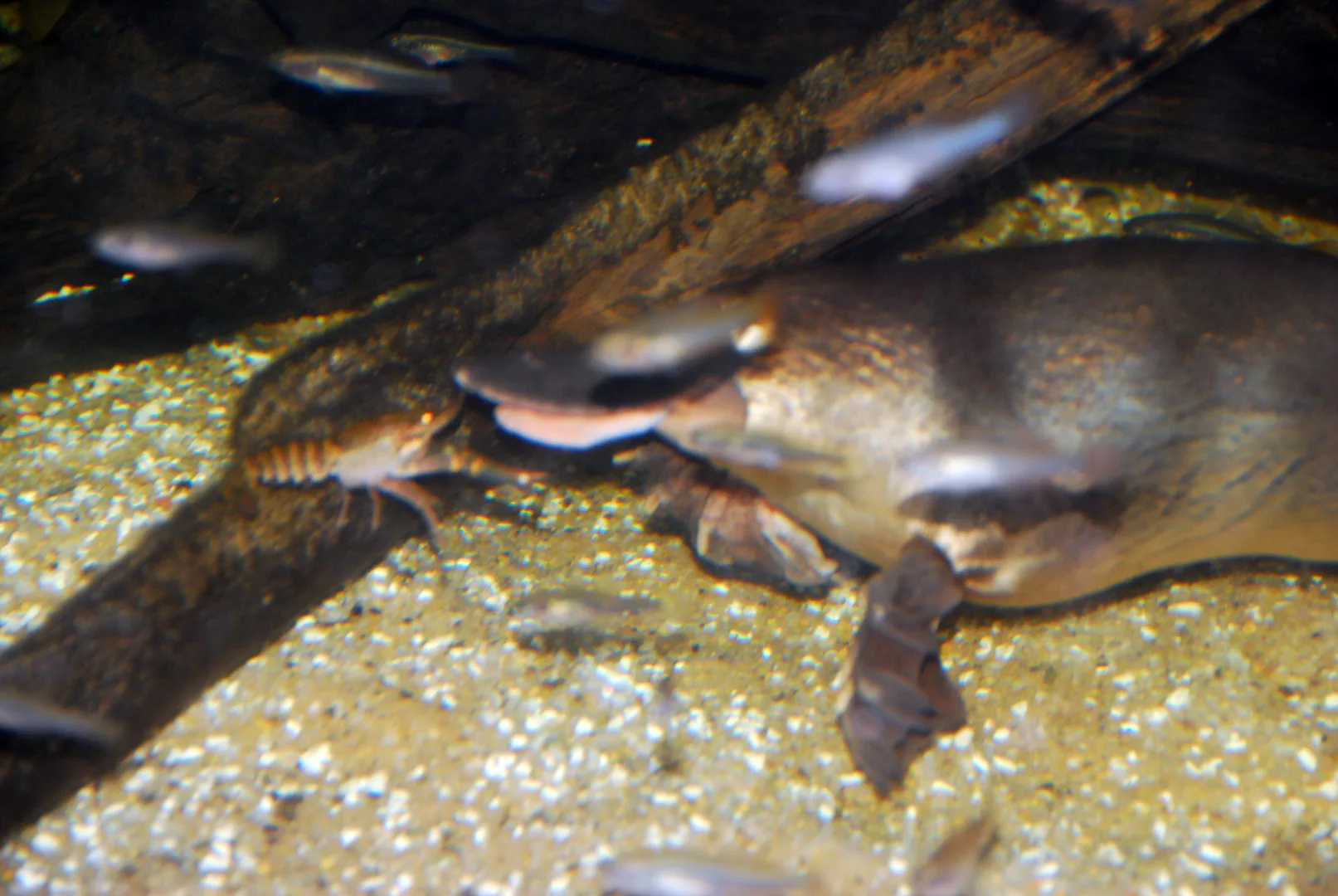
Platypus (Ornithorhynchus anatinus) feeding
Field
notes
A Mammal Built Like a Hoax
Platypuses and echidnas are the only living mammals that lay eggs, and together they are called monotremes. A genetics paper on the platypus’s venom opens by noting that when the species was first found, it “was thought to be a taxidermist’s hoax, as it has a blend of mammalian and reptilian features.” The paper reporting its genome sums up the mix: platypus females lactate, yet lay eggs, and males are equipped with venom similar to that of reptiles.
Males run 40 to 63 centimetres from bill to tail-tip and weigh up to 3 kilograms; females are smaller, at 37 to 55 centimetres and up to 1.7 kilograms. Platypuses typically live 12 to 15 years. The species lives in the wetter regions of eastern Australia and Tasmania, in rivers, lagoons and streams. By day it rests in a burrow dug along the bank, or under rock ledges, roots and debris.
Venom Built From a Borrowed Gene
Male platypuses deliver venom through spurs on their hind legs, not through a bite. Its major components come from a repurposed antimicrobial gene: three venom genes arose when copies of a gene family called beta-defensins duplicated and changed function. Some snakes and lizards make similar venom molecules, but theirs evolved separately, so the trick has evolved more than once.
Intravenous narcotics could not control the pain from two spur wounds to one man’s hand. A nerve block at the wrist was dramatically effective.
That’s from the first detailed medical report of a platypus envenomation, published in 1992, about a 57-year-old man spurred by a male platypus. It is not fatal to people, but the venom produces “savage local pain and marked local swelling,” and his hand did not work properly for three months. A spur can deliver enough venom to kill a medium-sized dog. There’s more venom in the breeding season, which leads scientists to think males use it against rival males.
Hunting Blind, By Electric Field
When a platypus forages underwater, its eyes, ears and nostrils are closed, and an electrical sense in its bill helps it find prey. The bill carries 40,000 electroreceptors, which detect the electrical impulses living creatures make, plus 46,500 touch receptors. In 2008, researchers who mapped the bill called the platypus “presently the only mammal demonstrated to use electroreception to obtain food.” Dives usually last 30 to 60 seconds or so and go less than 5 metres down. Prey goes into cheek pouches to be eaten at the surface: freshwater shrimp, crayfish called yabbies, worms and insect larvae.
No Stomach Acid, and a Glow Under Blacklight
Hatchlings have molar-like milk teeth, but they’re shed around the time the young leave the nesting burrow; adults grind food between pads made of keratin. A 2008 genetic study found that platypuses have lost the main genes for making and using gastric juice, including those for pepsin and the stomach’s acid pump. That’s not the same as having no stomach, a claim a 2025 review uses as an example of how “science misinformation can be propagated.” Platypuses “do have stomachs,” the review says, just non-secretory ones, unlike those of all other mammals. Under ultraviolet light, the brown fur of three museum specimens glowed green or cyan, the first biofluorescence reported in any monotreme.
Published Updated
Traits
Intel
& FAQ
Guess
first
How big is a Duck-Billed Platypus, really? Slide, lock in, and see what the sources say. Every answer is a figure from this page, quoted from where it came from.
Sources
- 01Ornithorhynchus anatinus (duck-billed platypus). Animal Diversity Web, University of Michigan.
- 02Platypus. San Diego Zoo Wildlife Alliance.
- 03Fenner, Williamson & Myers (1992). Platypus envenomation - a painful learning experience. Medical Journal of Australia.
- 04Whittington et al. (2008). Defensins and the convergent evolution of platypus and reptile venom genes. Genome Research.
- 05Genome analysis of the platypus reveals unique signatures of evolution.
- 06Manger & Pettigrew (2008). Ultrastructure, Number, Distribution and Innervation of Electroreceptors and Mechanoreceptors in the Bill Skin of the Platypus, Ornithorhynchus anatinus (Part 1 of 2). Brain, Behavior and Evolution.
- 07Ordoñez et al. (2008). Loss of genes implicated in gastric function during platypus evolution. Genome Biology.
- 08Nicol (2025). Does the platypus have a stomach? The perils of popular science. Australian Zoologist.
- 09Anich et al. (2020). Biofluorescence in the platypus (Ornithorhynchus anatinus). Mammalia.
- 10Woinarski & Burbidge (2016). Ornithorhynchus anatinus. The IUCN Red List of Threatened Species 2016: e.T40488A21964009.
What the sources say: 58 claims checked word for word against these sources →