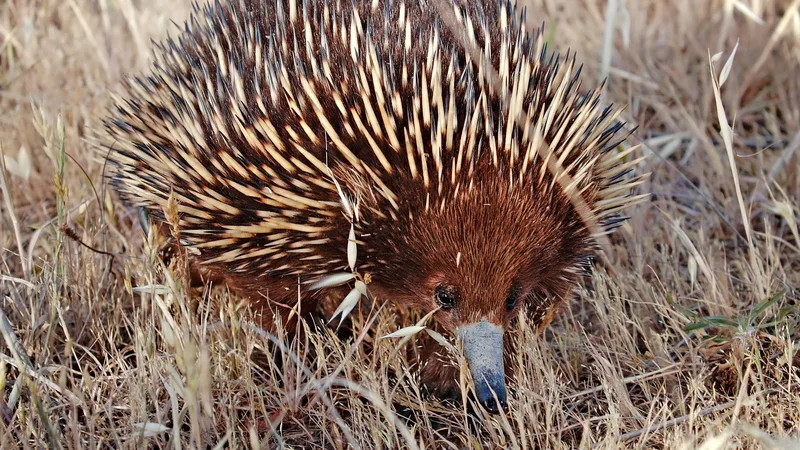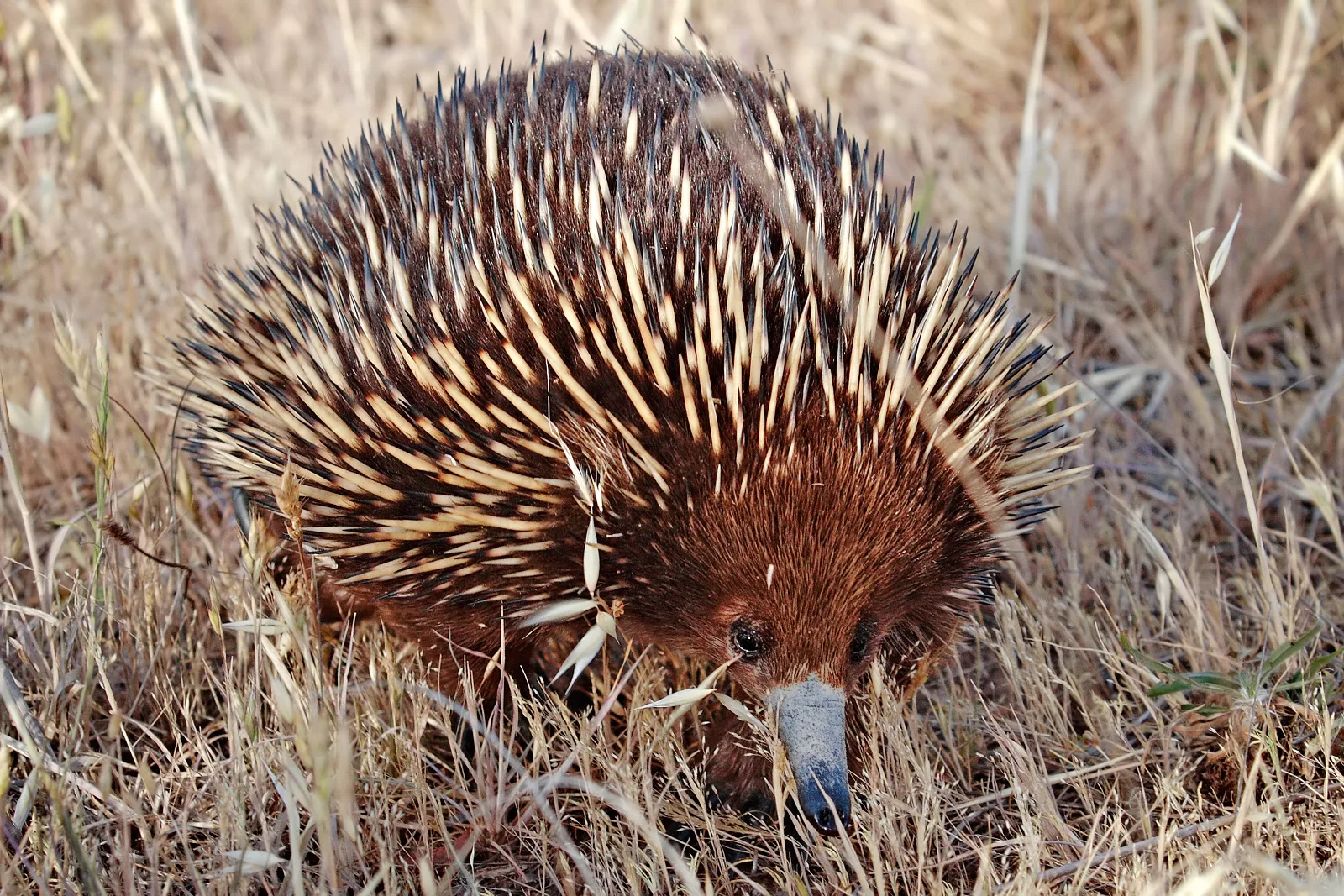
Short-beaked echidna (Tachyglossus aculeatus setosus), Scottsdale, Tasmania.
Field
notes
An Electric Sense on Dry Land
In a 1989 study, researchers recorded nerve signals from the snouts of four echidnas and identified 47 electroreceptors, sensors that detect weak electric fields. Each one responded to a spot on the tip of the snout. In the same study, a trained echidna learned to detect a field as weak as 1.8 millivolts per centimetre across a trough of tap water. What electric fields an echidna meets in the wild, the authors wrote, remained to be determined.
A 2021 genome study describes echidnas as led by smell. An echidna’s main olfactory bulb, the brain’s smell centre, is much bigger than a platypus’s, and its genome carries 693 smell receptor genes to the platypus’s 299. The authors suggest this may help it search for the odours of underground prey.
An Electric First The 1989 team concluded that the echidna, like the platypus, has an electric sense. They called it the first known example of electroreception in a land animal.
A Toothless Digger With a Wide Range
Short-beaked echidnas measure 30 to 45 centimetres and weigh 2 to 7 kilograms. They have no teeth. They dig into ant and termite nests with their front paws, poke a long, sticky tongue into the gaps, and grind the insects on hard pads at the back of the mouth.
A 2016 study gives their life expectancy as up to 45 years, and says this is generally put down to a low metabolism and torpor, a controlled drop in energy use and body temperature.
The species has one of the widest ranges of any native Australian mammal, turning up almost anywhere from deserts to wet forests to alpine regions. It lives in mainland Australia, Tasmania, Kangaroo Island, and southern and eastern New Guinea. That continent-wide spread is why it is considered Australia’s most common native mammal, though its numbers are low everywhere.
Spines, Torpor and a Long Wait Out
Feral cats, pigs, dingoes and goannas occasionally prey on echidnas, mostly the young and half-grown. An adult escapes by hiding under rocks or logs, or by digging down until only its spiny back shows. It can also curl up to protect its underside. Cars kill hundreds of echidnas on Australia’s roads every year.
Short-beaked echidnas are among the largest known deep hibernators. In a 2016 study, researchers tracked ten echidnas through a planned burn in Western Australia. Four of the five at the fire site survived. The one that died was resting inside a log that caught fire. When not in torpor, echidnas typically keep a body temperature of 28 to 35 degrees Celsius. During the study, the lowest recorded was 11.6 degrees. For weeks after the fire, the fire-affected echidnas stayed in their home areas and lowered their body temperature and activity. The authors suggest torpor helps animals survive in a fire-scorched landscape.
Eggs, a Pouch and No Nipples
Echidnas and the platypus are the only two living lineages of monotremes, the egg-laying mammals. After a pregnancy of about 23 days, a female short-beaked echidna lays a single soft-shelled egg in her pouch. It hatches 10 or 11 days later, and a baby echidna is called a puggle. Mothers have no nipples or teats. The young feed through pores connected to the mother’s paired mammary glands.
A female may be followed by one or several males. Several males trailing one female is called an “echidna train.” She mates with only one male per season.
Published Updated
Traits
Intel
& FAQ
Guess
first
How big is a Short-Beaked Echidna, really? Slide, lock in, and see what the sources say. Every answer is a figure from this page, quoted from where it came from.
Sources
- 01Tachyglossus aculeatus (short-beaked echidna). Animal Diversity Web, University of Michigan.
- 02Echidna. San Diego Zoo Wildlife Alliance.
- 03Aplin et al. (2016). Tachyglossus aculeatus. The IUCN Red List of Threatened Species 2016: e.T41312A21964662.
- 04Zhou et al. (2021). Platypus and echidna genomes reveal mammalian biology and evolution. Nature.
- 05Nowack, Cooper & Geiser (2016). Cool echidnas survive the fire. Proceedings of the Royal Society B: Biological Sciences.
- 06Rismiller & Grutzner (2019). Tachyglossus aculeatus (Monotremata: Tachyglossidae). Mammalian Species.
- 07Gregory et al. (1989). Responses of electroreceptors in the snout of the echidna. The Journal of Physiology.
What the sources say: 62 claims checked word for word against these sources →