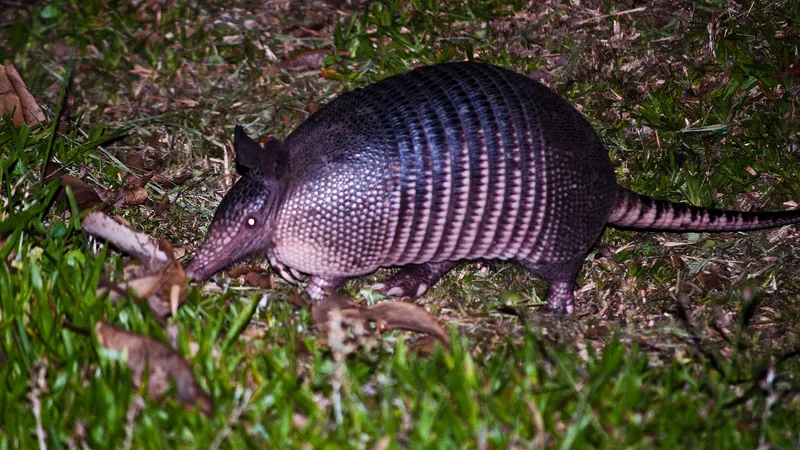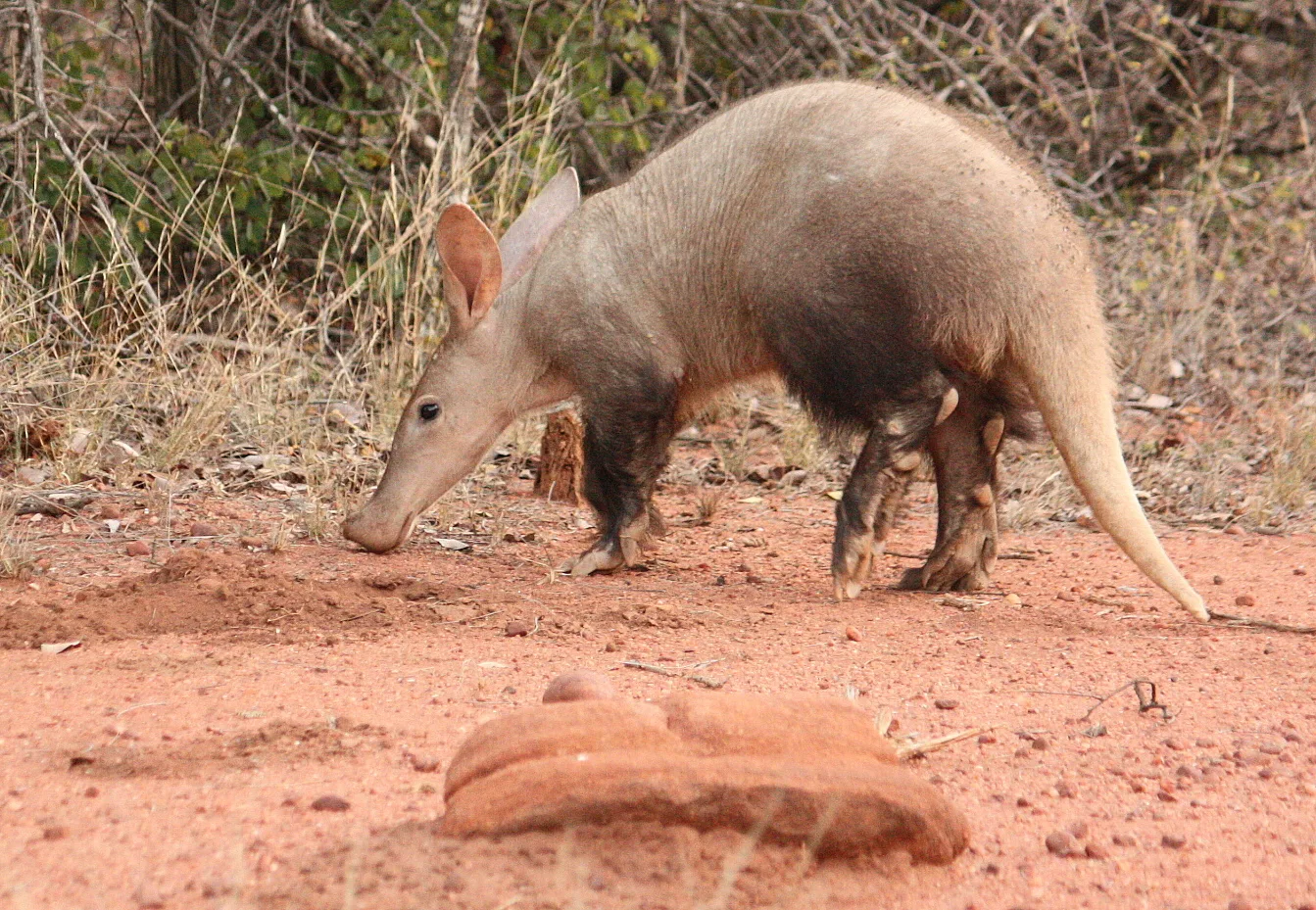
Orycteropus afer
Field
notes
Termite-mining machine
The aardvark, Orycteropus afer, is the only living species of its whole order, Tubulidentata. Its job is simple: dig up ants and termites. In a study that radio-tagged thirteen aardvarks in the Nama Karoo, the diet consisted entirely of ants and termites, with ants leading in all seasons and years.
Each toe ends in a spade-like claw that helps it dig with great speed and force. Its long, sticky tongue sweeps the insects into a small mouth, and it swallows with little or no chewing.
Tooth check Aardvarks have peg-like back teeth and no incisors or canines. Their teeth lack enamel, the hard outer coating on a tooth, and are made of densely packed tubules instead.
Size, weight and lifespan
The aardvark is the largest living burrowing mammal, at about 1.4 to 2.2 m in total length and 40 to 100 kg. It is the size of a small pig, with very thick skin. Aardvarks caught for a Kalahari study averaged 35 kg.
A lifespan database records one captive aardvark that lived 29.8 years. That is one captive animal, not a wild average.
Built for the night
Aardvarks forage at night, covering 2 to 5 km each time. Before setting off, an aardvark stops at its den opening to look for enemies, runs out, jumps around repeatedly, looks about, and then trots off.
Its retinas contain only rods, which allow it to see at night but leave it colorblind. Its ears can move independently and fold shut while it tunnels.
If a predator turns up, it tries to dig a hole to hide in. Failing that, it stands up on its hind legs and tail, or lies on its back, and defends itself with its large front claws. Lions, hyenas and leopards are known to kill aardvarks.
Landlord of the savanna
Aardvarks live across sub-Saharan Africa, except the West and Central rain forest regions. Their burrows can have eight or more entrances and reach as much as 6 meters underground. Hyenas, warthogs, squirrels, hedgehogs, mongooses and bats, as well as birds and reptiles, use the holes.
Many animal species depend on those burrows for refuge. In the Kalahari, after a hot, dry summer, five of six aardvarks fitted with implanted loggers and 11 others at the site died. Their body temperatures fell as low as 25°C before death, likely due to starvation, and their activity shifted from night to day. The IUCN Red List rates the species Least Concern.
Published
Traits
Intel
& FAQ
Guess
first
How big is a Aardvark, really? Slide, lock in, and see what the sources say. Every answer is a figure from this page, quoted from where it came from.
Sources
- 01Taylor & Lehmann (2015). Orycteropus afer. The IUCN Red List of Threatened Species 2015: e.T41504A21286437.
- 02Orycteropus afer (aardvark). Animal Diversity Web, University of Michigan.
- 03AnAge entry for Orycteropus afer. AnAge: The Animal Ageing and Longevity Database, Build 15, Human Ageing Genomic Resources.
- 04Taylor, Lindsey & Skinner (2002). The feeding ecology of the aardvark Orycteropus afer. Journal of Arid Environments.
- 05Legendre & Botha-Brink (2018). Digging the compromise: investigating the link between limb bone histology and fossoriality in the aardvark (Orycteropus afer). PeerJ.
- 06Weyer et al. (2020). Increased Diurnal Activity Is Indicative of Energy Deficit in a Nocturnal Mammal, the Aardvark. Frontiers in Physiology.
- 07Rey et al. (2017). Drought-induced starvation of aardvarks in the Kalahari: an indirect effect of climate change. Biology Letters.
- 08Arnason, Gullberg & Janke (1999). The mitochondrial DNA molecule of the aardvark, Orycteropus afer, and the position of the Tubulidentata in the eutherian tree. Proceedings of the Royal Society of London. Series B: Biological Sciences.
- 09Endo et al. (2003). Three-dimensional CT image analysis of the digging system in the aardvark. Annals of Anatomy - Anatomischer Anzeiger.
What the sources say: 40 claims checked word for word against these sources →