Málaga, Spain
Field
notes
A Heart on Overdrive
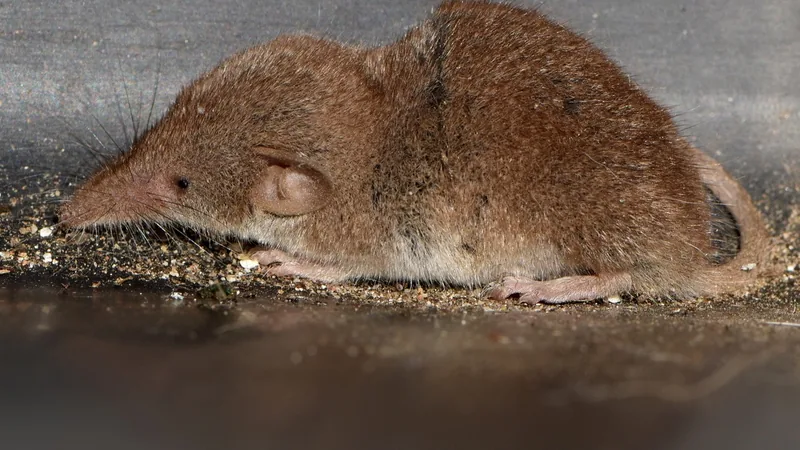
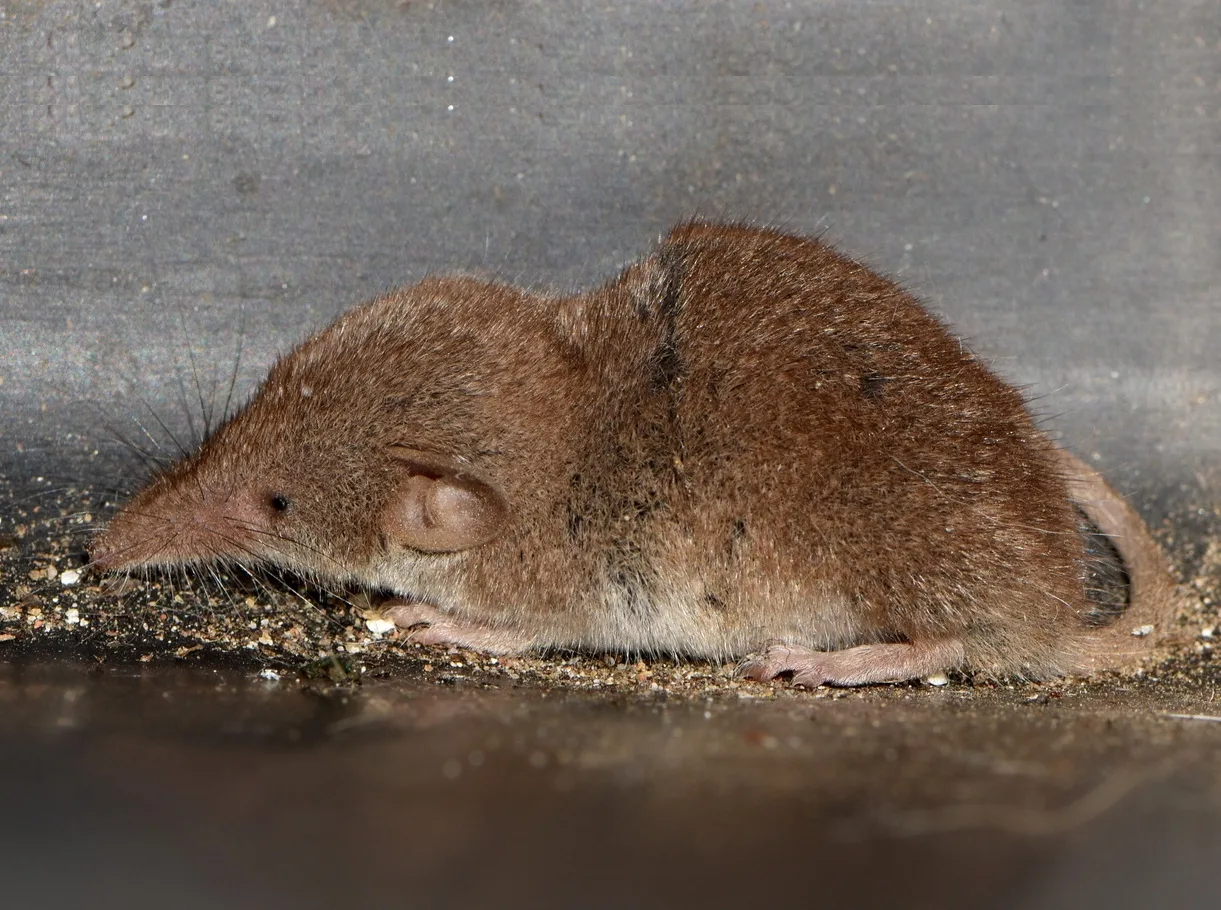
The Etruscan shrew is one of the smallest mammals alive. Most adults weigh 1.8 to 3 grams and measure 35 to 50 mm long. Its body runs at full tilt. A resting shrew’s heart beats 835 times a minute on average, and the highest single value recorded was 1,511 beats a minute. That is the highest heart rate reported so far for an endotherm, an animal that makes its own body heat.
A resting shrew also takes 661 breaths a minute on average. Its specific oxygen consumption rate, which is oxygen use relative to body mass, is 67 times higher than a resting human’s.
Hunting in the Dark by Touch
All that burning needs fuel. The shrew feeds up to 25 times a day and eats more than its own body weight in food. It eats ants and other small insects, and crickets are among its preferred food. A cricket can be almost as big as the shrew itself.
It tracks prey down in darkness by touch, using two sets of whiskers: long ones that help it aim its attack and short ones around the mouth. It needs both sets to catch prey. The shrew can react to prey movement in as little as 25 to 30 milliseconds. It can also enter slits as thin as 7 mm to capture prey, and it shelters in old dry stone walls.
Waking from the cold Shrews put into torpor, a state of lowered activity, cooled to a mean low of 12.1 degrees Celsius. They then rewarmed at 0.83 degrees a minute on average, among the highest rates recorded in mammals.
Up to about 17 degrees, the heat came mainly from brown adipose tissue, or brown fat. In these shrews it made up 9.2% of body mass, which the 1997 study found higher than in any other mammal.
From Portugal to the Middle East
Etruscan shrews live mainly in the Mediterranean lowlands, from Portugal to the Middle East. Their habitat includes forest, shrub and grassland. Around the Mediterranean they like abandoned olive groves and vineyards overrun by shrubs. Owls are known predators.
They are hard to keep alive in captivity. One captive lived 3.2 years, but AnAge rates that record as questionable and says the real maximum may be considerably higher. The IUCN Red List rates the species Least Concern.
Published
Traits
Intel
& FAQ
Guess
first
How big is a Etruscan Shrew, really? Slide, lock in, and see what the sources say. Every answer is a figure from this page, quoted from where it came from.
Sources
- 01Suncus etruscus. The IUCN Red List of Threatened Species 2024: e.T90389138A221340889.
- 02Suncus etruscus (white-toothed pygmy shrew). Animal Diversity Web, University of Michigan.
- 03AnAge entry for Suncus etruscus. AnAge: The Animal Ageing and Longevity Database, Build 15, Human Ageing Genomic Resources.
- 04Heart and respiratory rates and their significance for convective oxygen transport rates in the smallest mammal, the Etruscan shrew Suncus etruscus. Journal of Experimental Biology, 1996.
- 05Rates of rewarming, heart and respiratory rates and their significance for oxygen transport during arousal from torpor in the smallest mammal, the Etruscan shrew Suncus etruscus. Journal of Experimental Biology, 1997.
- 06Tactile guidance of prey capture in Etruscan shrews. Proceedings of the National Academy of Sciences, 2006.
- 07The neurobiology of Etruscan shrew active touch. Philosophical Transactions of the Royal Society B, 2011.
- 08Roth-Alpermann & Brecht (2009). Vibrissal touch in the Etruscan shrew. Scholarpedia.
What the sources say: 47 claims checked word for word against these sources →