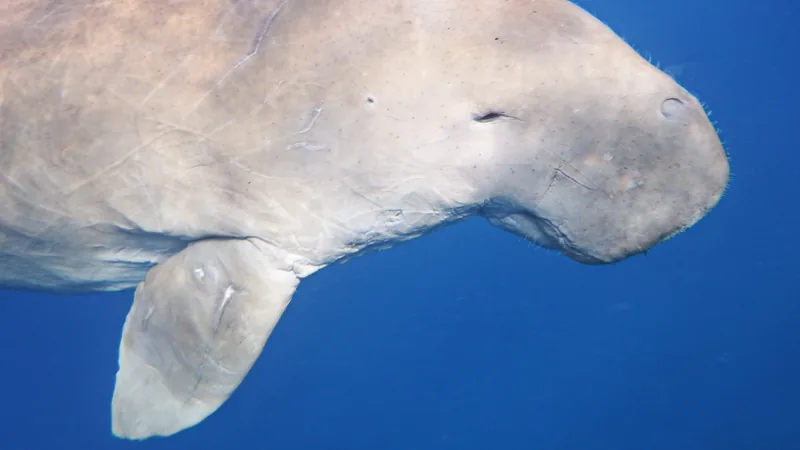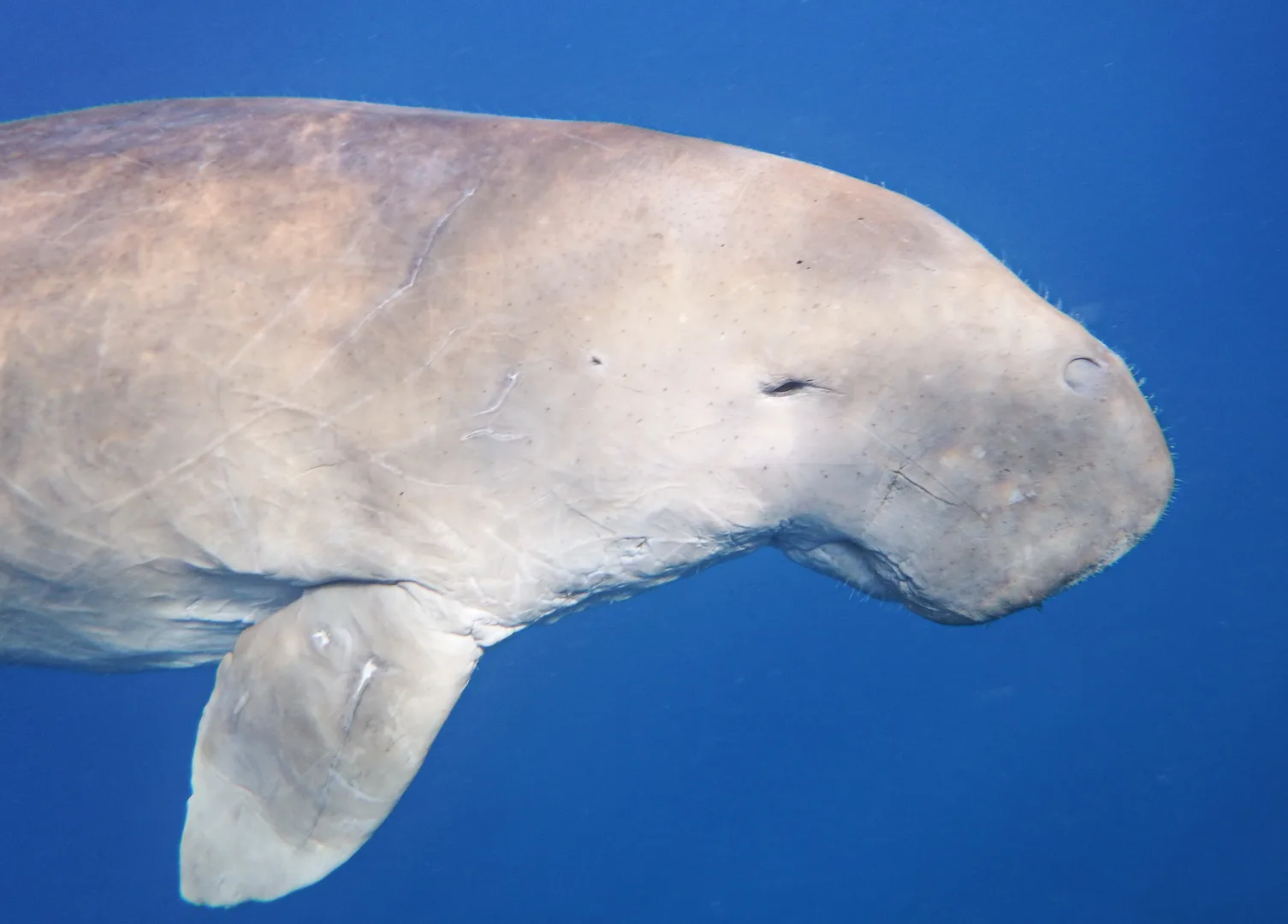
Dugong in the Red Sea at Marsa Alam, Egypt
Field
notes
A lip that ploughs the seabed
Dugongs are plant-eating grazers. Seagrass is their main food, and they harvest it with a flexible upper lip that rips up entire plants. If a plant will not come up whole, the dugong tears off the leaves. The grazing leaves furrows in the seagrass bed that can be seen from the surface.
Whiskers everywhere Sensory bristles cover a dugong’s upper lip and help it find food. Bristles also cover the rest of its body.
An adult dugong weighs 230 to 400 kg and is 2.4 to 4 m long. A long intestine aids the digestion of seagrass, and the dugong has a low metabolism.
Tusks that tell its age
Dugongs are estimated to live more than 50 years in the wild, and one estimate suggests they may reach 73. A dugong’s age is estimated by counting the growth layers in a tusk. Tusks are projections of the incisor teeth, and they are usually only visible through the skin in mature males and old females. Mating can be violent, and the protruding tusks leave scars on females and on competing males.
Shy and shark-wary
Dugongs live in tropical waters from East Africa to Vanuatu, about 26 degrees north and south of the equator. The biggest population lives off northern Australia, between Shark Bay and Moreton Bay. The second biggest lives in the Arabian Gulf.
They stay in shallow water, usually about 10 m deep, and occasionally dive as deep as 39 m to feed. Their nostrils sit on top of the head, and valves keep them shut during a dive. A dugong surfaces every few minutes to breathe. Their eyesight is poor, and they use hearing more than sight. They chirp, whistle and bark to communicate.
They are quite shy: approached with care, they investigate a diver or boat from long range but hesitate to come closer. Sharks, crocodiles and killer whales feed on juveniles. In Shark Bay, dugongs used shallow and deep water in proportion to the food in each when large tiger sharks were scarce. When large tiger sharks were common, they overused the deep water, which the study calls safe but impoverished. The authors describe an apparent food-safety trade-off.
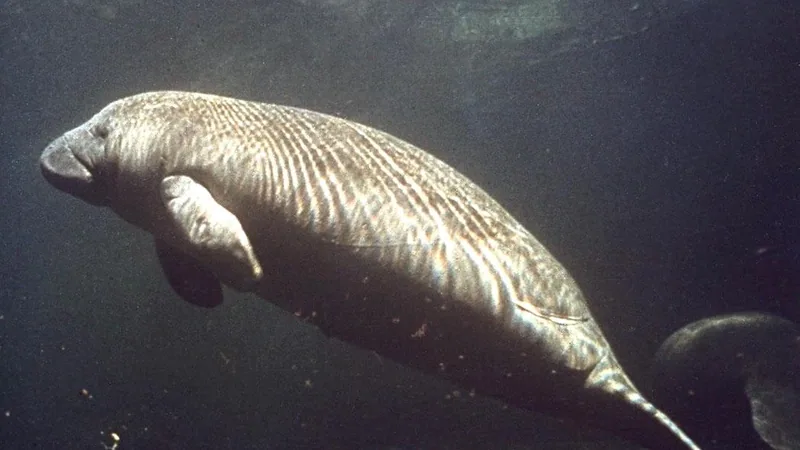
Its family once included Steller’s sea cow, a North Pacific giant 7 to 10 m long that was hunted to extinction around 1768. The IUCN Red List rates the dugong Vulnerable.
Published
Traits
Intel
& FAQ
Guess
first
How big is a Dugong, really? Slide, lock in, and see what the sources say. Every answer is a figure from this page, quoted from where it came from.
Sources
- 01Dugong (Dugong dugon) longevity, ageing, and life history. AnAge: The Animal Ageing and Longevity Database.
- 02Macdonald. Dugong dugon (dugong). Animal Diversity Web, University of Michigan.
- 03Wirsing, Heithaus & Dill (2007). Fear factor: do dugongs (Dugong dugon) trade food for safety from tiger sharks (Galeocerdo cuvier)? Oecologia.
- 04Springer et al. (2015). Interordinal gene capture, the phylogenetic position of Steller’s sea cow based on molecular and morphological data, and the macroevolutionary history of Sirenia. Molecular Phylogenetics and Evolution.
- 05Marsh & Sobtzick (2019). Dugong dugon. The IUCN Red List of Threatened Species 2019: e.T6909A160756767.
What the sources say: 52 claims checked word for word against these sources →