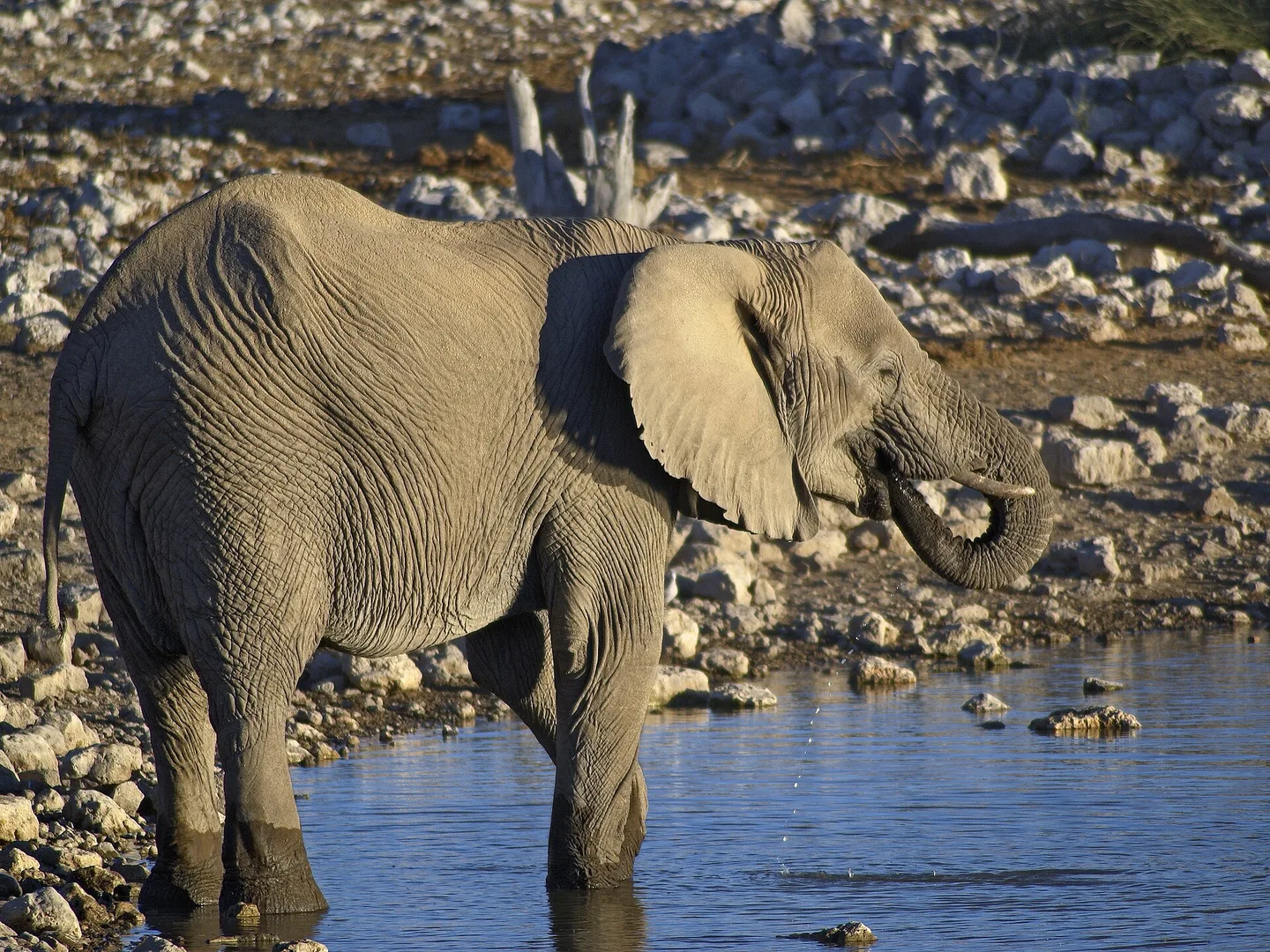
African Elephant drinking at the waterhole of Okaukuejo, Etosha, Namibia.
Field
notes
The Largest Land Mammal Alive
The African savanna elephant is the largest land mammal alive. Bulls average about 6,000 kilograms and cows around 2,800 kilograms, with a head-to-body length of 6 to 7.5 metres. The biggest individual ever recorded, an adult male, weighed roughly 10,886 kilograms and stood 3.96 metres at the shoulder. Lions, wild dogs, hyenas and Nile crocodiles all prey on elephants, but mostly on young ones that lag behind the herd. A healthy adult’s only real threat is people. In the wild, African elephants likely live about 30 to 40 years.
A Nose With No Bones
An elephant’s trunk serves as both its upper lip and its nose, and there isn’t a single bone or piece of cartilage inside it. San Diego Zoo counts eight major muscles down each side and around 150,000 muscle fascicles running through the whole structure. The trunk is strong enough to pick up large tree trunks and nimble enough to pick up a single piece of straw. African elephants finish the trunk in two finger-like lobes at the tip; Asian elephants have only one. In a study of six African savanna elephants offered food of different shapes (cubes, flat pieces, and long thin ones), half of the elephants changed the shape of the trunk tip to match, essentially adjusting their grip before they grabbed. It doesn’t drink like a straw, either: an elephant sucks water only part way up the trunk, curls it toward its mouth, tilts its head up and lets the water pour in.
Rumbles in the Ground
Many elephant calls are deep rumbles of about 20 hertz, and elephants can hear one from more than two kilometres away. Part of that signal also travels through the ground, where it has the potential to carry farther than the sound in the air. Researchers reproduced African elephant warning calls as seismic vibrations and played them into the earth near wild breeding herds. The herds detected the signal and reacted to it as a warning. The team judged that from the elephants’ behaviour, the spacing between herd members and the time they spent at the waterhole. A herd is usually led by its oldest female, the matriarch.
A matriarch carries the map In a drought, an experienced matriarch uses what she knows about water and food to lead her herd across long distances.
Two Species, Two Verdicts
The IUCN only started assessing African elephants as two separate species in 2021, after new genetic evidence emerged. Before that, both were lumped together as one species, listed as Vulnerable. The forest elephant, Loxodonta cyclotis, was placed straight into Critically Endangered. The savanna elephant, the species on this page, came in one step better at Endangered, but its population has still fallen by at least 60% over the last 50 years. Poaching for ivory drove much of that decline; it spiked after 2008 and peaked in 2011. Turning elephant habitat into farmland is another serious, ongoing threat. A cow typically waits three to five years before her next calf, and sometimes as long as nine and a half.
Published Updated
Traits
Intel
& FAQ
Guess
first
How big is a African Bush Elephant, really? Slide, lock in, and see what the sources say. Every answer is a figure from this page, quoted from where it came from.
Sources
- 01African elephant species now Endangered and Critically Endangered - IUCN Red List.
- 02African Elephants (Loxodonta africana and L. cyclotis) Fact Sheet. San Diego Zoo Wildlife Alliance Library, 2025.
- 03Elephant. San Diego Zoo Animals & Plants.
- 04Loxodonta africana. Animal Diversity Web, University of Michigan.
- 05O'Connell-Rodwell et al. (2004). Elephant low-frequency vocalizations propagate in the ground and seismic playbacks of these vocalizations are detectable by wild African elephants (Loxodonta africana). The Journal of the Acoustical Society of America.
- 06Soppelsa et al. (2022). The relationship between distal trunk morphology and object grasping in the African savannah elephant (Loxodonta africana). PeerJ.
What the sources say: 42 claims checked word for word against these sources →