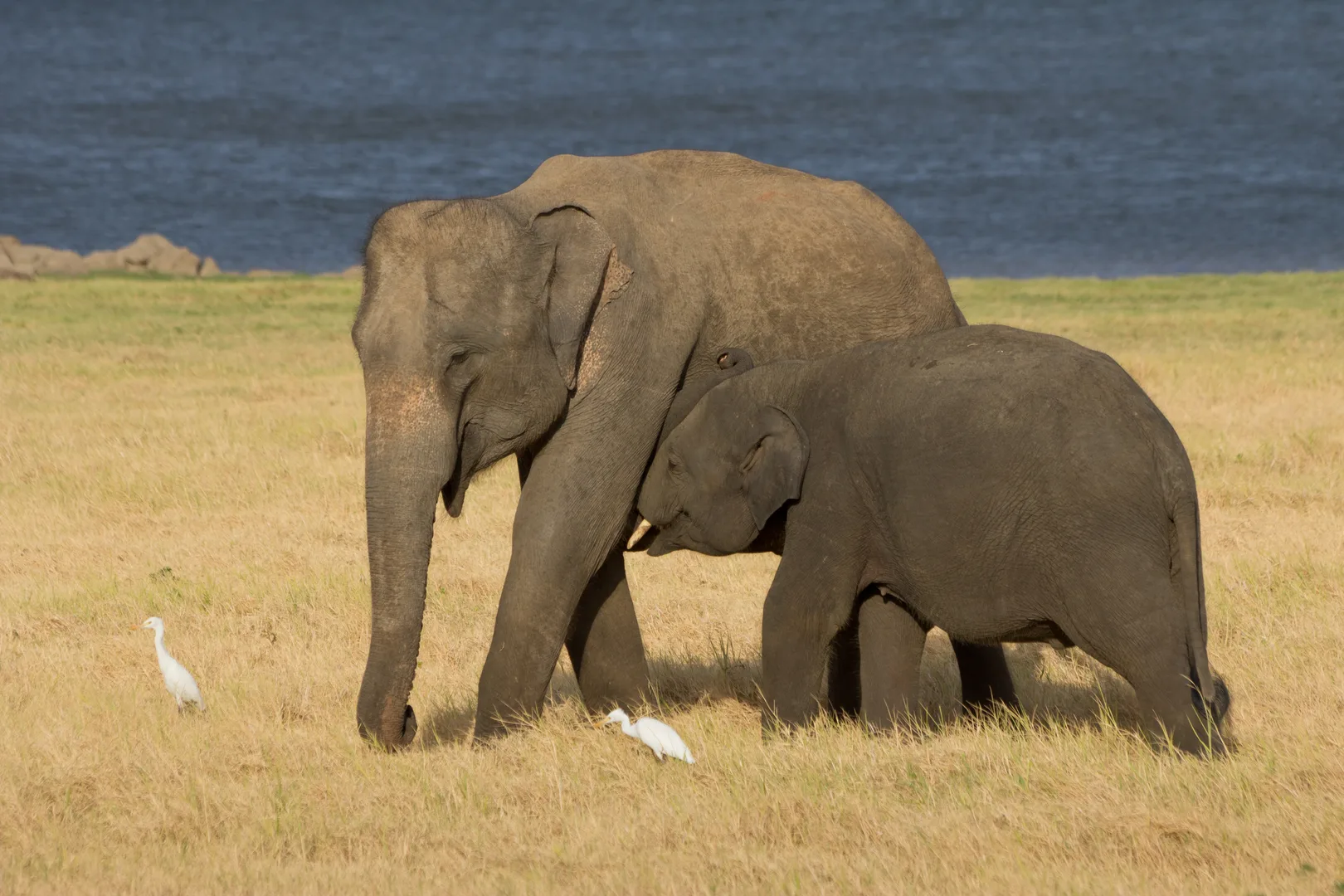
Wild Asian elephants, Minneriya National Park, Sri Lanka
Field
notes
A trunk with no bones
Elephants are the largest living land animals. Adult Asian elephants weigh on average between 6,000 and 12,000 pounds (2,750 to 5,420 kilograms). They typically stand 1.8 to 3.8 meters tall at the shoulder.
The trunk is a fusion of the nose and upper lip. It contains no bones, but it has about 150,000 muscle units and tendons. It can hold about 2 gallons (7.57 liters) of water. At the tip sits one small “finger” that aids with precision. Big ears work as cooling devices too. Flapping them on hot days cools the blood in the ears’ veins.
What an elephant eats
Asian elephants are herbivores, which means plant eaters. They spend about three-quarters of each day eating or moving toward food or water. They feed primarily on grasses, but they also eat leaves, roots, vines, twigs, shoots, bark and fruit.
In the wild an elephant needs about 165 to 330 pounds (74 to 150 kilograms) of food and about 50 gallons (189 liters) of water per day. An elephant absorbs only about 44 percent of what it eats, so it has to put away huge amounts.
Wild herds live in isolated pockets of India and Southeast Asia, including Sumatra and Borneo. India is home to almost half of the total population of Asian elephants. They count as forest animals, yet they have been seen to prefer zones with intermittent open grassy glades.
Rumbles, words and mirrors
Elephants talk in infrasonic rumbles. These are low-pitched sounds that are barely audible to humans. Other elephants can hear and understand them from more than 2 miles away.
Researchers documented a male Asian elephant named Koshik imitating human speech. He put his trunk inside his mouth and matched Korean in such detail that Korean native speakers could understand and transcribe it. Mirror self-recognition has long seemed limited to humans and apes, but researchers who tested three Asian elephants reported a successful study.
Calves, enemies and lifespans
Nearly two years A female Asian elephant carries her calf for between 21.5 and 22 months. Usually one calf (occasionally two) is born, weighing between 150 and 350 pounds (68 to 158 kilograms).
A grown bull or cow has no enemies except humans. A young elephant is another matter: where the two ranges overlap, tigers attack them.
The evidence points to a typical lifespan into the mid-50s, though the data on wild Asian elephants is not consistent enough for an accurate estimate. The median life expectancy for females is 47 years, and the maximum longevity listed in a database of animal lifespans is 79.6 years, in captivity.
The IUCN Red List lists the species as Endangered. Crop raiding is frequent, and it can lead to elephant deaths as well as human deaths.
Published
Traits
Intel
& FAQ
Guess
first
How big is a Asian Elephant, really? Slide, lock in, and see what the sources say. Every answer is a figure from this page, quoted from where it came from.
Sources
- 01Plotnik et al. (2011). Elephants know when they need a helping trunk in a cooperative task. Proceedings of the National Academy of Sciences.
- 02Asian elephant. Smithsonian's National Zoo and Conservation Biology Institute.
- 03AnAge entry for Elephas maximus. AnAge: The Animal Ageing and Longevity Database, Human Ageing Genomic Resources.
- 04Williams et al. (2020). Elephas maximus. The IUCN Red List of Threatened Species 2020: e.T7140A45818198.
- 05Stoeger et al. (2012). An Asian Elephant Imitates Human Speech. Current Biology.
- 06Plotnik, de Waal & Reiss (2006). Self-recognition in an Asian elephant. Proceedings of the National Academy of Sciences.
What the sources say: 53 claims checked word for word against these sources →