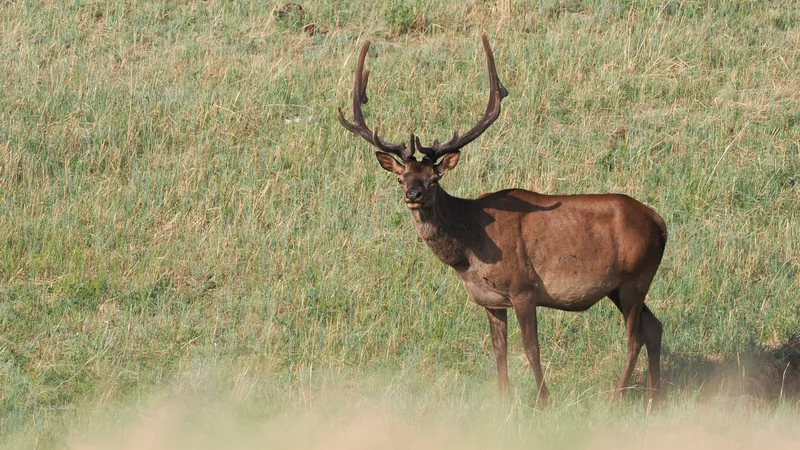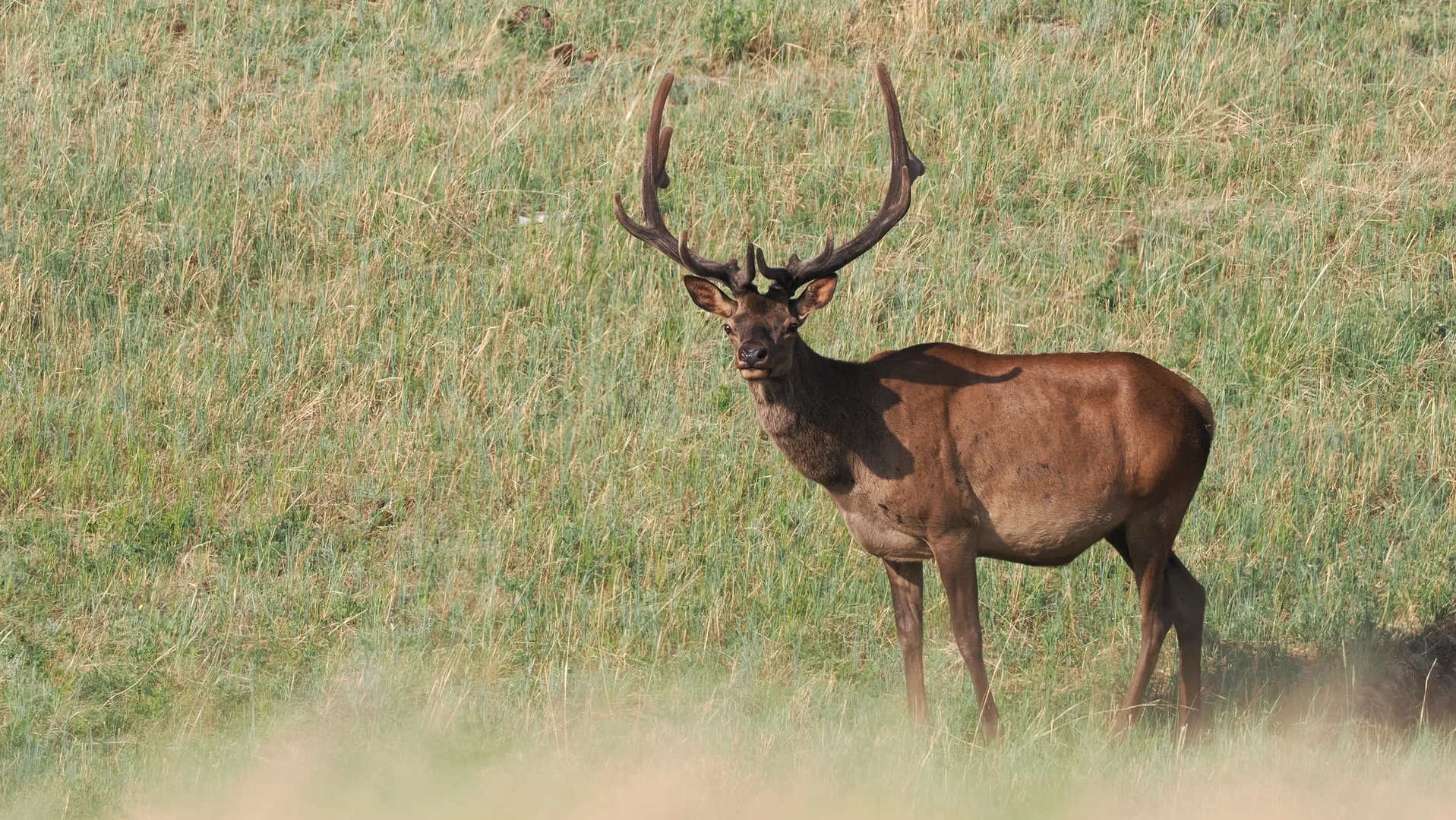
Siberian wapiti, Altanbulag, Töv, Mongolia
Field
notes
One name, two animals
In Europe, “elk” is the word for a moose. This page is about a different animal, Cervus canadensis, which settlers in North America also called elk. Its other name is wapiti, a Shawnee word for “white deer”. It lives in Asia too: one subspecies, the Manchurian wapiti, survives in parts of China, from the north-east to Tibet.
A big bull can weigh 700 to 1,000 pounds (roughly 320 to 450 kg). He stands about five feet (1.5 m) tall at the shoulder and measures about eight feet from nose to tail. Cows are smaller, at 300 to 500 pounds. A 2016 study of wapiti calls puts the average male at 320 kg and calls the wapiti the largest living species of Old World deer.
A call with two voices
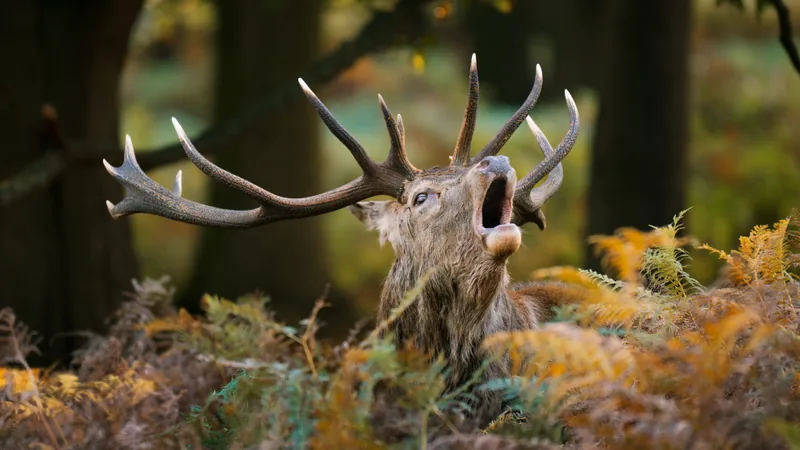
In autumn, bulls bugle to announce themselves to females and to challenge other bulls. The sound starts deep, rises to a squeal, then drops into grunts.
Two voices in one throat Spectrograms of bugles point to two sound sources working at once. One averages 145 Hz. The other, averaging 1,426 Hz, best fits a whistle made as air rushes through a narrow gap above the vocal folds.
Hz means vibrations per second, so the second voice is roughly ten times higher than the first. The researchers suspect the low part tells rivals about body size at close range, while the piercing whistle carries the bull’s presence farther. When two bulls answer each other, they sometimes crash antlers and shove. The fights are loud and hard work, but they rarely cause serious injury.
Antlers on a yearly clock
Bulls carry antlers, and a cow very occasionally grows a pair too. A bull sheds his old pair and grows a new one each year. In a mature bull, growth takes about 140 days. In the second half of that time, the antlers add two-thirds of an inch (about 1.7 cm) a day. The finished rack of a healthy bull is 55 to 60 inches long and just under six feet wide, and the pair weighs about 30 pounds. Antlered bulls usually settle disputes by wrestling, and they keep the antlers through winter.
Grazers on the move
Elk mostly graze on grasses and forbs, which are broad-leaved plants that are not grasses, and they also browse shrubs. In the Rocky Mountains, herds climb to high country in summer and drop to lower ground in winter. Yellowstone is summer range for an estimated 10,000 to 20,000 elk, and they make up about 85% of the wolf kills there in winter. They are also an important food for bears and mountain lions.
Elk in the wild live 10 to 13 years. Around Rocky Mountain National Park, settlers hunted them hard, and by 1890 few, if any, were left. In 1913 and 1914 people moved 49 elk in from Yellowstone to restart the herd. Great Smoky Mountains National Park began bringing elk back in 2001.
Published
Traits
Intel
& FAQ
Guess
first
How big is a Elk, really? Slide, lock in, and see what the sources say. Every answer is a figure from this page, quoted from where it came from.
Sources
- 01Brook et al. (2018). Cervus canadensis. The IUCN Red List of Threatened Species 2018: e.T55997823A142396828.
- 02Reby et al. (2016). Evidence of biphonation and source–filter interactions in the bugles of male North American wapiti (Cervus canadensis). Journal of Experimental Biology.
- 03Elk. Yellowstone National Park, National Park Service.
- 04Elk. Great Smoky Mountains National Park, National Park Service.
- 05Elk. Rocky Mountain National Park, National Park Service.
- 06Tian (2019). Winter home range of the Manchurian wapiti (Cervus canadensis xanthopygus) based on noninvasive sampling. Applied Ecology and Environmental Research.
What the sources say: 65 claims checked word for word against these sources →