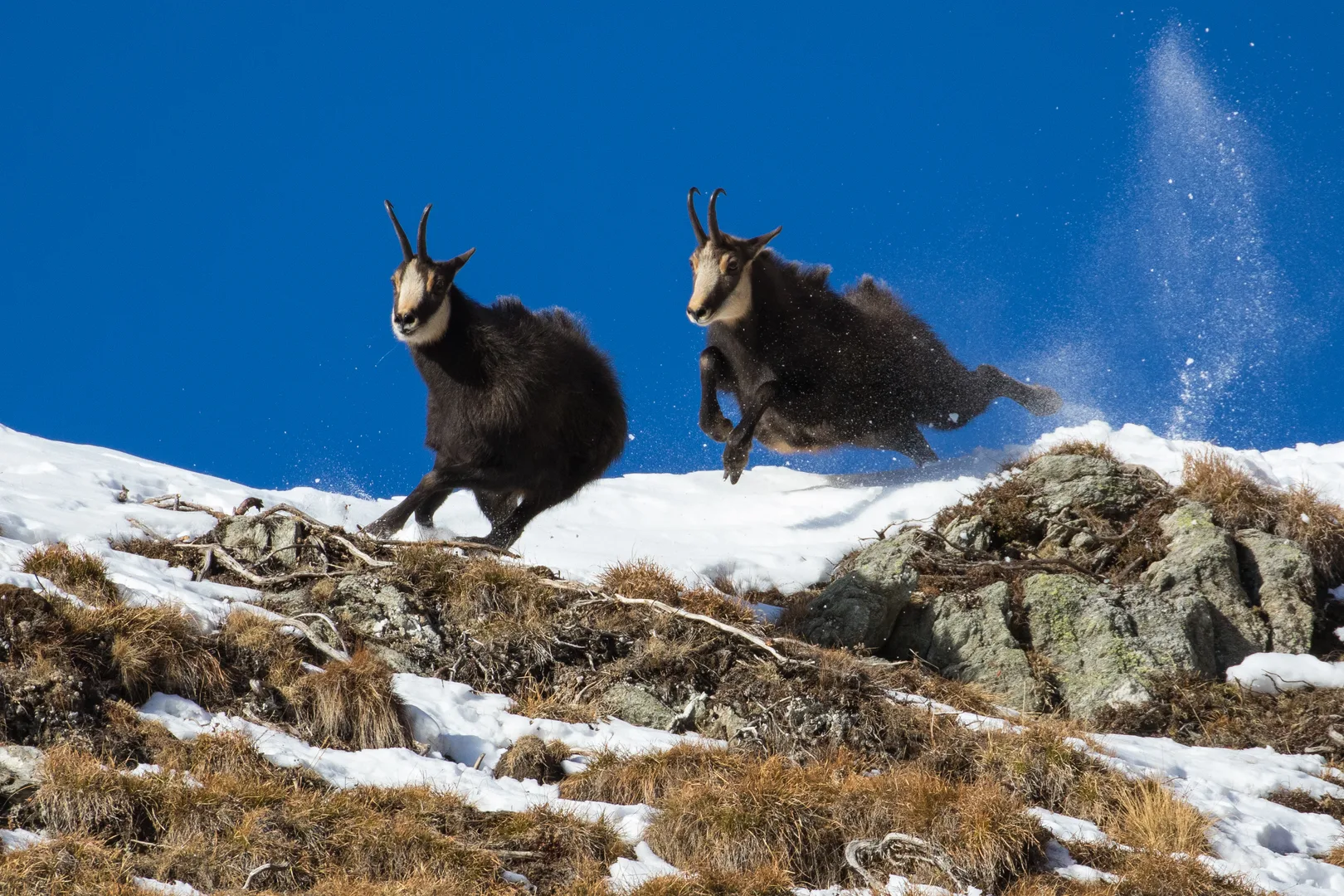
Two chamois chasing each other over snow-covered rock during the autumn rut.
Field
notes
Mountain Life
The Alpine chamois (Rupicapra rupicapra) belongs to the same family as goats, sheep, cattle and antelopes. A chamois stands 70 to 80 cm at the shoulder, weigh 25 to 50 kg, and measure 110 to 135 cm long. Its potential lifespan has been estimated at 22 years, but the oldest chamois on record in captivity lived 17.6 years.
It lives in the mountains of south and central Europe, Turkey and the Caucasus, in alpine and subalpine meadows above the treeline. It spends winter in forests and on steep slopes where snow does not pile up. People also introduced it to New Zealand’s South Island. Males there stand 65 to 90 cm at the shoulder and weigh 25 to 45 kg, while females stand 60 to 80 cm and weigh 19 to 35 kg.
A grip for slippery rock Its hooves are excellent for gripping slippery rock. When alarmed, a chamois flees to the hardest places to reach, often making huge leaps.
Horns, Herds and the Rut
Both males and females grow slender black horns that rise straight up, then curve backward into sharp hooks at the tips. A male’s horns are usually stouter, with more strongly developed hooks. Females and young males are gregarious, meaning they live in groups. Adult males are mostly solitary except in the breeding season, and they join the herds in late summer.
In its native mountains, the rut, or mating season, runs from October through December, and a single kid is usually born the next May or June. In New Zealand the rut comes in May and June. Breeding males turn aggressive, driving younger males away from the herds of mothers and young and sometimes killing them. A newborn kid can follow its mother almost straight after birth, and within its first few days it is rapidly getting better at leaping.
Predators, Winter and Sheep
Its known predators include Eurasian lynx, gray wolves and humans. A chamois signals danger with a whistle and by stamping its feet. In summer it eats mostly herbs and flowers, and in winter it eats lichens, mosses and young pine shoots. Its chestnut coat is lighter in spring and summer. In winter it grows long guard hairs, the outer layer of a coat, over dark brown underfur.
A 2014 study compared two things that move chamois uphill: hot weather and domestic sheep. Chamois did climb higher when it was hotter, but only a little compared with their response to sheep. With sheep around, they moved 89 to 103 meters upslope, into a band of altitude they did not otherwise use. Across the European Alps, a shift that size would mean 46% less suitable feeding ground.
Published Updated
Traits
Intel
& FAQ
Guess
first
How big is a Alpine Chamois, really? Slide, lock in, and see what the sources say. Every answer is a figure from this page, quoted from where it came from.
Sources
- 01Rupicapra rupicapra (chamois). Animal Diversity Web, University of Michigan.
- 02AnAge entry for Rupicapra rupicapra. AnAge: The Animal Ageing and Longevity Database, Build 15, 2023.
- 03Chamois. New Zealand Department of Conservation.
- 04Mason et al. (2014). Predicting potential responses to future climate in an alpine ungulate: interspecific interactions exceed climate effects. Global Change Biology.
- 05Anderwald et al. (2025). Rupicapra rupicapra. The IUCN Red List of Threatened Species 2025: e.T39255A215860127.
What the sources say: 30 claims checked word for word against these sources →