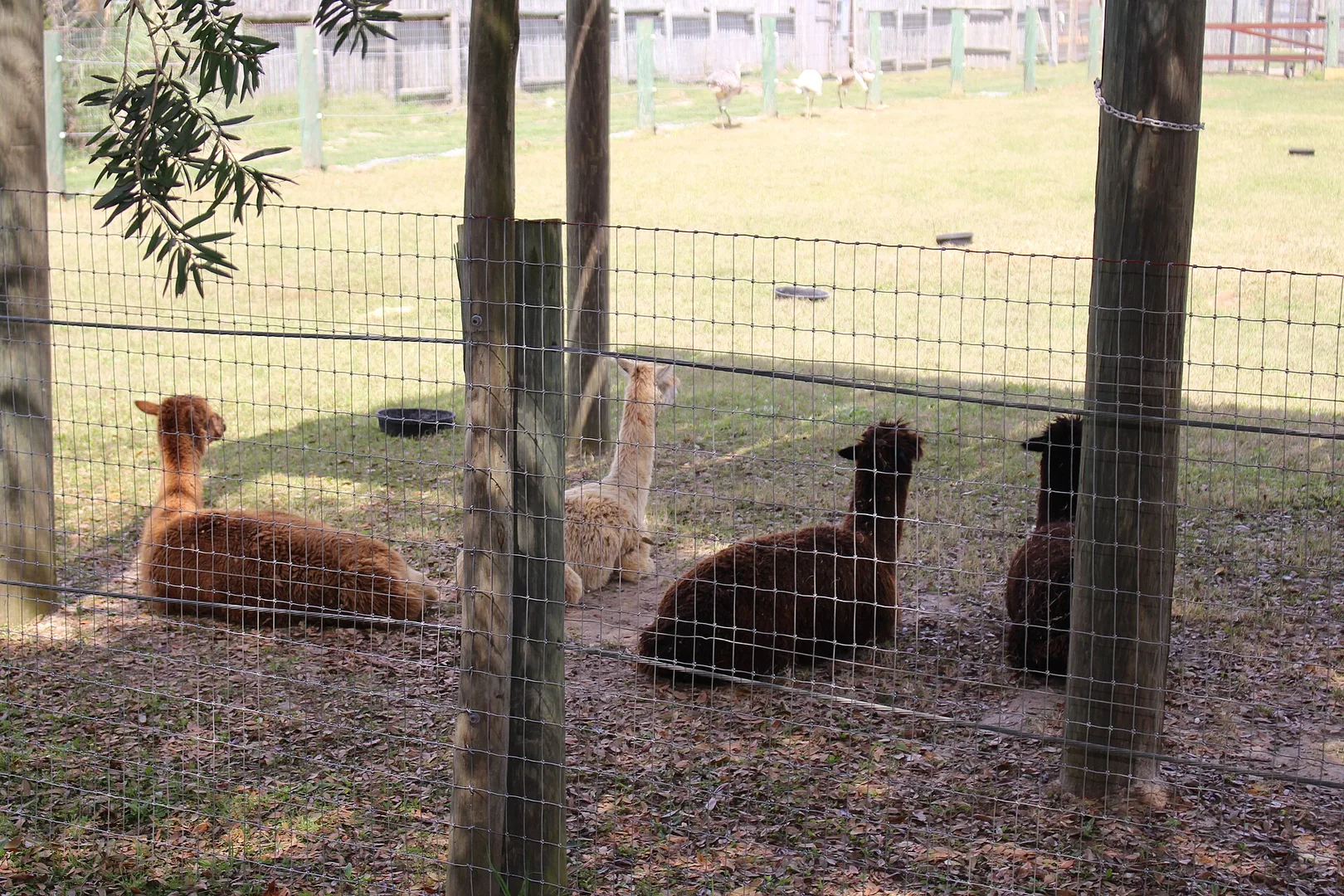
Alpaca group at Wild Adventures, Lowndes County, Georgia
Field
notes
Tracing the Wild Ancestor
For a long time, the alpaca’s wild ancestor was disputed. Its domestication has been dated to 6,000 to 7,000 years ago in the Peruvian Andes, but hybridization, near extirpation during the Spanish conquest, and difficult archaeology left the record hard to read. Tradition credited both the alpaca and the llama to the guanaco. In one genetic study, mitochondrial DNA placed about 80 percent of alpaca and llama samples in the guanaco lineage, but a different kind of marker told another story: alpacas are close to wild vicuñas and llamas to guanacos, with some hybridization in both directions. Its authors proposed reclassifying the alpaca as Vicugna pacos, the name taxonomists list today, with Lama pacos kept as a synonym.
The Smallest Domestic Camelid
Alpacas are the smallest of the domesticated camelids. Adults usually weigh 45 to 90 kilograms and stand 0.8 to 1.1 meters at the shoulder. Andean people domesticated them as a source of fuel, meat, and fiber for fabric, and that fiber has a hair-like structure that is more resilient and much stronger than Merino sheep wool. Their native range runs through the central and southern Andes from Peru to Argentina at up to 4,800 meters, on the high plateau called the altiplano, where nights drop below freezing. In zoos they can live up to 25.8 years.
Less Food, Less Methane
Alpacas are strict grazers that have lived for thousands of years where grass grows sparsely, and they need much less food than most animals their size. In one Chilean highland study, their diet was dominated by grasses, cushion plants, and a woody shrub. Their foregut has three compartments: the first two form a fermentation chamber similar to a ruminant’s rumen, and the third is a long tube that resembles a ruminant’s abomasum, though these compartments are not direct counterparts of the ruminant ones. Kept in respiration chambers, alpacas, llamas, and Bactrian camels produced about 0.32 liters of methane per kilogram of body weight each day, a little over half the published figure for domestic ruminants on roughage diets. Gram for gram of fiber digested, though, camelids release about as much methane as ruminants, which suggests their gut microbes make it in similar ways. The study explains the gap by camelids’ generally lower food intake for their size, and the most likely reason is a generally lower metabolism.
Antibodies Missing a Chain Alpacas, like other camelids, make antibodies with no light chain. The variable region of these heavy-chain-only antibodies is heat-stable and able to refold, and scientists widely use it in diagnostics, bio-imaging, food safety, and medical treatments.
Life in the Herd
Alpacas are social herd animals whose only defense is flight. They feel safest in numbers, and each one needs at least one other alpaca to thrive. They communicate with a soft hum, other calls, and body language. A threatened alpaca gives a staccato alarm call that alerts the herd, then either flees or goes to investigate. They also spit at each other to register a complaint, and a dominance stand-off between two alpacas may include spitting and pushing. They rarely spit at people unless frightened or abused. Alpacas use communal dung piles, which may be a source of chemical communication among them.
Published Updated
Traits
Intel
& FAQ
Guess
first
How big is a Alpaca, really? Slide, lock in, and see what the sources say. Every answer is a figure from this page, quoted from where it came from.
Sources
- 01Alpaca. Smithsonian's National Zoo and Conservation Biology Institute.
- 02Lama pacos (alpaca). Animal Diversity Web, University of Michigan.
- 03Vicugna pacos. AnAge: The Animal Ageing and Longevity Database, Build 15, 2023.
- 04Kadwell et al. (2001). Genetic analysis reveals the wild ancestors of the llama and the alpaca. Proceedings of the Royal Society of London. Series B: Biological Sciences.
- 05Vicugna pacos (Linnaeus, 1758). Integrated Taxonomic Information System (ITIS).
- 06Dittmann et al. (2014). Methane Emission by Camelids. PLoS ONE.
- 07Tu et al. (2020). Landscape of variable domain of heavy‐chain‐only antibody repertoire from alpaca. Immunology.
What the sources say: 58 claims checked word for word against these sources →