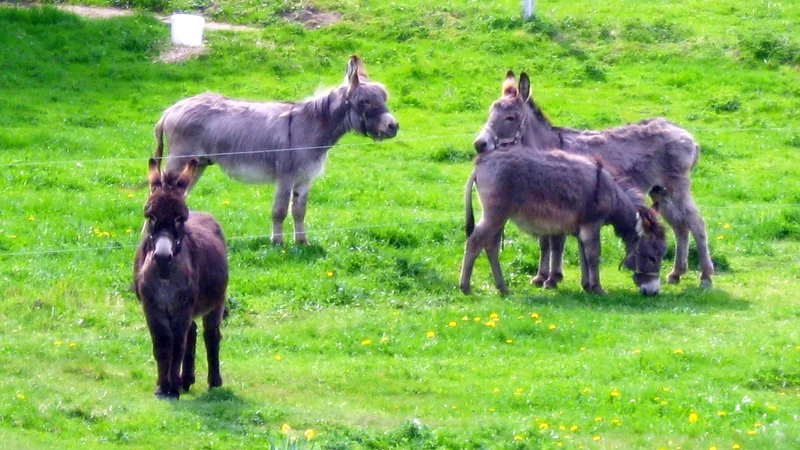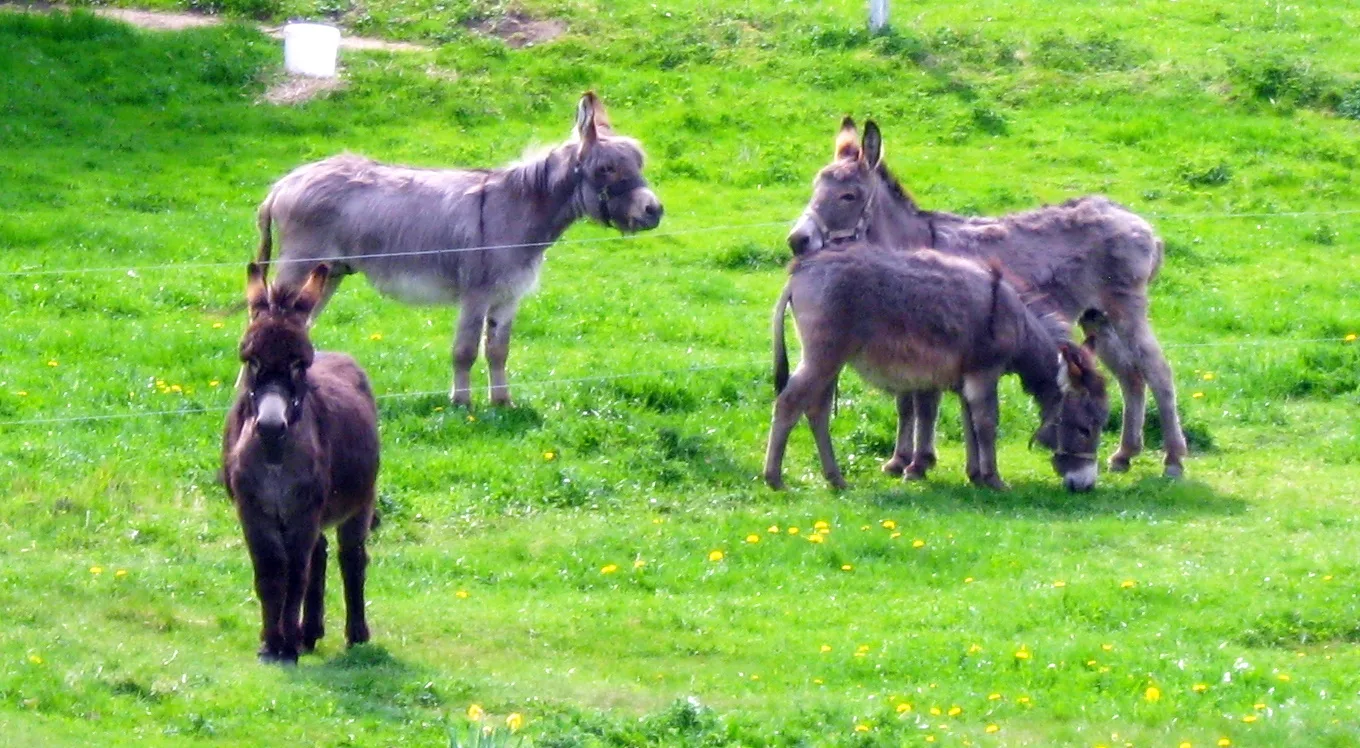
4 donkeys
Field
notes
A hee-haw built for distance
Donkeys are asses, in the family that also holds horses and zebras. They talk with their bodies, sounds and smells. Ears show mood: pinned back for anger, perked forward for alertness, one forward and one back for curiosity. A quick tail swish shows annoyance. Males also use calls to tell females they are ready to mate.
Long-range call Donkeys use a “hee-haw” sound that can travel up to 3 km away. Their hearing is good enough to detect these calls at such distances.
Males are very territorial. They bite rival males that enter, and piles of dung mark the boundaries.
Small hooves, rough country
A donkey stands 110 to 140 cm tall at the shoulder. Mass is not often reported. One study of five adult females averaged 320 kg, while the AnAge database lists about 165 kg for the species. A newborn foal weighs 20 to 34 kg. Donkeys have been reported to live up to 47 years, though claims of animals past 50 are doubtful.
Small hooves help them cross rocky ground and keep steady footing in the mountains. They are herbivores, and their molars are wide with blunt, shallow grooves that grind plants down. A study of donkeys in the United States found them eating grasses, forbs and browsing plants as the seasons changed, with arrowweed and mesquite making up 50% of their diet.
A typical herd holds one male and ten females. Donkeys form groups to reduce the risk of predation and help keep the young safe. When something looks threatening, donkeys investigate before reacting, then trot or gallop away if it is real.
Domesticated once, around 5000 BCE
Donkeys now live with people worldwide, but their DNA points to one origin. A 2022 genome study of 207 modern and 31 ancient donkeys supports a single domestication in Africa around 5000 BCE. The animals then spread across Africa and Eurasia, and finally returned to Africa. The study calls them essential beasts of burden for long-distance movement, especially in semi-arid and upland country. It also found that donkey breeders produced giant bloodlines when mules were essential to the Roman economy and military.
Ancient breeders went further. Cuneiform tablets from Mesopotamia record the breeding of prized equids called kungas for diplomacy, ceremony and warfare. DNA from a 4,500-year-old equid buried in Syria shows kungas were first-generation hybrids between female donkeys and male Syrian wild asses, the earliest evidence of hybrid animal breeding.
Published
Traits
Intel
& FAQ
Guess
first
How big is a Donkey, really? Slide, lock in, and see what the sources say. Every answer is a figure from this page, quoted from where it came from.
Sources
- 01Equus asinus (ass). Animal Diversity Web, University of Michigan.
- 02AnAge entry for Equus asinus. AnAge: The Animal Ageing and Longevity Database, Build 15, Human Ageing Genomic Resources.
- 03Todd et al. (2022). The genomic history and global expansion of domestic donkeys. Science.
- 04Bennett et al. (2022). The genetic identity of the earliest human-made hybrid animals, the kungas of Syro-Mesopotamia. Science Advances.
What the sources say: 53 claims checked word for word against these sources →