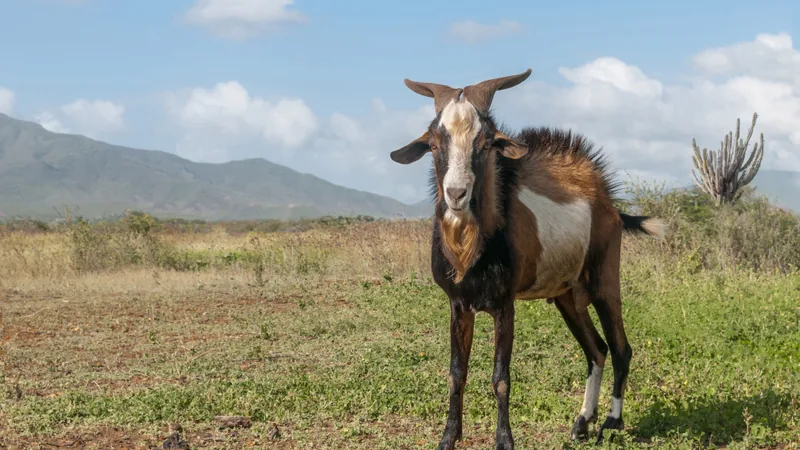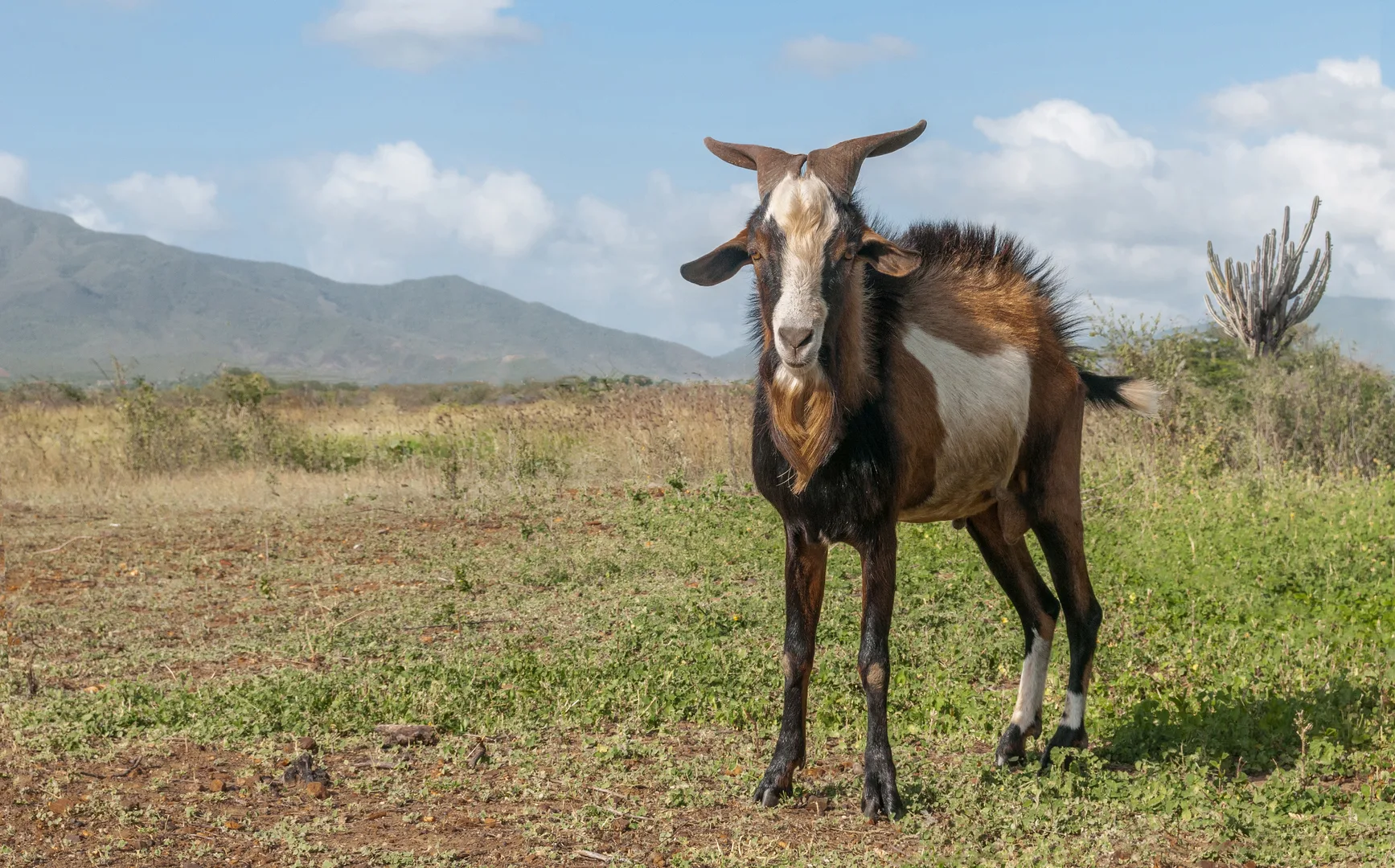
Male goat ( Capra aegagrus hircus ), Margarita Island, Venezuela.
Field
notes
A gut that runs nonstop
A goat’s digestive system works nonstop throughout its adult life. Some animals alternate between periods of stress and inactivity in their digestive organs. Goats must produce digestive juices and enzymes 24 hours a day. They have a four-compartment stomach, and their intestinal canal is about 100 feet (30.5 meters) long. Feed takes 11 to 15 hours to pass through the whole digestive system.
The mouth is odd too. A goat’s upper jaw does not develop milk teeth. It has bony plates that meet the lower teeth instead. Because the upper jaw is wider than the lower, a goat can only use one side of its mouth at a time to grind food.
Rectangular pupils A goat’s eye has a rectangular pupil. It is believed that goats have excellent night vision.
Grass, scrub and gate latches
Goats eat grasses and shrubs. Unlike sheep and cattle, they can also survive on bushes, trees, desert scrub and aromatic herbs. Most goats will also stand on their back legs to reach tree branches and shrubs. Grazing goats have been observed refusing to graze forage that has been trampled and soiled.
They are also intelligent and quick to learn good and bad habits, such as opening gate latches.
Size by breed
Size depends on the breed. Typical adults weigh 45 kg. Mature female dwarf goats can weigh as little as 20 pounds (9.1 kg) and stand 18 inches (45.7 cm) tall. Indian Jamnapari, Swiss Saanen and Alpine goats go up to 250 pounds (113.5 kg) and 42 inches (106.7 cm) tall.
For lifespan, the record for a goat in captivity belongs to one female who lived 20.8 years. It is possible that goats may live for longer, but they are culled before reaching their maximum lifespan, due to issues in the nervous, digestive and reproductive systems, and lameness.
From the Zagros to everywhere
Goats descend primarily from the bezoar goat, Capra aegagrus. The Zagros Mountains of western Iran provide some of the earliest archaeological evidence of goat management and husbandry, by circa 8200 cal BC. Humans have since spread goats all over the world.
Feral groups, meaning goats living wild, are found usually in rugged mountain country, rocky crags and alpine meadows. There are some on Hawaii and on other islands. If given a chance, goats can easily revert to feral or wild condition.
Published
Traits
Intel
& FAQ
Guess
first
How big is a Goat, really? Slide, lock in, and see what the sources say. Every answer is a figure from this page, quoted from where it came from.
Sources
- 01Capra hircus (domestic goat). Animal Diversity Web, University of Michigan.
- 02Goat. Smithsonian's National Zoo and Conservation Biology Institute.
- 03AnAge entry for Capra hircus. AnAge: The Animal Ageing and Longevity Database, Build 15, Human Ageing Genomic Resources.
- 04Daly et al. (2021). Herded and hunted goat genomes from the dawn of domestication in the Zagros Mountains. Proceedings of the National Academy of Sciences.
What the sources say: 50 claims checked word for word against these sources →