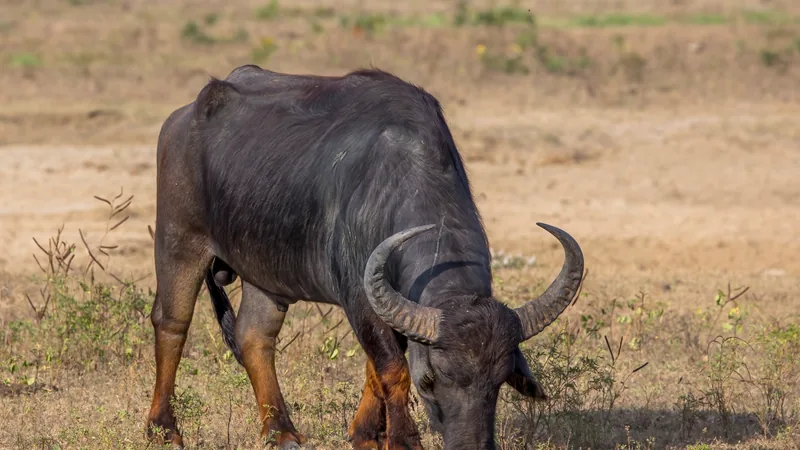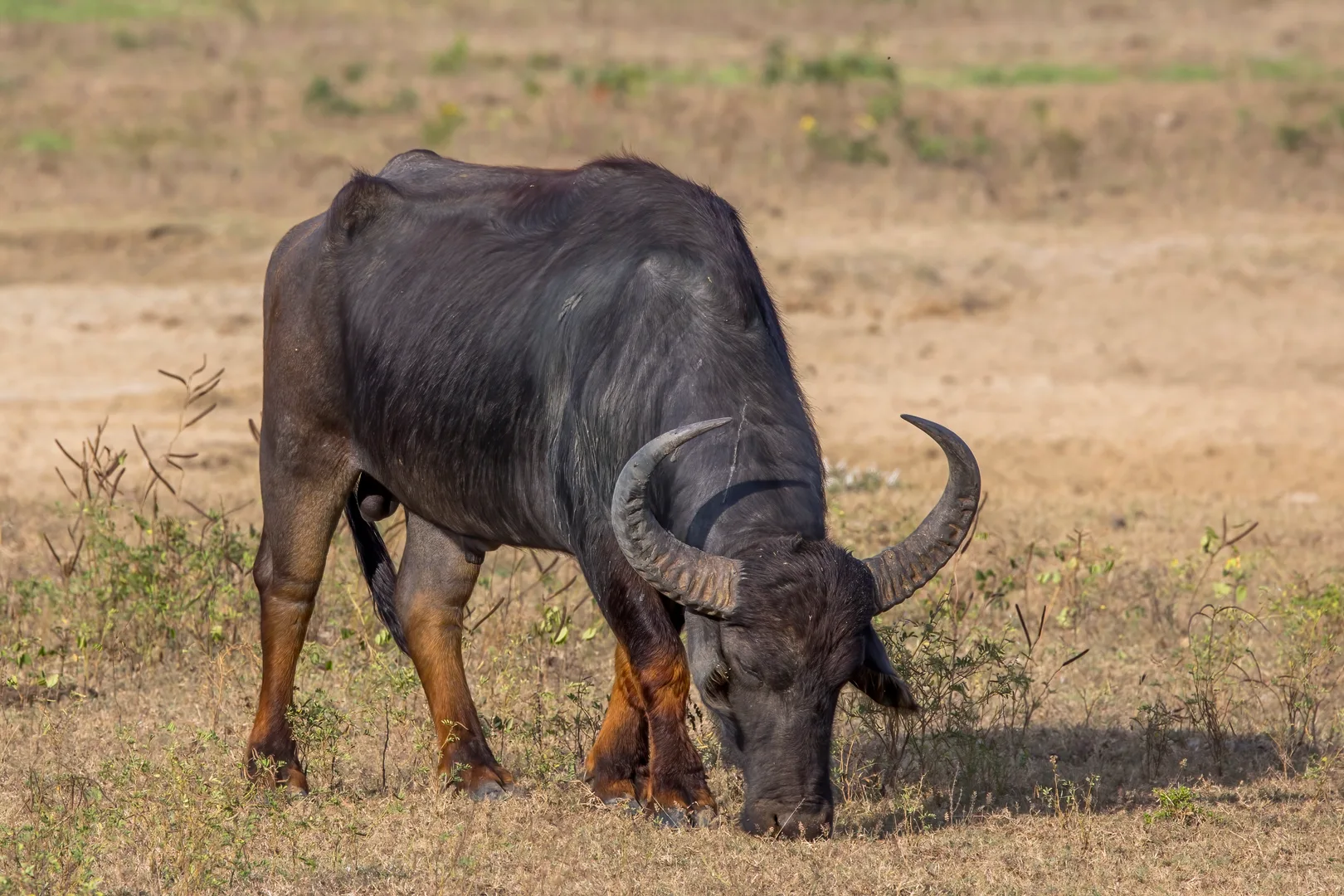
Grazing at Yala, Sri Lanka.
Field
notes
River and swamp
The domestic water buffalo (Bubalus bubalis) comprises two subspecies, the river buffalo and the swamp buffalo. The river buffalo usually weighs between 450 and 1,000 kg. The swamp buffalo is smaller and normally weighs 325 to 450 kg. Across the species, the body is 240 to 300 cm long, with a tail of 60 to 100 cm. Buffaloes can surpass 30 years of age, and keep their reproductive capacity until they are 18 to 25 years old.
The wild Asian water buffalo, a separate species, is considered the most probable ancestor of both. They were domesticated 3,000 to 7,000 years ago, which is recent next to cattle at about 10,000 years. A 2020 review puts the best estimate at 208,098,759 buffalo head in 77 countries on five continents. River buffalo are mostly found in India, Pakistan and parts of Europe and the Americas. Swamp buffalo are common in Southeast Asia and Australia.
Built for the wallow
A water buffalo has relatively lower heat tolerance than other livestock, owing to its dark coat and inadequately dispersed sweat glands. Those two traits result in a less efficient evaporative cooling system. It is known for wallowing in mud. In the hotter parts of the day it rests in dense cover or sinks into water with only its nostrils and eyes showing.
Mud beats water Water in mud evaporates more slowly than plain water, which extends the cooling. The mud coat also protects the animal from biting insects.
Horns, grass and farm work
Both sexes bear horns that are heavy set at the base and ribbed. The horns are triangular in cross-section. River buffalo have tightly curled horns, while the swamp buffalo’s are swept back and out, and it is more ashy gray, with a drooping neck.
It is predominately a grazer on grasses, but also eats herbs, aquatic plants, leaves and farm crops. It has a high capacity to convert feed of poor nutritional value.
In Asia it is used as a draft animal, a working animal, owing to its strength, and on Marajó Island, Brazil, people ride it. Several countries farm it mainly for its meat and its high-fat milk.
Published
Traits
Intel
& FAQ
Guess
first
How big is a Water Buffalo, really? Slide, lock in, and see what the sources say. Every answer is a figure from this page, quoted from where it came from.