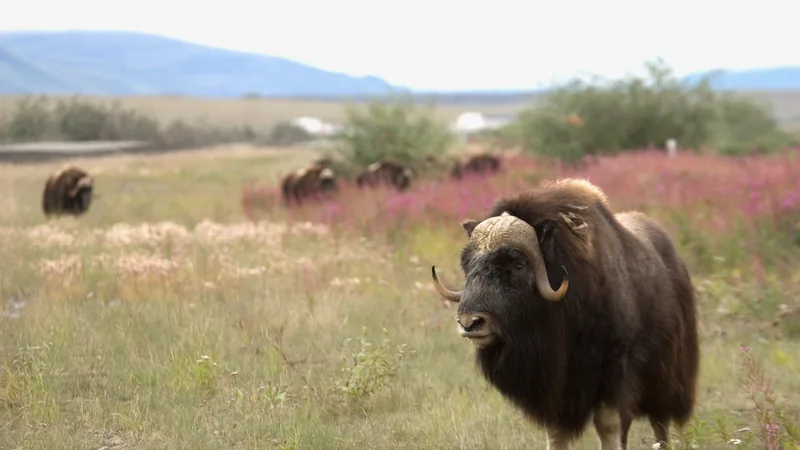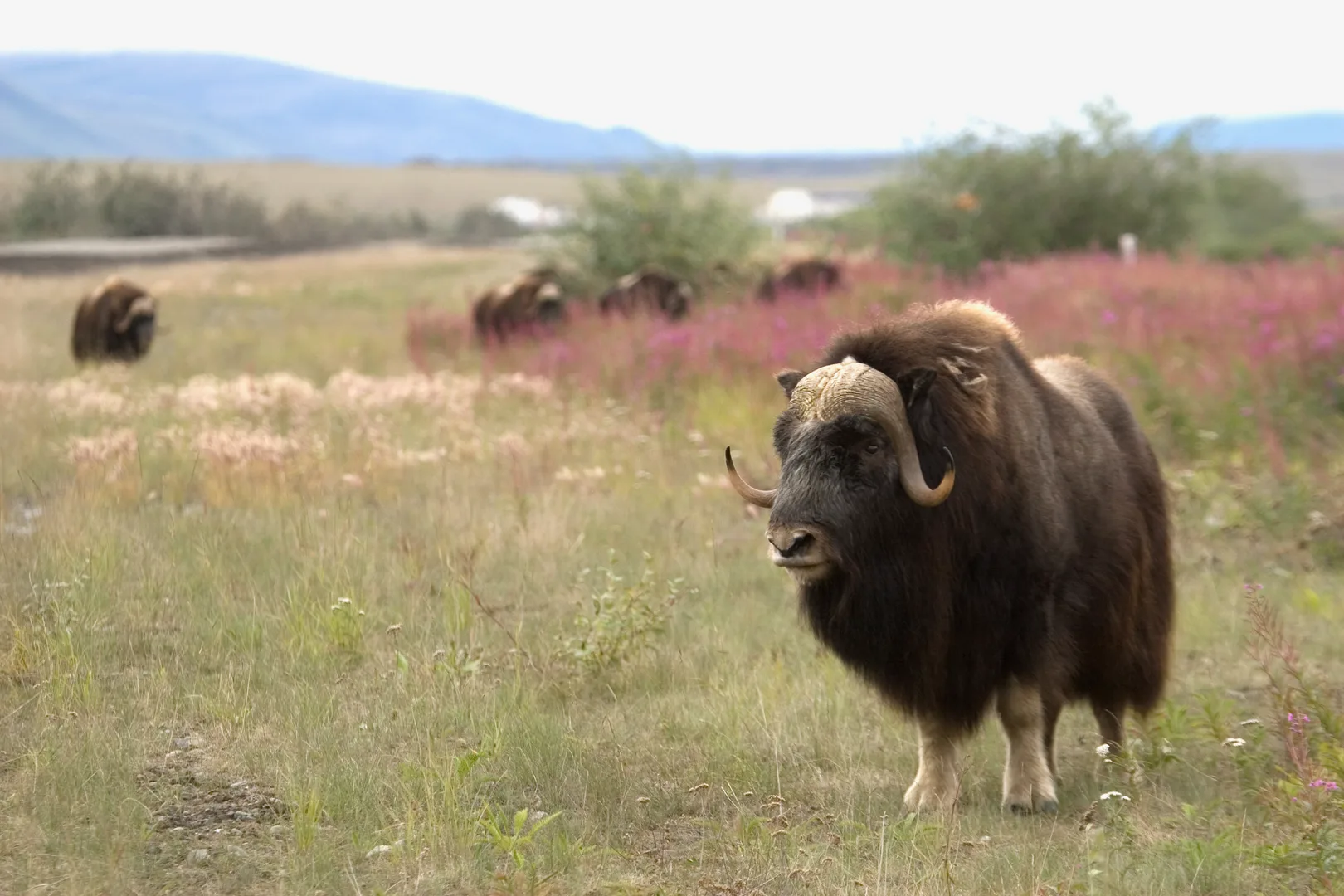
A bull by the Dalton Highway, Alaska.
Field
notes
The muskox (Ovibos moschatus) settles its rivalries with a head-on crash. During the rut, the breeding season, bulls charge at top speed from distances of 50 yards or more and collide squarely on the horn bosses. After a clash, the bulls back away from each other, swing their heads from side to side and repeat the sequence until one bull turns and runs away. Battles have included upwards of 20 clashes.
Skulls built for the crash
A horn boss is the extra-thick base of a bull’s horns; cows lack it. The bases nearly span the entire forehead, and the boss is between 15 and 20 cm thick. Bull muskoxen have heavily armored skulls to protect them from the shock of impact: four inches of horn and three inches of bone lie directly over the brain in the area of contact. Both sexes have horns, but the horns of bulls are larger and heavier than those of cows.
Mating takes place between August and October. Harem groups form during that season, holding 5 to 15 females and sub-adults with one dominant bull who prevents other adult bulls from entering the group. Fights between bulls are rarely fatal.
A ring of horns
Wolves and grizzly bears hunt muskoxen. When a predator comes head on, muskoxen line up with their heads down and their horns facing the attacker, with the calves generally behind the adults. When several predators attack, the herd creates a circle with horns pointed out and calves in the center. Muskoxen have been known to throw and trample wolves.
Muskoxen can overheat easily and cannot run faster than wolves or bears long enough to escape. They tend to stay in the circle as long as possible.
A floor-length coat with a secret layer
The coat has a long, coarse outer layer and a short, fine underhair. The long guard hair hangs nearly to the ground, and on older animals it can grow long enough to brush it. For warmth, calves often stand underneath their mother’s skirt of guard hair.
Qiviut The muskox’s soft, brownish, wool-like underhair has been called the rarest fiber in the world and is highly valued.
Alaska’s wildlife agency says it is considered the world’s warmest wool for its weight. It begins growing in the fall and is shed out through the guard hair in the spring.
Size, range and lifespan
Mature bulls stand about 5 feet (1.5 m) high at the shoulder and weigh 600 to 800 pounds (roughly 270 to 360 kg). Cows average about 4 feet (1.2 m) and 400 to 500 pounds (roughly 180 to 230 kg). Bulls measure 200 to 250 cm from head to rump, and cows 135 to 200 cm. A lifespan database reports that muskoxen may live up to 24 years in the wild, and one wild-born animal was about 27.4 years old when it died in captivity.
Muskoxen live north of the tree line on the Arctic tundra. They are native to Canada and Greenland. They had disappeared from Alaska by the 1920s. In 1930, 34 animals were captured in East Greenland and brought to Fairbanks, and all muskoxen in Alaska today descend from them. Herds have also been introduced to Russia, Svalbard and Norway, and some found their own way from Norway into Sweden. The IUCN Red List rates the species Least Concern.
Published
Traits
Intel
& FAQ
Guess
first
How big is a Muskox, really? Slide, lock in, and see what the sources say. Every answer is a figure from this page, quoted from where it came from.
Sources
- 01Gunn & Forchhammer (2022). Ovibos moschatus. The IUCN Red List of Threatened Species 2022: e.T29684A22149286.
- 02Muskox (Ovibos moschatus) species profile. Alaska Department of Fish and Game.
- 03Muskox (Ovibos moschatus): uses. Alaska Department of Fish and Game.
- 04Ovibos moschatus (muskox). Animal Diversity Web, University of Michigan.
- 05AnAge entry for Ovibos moschatus. AnAge: The Animal Ageing and Longevity Database, Build 15, Human Ageing Genomic Resources.
What the sources say: 46 claims checked word for word against these sources →