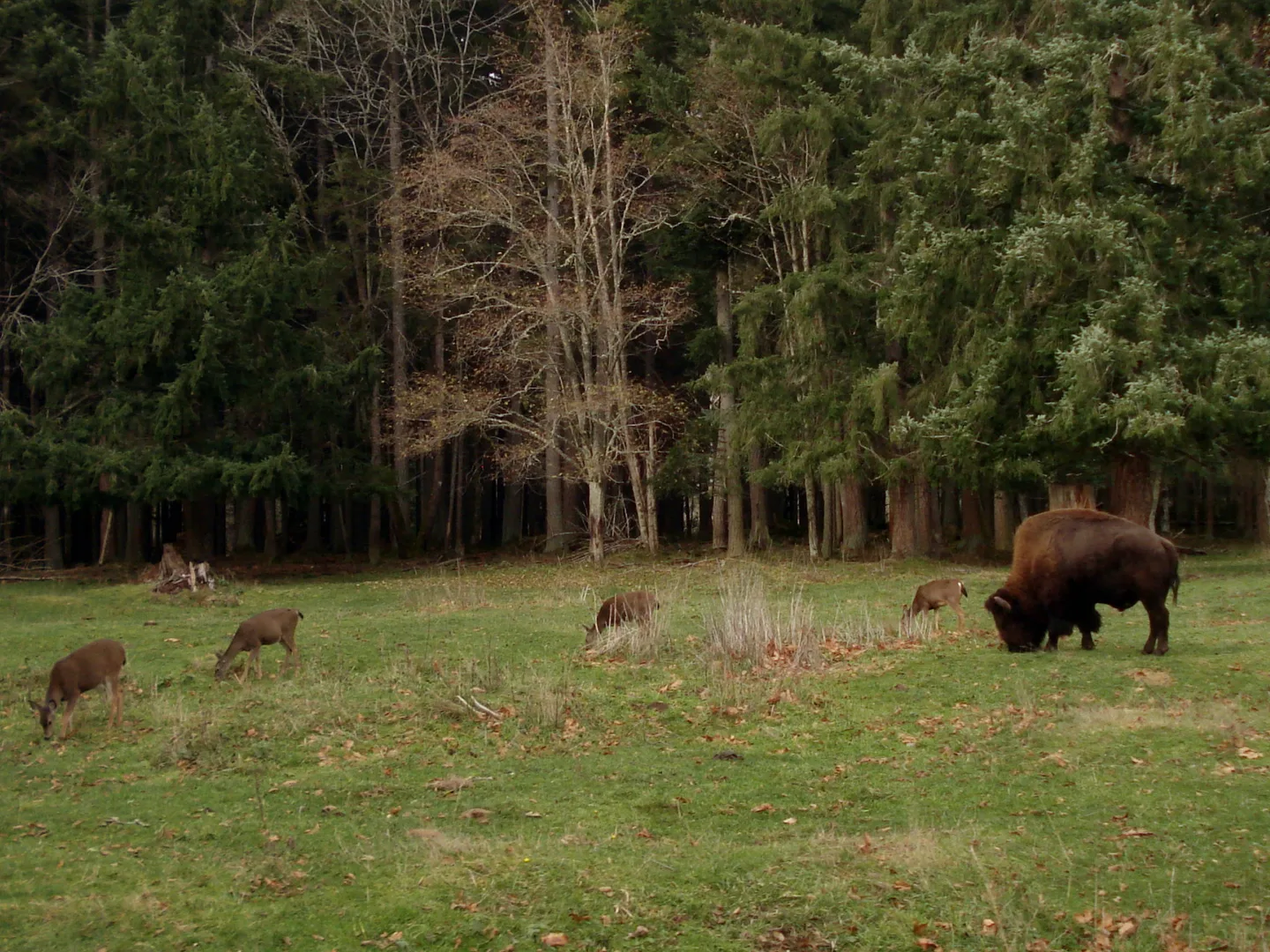
American bison bull in Yellowstone National Park, Wyoming.
Field
notes
One Wolf, One Percent
Elk are the main year-round prey for Yellowstone’s wolves, but bison are a different fight. Researchers studying those wolves describe bison as the most difficult prey for wolves to kill in North America, and in Yellowstone they are three times harder to kill than elk, because a bison is larger, more aggressive, and more likely to injure or kill a wolf that attacks it.
Lone-wolf odds A lone wolf attacking an adult bison manages to bite and restrain it only about 1% of the time, 93% less often than a lone wolf hunting elk. A capture is not necessarily a kill, because bison that wolves bite and restrain often escape. Each extra wolf in the hunting group raises its odds of a capture, up to about nine to thirteen wolves.
North America’s Largest Land Animal
Bison are North America’s largest terrestrial animals, and the numbers back that up. A mature bull can reach 5.5 to 6.5 feet high at the shoulder hump and nine to 12.5 feet in length; cows run smaller, at about 5 feet high and 7 to 10 feet long. Bison can weigh 1,800 to 2,400 pounds. A bison can hit 30 miles per hour despite that bulk, and its life expectancy is 15 to 20 years. In Yellowstone, bison have injured more people than any other animal. The park tells visitors to stay at least 25 yards (23 meters) away, because a bison approached too closely may bluff-charge.
From Millions to Fewer Than a Thousand
Bison were once widespread from Alaska to northern Mexico. Before 1800, bison roamed the Great Plains in vast numbers, with estimates ranging from 30 to 100 million. By the 1890s, fewer than 1,000 were left on the continent. The U.S. government slaughtered many bison in an organized effort to destroy the livelihood of the Plains Indians. Today around 30,000 bison live in conservation herds, which occupy about one percent of the original range. About 500,000 more are raised commercially as livestock.
Fire and free-roaming bison interact across the landscape in a pattern researchers call pyric herbivory, literally “grazing driven by fire,” and at the Tallgrass Prairie Preserve in the southern Great Plains that pattern was found to provide the foundation for biological diversity in North American grasslands. Day to day, a bison is mainly a grazer, eating mostly grasses but also flowering plants, lichens, and woody leaves when they’re available, working through about 1.6% of its own body weight in dry plant matter every day.
Snow-Sweepers and Early Starters
A bison’s shaggy head is the most heavily insulated part of its body, and it’s built to face straight into a blizzard. In winter, it sweeps its head side to side to clear snow off the grass buried underneath.
A newborn bison can stand and nurse within 30 minutes of being born, and within a couple of hours it begins to travel with the rest of the group. After a few days, the calf can keep up with the herd. Calves are nursed for seven to eight months and are fully weaned by the end of their first year, by which point a calf can weigh 350 to 425 pounds.
Published Updated
Traits
Intel
& FAQ
Guess
first
How big is a American Bison, really? Slide, lock in, and see what the sources say. Every answer is a figure from this page, quoted from where it came from.
Sources
- 01American bison. Smithsonian's National Zoo and Conservation Biology Institute.
- 02Aune, Jørgensen & Gates (2017). Bison bison. The IUCN Red List of Threatened Species 2017: e.T2815A123789863.
- 03MacNulty et al. (2014). Influence of Group Size on the Success of Wolves Hunting Bison. PLoS ONE.
- 04Fuhlendorf et al. (2009). Pyric Herbivory: Rewilding Landscapes through the Recoupling of Fire and Grazing. Conservation Biology.
- 05Bison Bellows: Birth of K-selected Species. National Park Service.
- 06Safety. Yellowstone National Park, U.S. National Park Service, 2026.
What the sources say: 61 claims checked word for word against these sources →