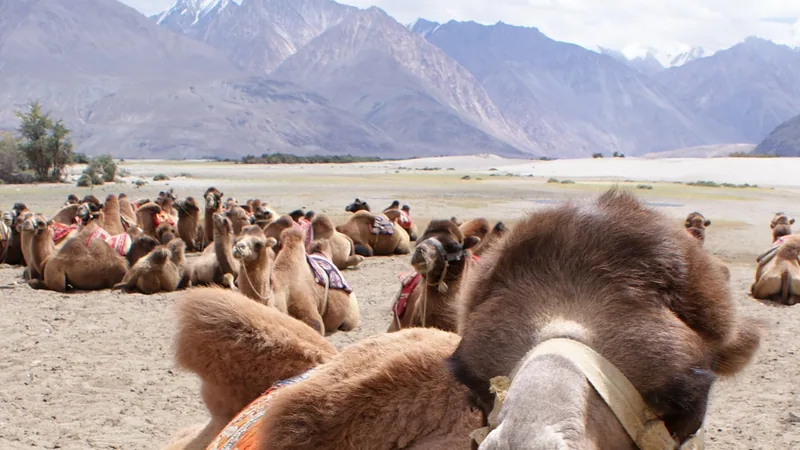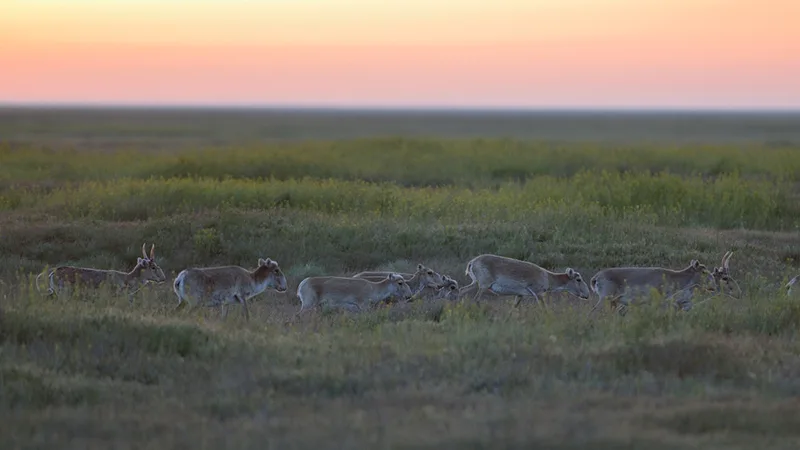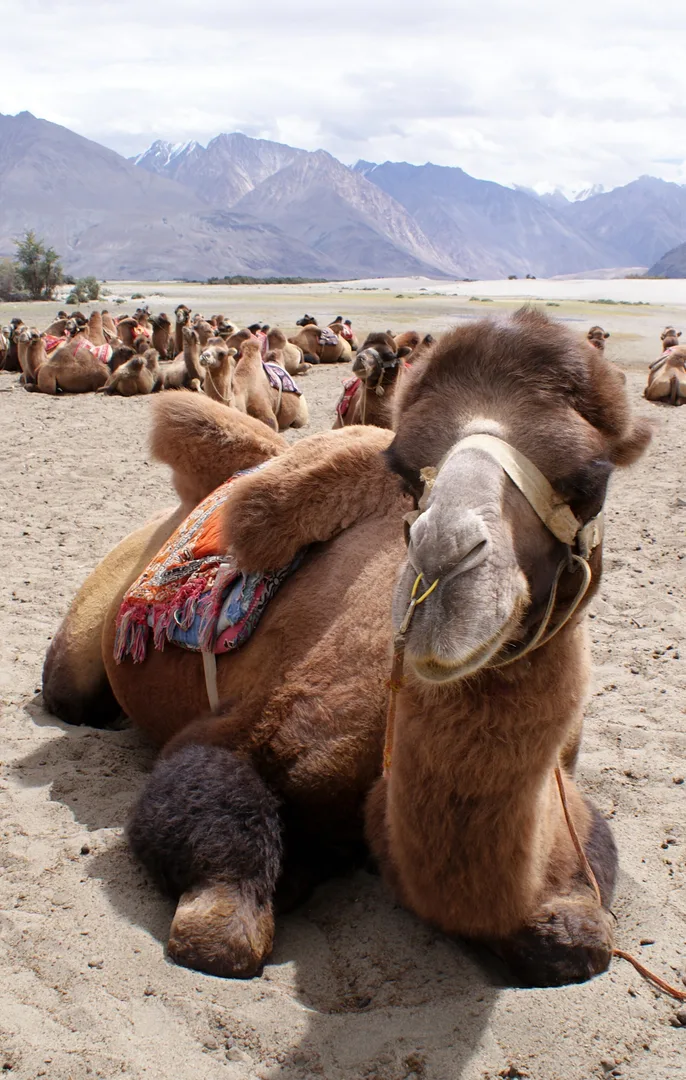
A Bactrian camel and its calf in western Mongolia.
Field
notes
Two Humps of Stored Fat
A Bactrian camel’s two humps store fat, not water. When food is scarce, the camel’s body uses that fat for energy, causing the hump to lean over and droop. Like other camels, a Bactrian camel can survive a 40 percent weight loss and then drink up to 32 gallons (145 liters) of water in one session.
Built for Heat, Cold and Sand
Bactrian camels grow a shaggy coat in winter, shed it in the hot summer, and can survive temperatures from minus 20°F (minus 29°C) to 120°F (49°C). They have few sweat glands and can let their body temperature rise 6°C before sweating, which prevents water loss. Like other camels, a Bactrian camel has a nictitating membrane, a thin, clear inner eyelid, shielding each eye from sandstorms, plus double rows of extra-long eyelashes and nostrils that close to keep sand out. Its broad, callused feet expand when stepped on and contract when lifted, easing walks on sand or snow.
Blood sugar that saves water. A 2014 study of gene activity in Bactrian camels found ways of holding on to water that depend on high blood sugar levels. Its authors think these are adaptations of the kidneys to desert life.
Size, Diet and Enemies
A grown Bactrian camel stands 5.2 to 5.9 feet (1.6 to 1.8 meters) at the shoulder and weighs 990 to 1,100 pounds (450 to 500 kilograms). The AnAge longevity database gives 35.4 years, in captivity, as the record for domestic camels. A Bactrian camel mainly grazes on grasses but also eats salty, dry and thorny desert plants, including halophytes, plants that grow in very salty water. Like cows, camels are ruminants: they bring food back up from the stomach to chew it again. In winter, Bactrian camels often dig under the snow to find food, and when there is little or no vegetation, camels may eat fish, bones, skin and even fabric.
Wolves have attacked Bactrian camels at waterholes, but leopards and wolves mainly ignore camels unless they are starving, because of their enormous size and how hard they are to kill. A camel’s “spit” is stomach contents and saliva, brought up and projected out to bother whatever threatens it.
Two Species, One Name
Archaeological and pictorial evidence suggests people began domesticating Bactrian camels roughly 5,000 years ago, in the late fourth and early third millennium BCE. They live mainly in Central Asian countries, including Mongolia, China and Kazakhstan. In some parts of Mongolia, camel meat, milk and wool make up 54 percent of herders’ cash income. Finds from Central Asia dating to the early second millennium BCE suggest camels were then used mainly to carry loads, and Mongolian herders still use them to move their gers (traditional tent homes) when moving camp, as well as for riding, tourism and sports.
Genetic studies confirmed that the wild two-humped camel is a separate species, Camelus ferus, whose ancestors split from those of the domestic Bactrian camel an estimated 1.1 million years ago. A 2019 review found its range reduced to four places, three in China and one in Mongolia. The Red List’s 2025 assessment lists the wild camel as Endangered, with 780 to 1,380 mature animals left and their number falling. The camel on this page is the domestic species.
Published Updated
Traits
Intel
& FAQ
Guess
first
How big is a Bactrian Camel, really? Slide, lock in, and see what the sources say. Every answer is a figure from this page, quoted from where it came from.
Sources
- 01Camelus bactrianus (Bactrian camel). Animal Diversity Web, University of Michigan.
- 02Camel. San Diego Zoo Wildlife Alliance.
- 03Camelus bactrianus. AnAge: The Animal Ageing and Longevity Database, Build 15, 2023.
- 04Burger, Ciani & Faye (2019). Old World camels in a modern world - a balancing act between conservation and genetic improvement. Animal Genetics.
- 05Wu et al. (2014). Camelid genomes reveal evolution and adaptation to desert environments. Nature Communications.
- 06Bolormaa et al. (2025). The role and significance of two-humped camels in Mongolia: adaptability, economic impact, and cultural importance. Pastoralism: Research, Policy and Practice.
- 07Mallon et al. (2025). Camelus ferus. The IUCN Red List of Threatened Species 2025: e.T63543A50197851.
What the sources say: 49 claims checked word for word against these sources →