Etosha National Park, Namibia
Field
notes
The bounce
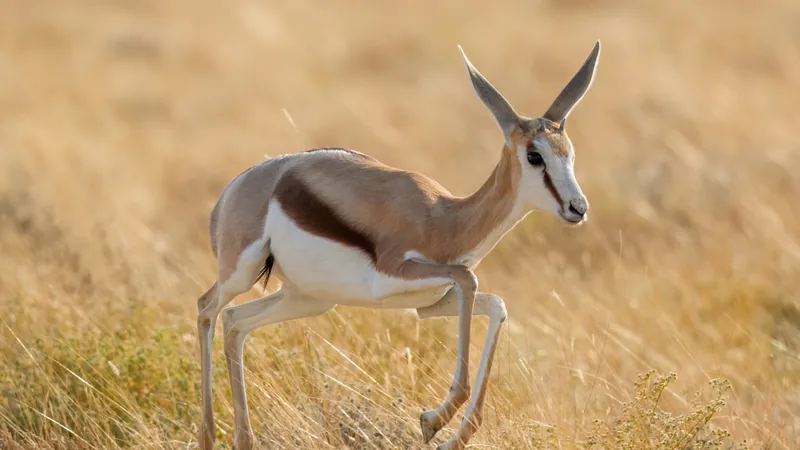
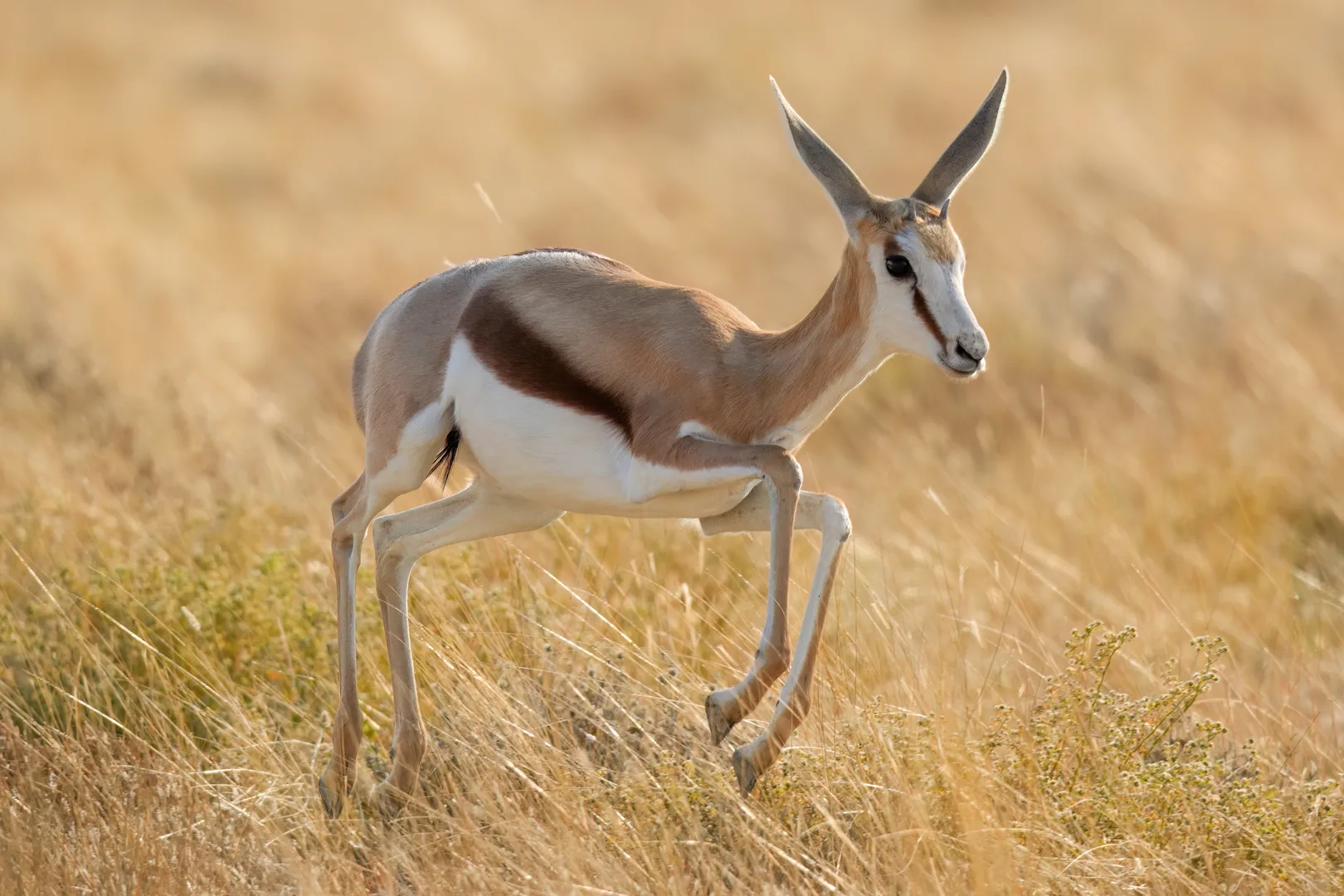
A frightened or excited springbok does not simply run. It launches into pronking: stiff-legged leaps straight up, up to 3.5 m high, with the head lowered, the hooves gathered together and the back curved. Lions and cheetahs are among the hunters the leaps are said to distract.
Hidden crest A fold of skin runs from the middle of the back to the rump, and when the springbok is excited it can open the fold to show a crest of white hair.
Body and muscle
The springbok is a strikingly marked, gazelle-like antelope with a white face, a reddish-brown coat and a white backside. It stands about 80 cm at the shoulder and weighs 33 to 46 kg, and AnAge lists an average adult at 39 kg. Both sexes carry black, lyre-shaped horns, and the horns of larger males measure 36 to 48 cm.
A muscle study sampled the vastus lateralis (a leg muscle) and the longissimus lumborum (a back muscle) of springbok and fallow deer. Type IIX was the predominant fibre type in both muscles and both species, at more than 50%, and springbok had more type IIX fibres than the deer. The authors add that the muscles’ high oxidative capacity suggests these animals may hold off fatigue for long periods.
Staying steady in the heat
One study tracked eight free-ranging adults for 11 to 13 months, as air temperature ranged from -6 degrees C to 34 degrees C. Even so, their mean daily body temperature was only about 0.3 degrees C higher in summer than in winter. The authors call this remarkable homeothermy, meaning a steady body temperature.
Color matters too. A second study compared black, white and normal springbok, and the black pelt absorbed more heat from simulated sunlight. The researchers suggested that energy costs may explain why these morphs are rare.
Food helps with water too. Springbok eat both grass and browse, and in the hot, dry season they shift to flowers, which hold twice the water of the grass they eat in the wet season. Eating this way frees them from needing a constant water supply.
Range and numbers
Springbok live in south and southwestern Africa, mainly in Namibia, Botswana, Angola and South Africa, on treeless savanna beside dry lake beds. They once traveled by the hundreds and even millions, in mass herds called treks, and Dutch farmers whose crops were ruined by the treks hunted them. By ADW’s 1999 account they were mostly confined to private farms and game reserves. The IUCN rated the species Least Concern in its 2016 assessment.
In the wild, springbok live under 10 years on average, though it has been speculated that they may reach 20. The captive record is 19.8 years.
Published
Traits
Intel
& FAQ
Guess
first
How big is a Springbok, really? Slide, lock in, and see what the sources say. Every answer is a figure from this page, quoted from where it came from.
Sources
- 01Antidorcas marsupialis. Animal Diversity Web.
- 02AnAge entry for Antidorcas marsupialis. Human Ageing Genomic Resources, AnAge.
- 03Antidorcas marsupialis. The IUCN Red List of Threatened Species 2016: e.T1676A115056763.
- 04Curry et al. (2012). High oxidative capacity and type IIx fibre content in springbok and fallow deer skeletal muscle suggest fast sprinters with a resistance to fatigue. Journal of Experimental Biology.
- 05Fuller et al. (2005). A year in the thermal life of a free-ranging herd of springbok Antidorcas marsupialis. Journal of Experimental Biology.
- 06Hetem et al. (2009). Body temperature, thermoregulatory behaviour and pelt characteristics of three colour morphs of springbok (Antidorcas marsupialis). Comparative Biochemistry and Physiology Part A: Molecular & Integrative Physiology.
What the sources say: 39 claims checked word for word against these sources →