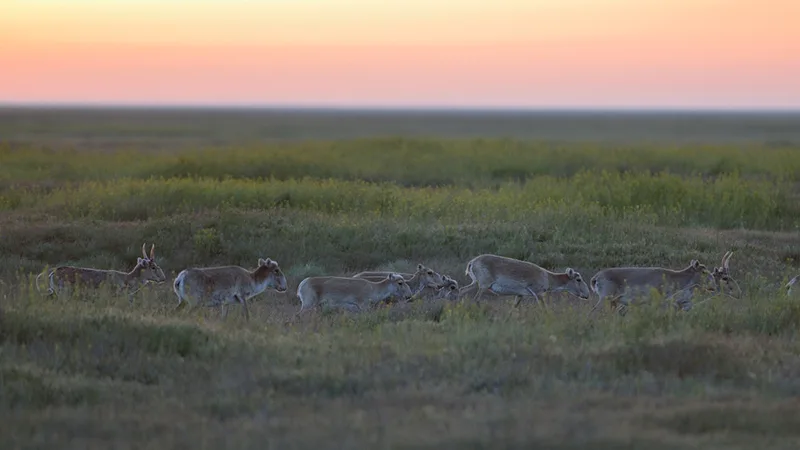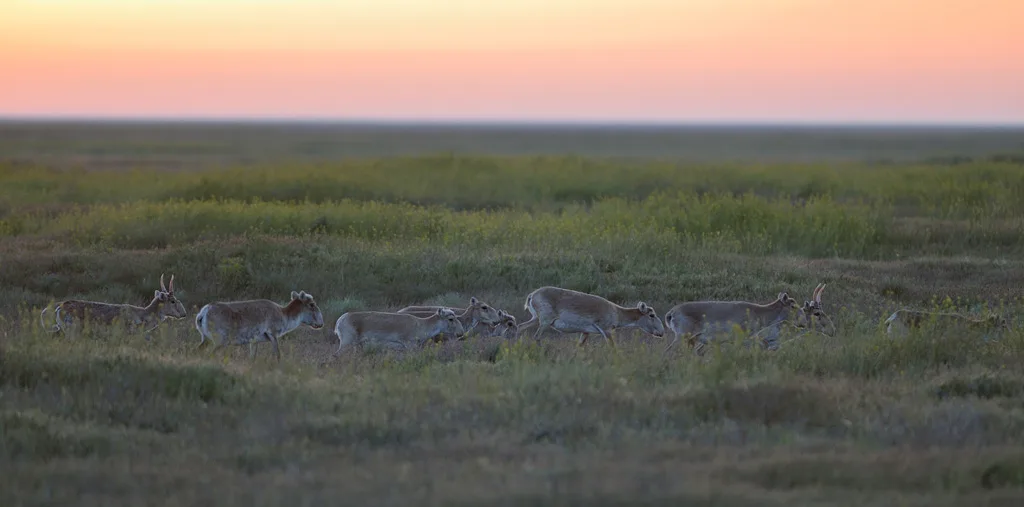
A male in winter coat, the nose hanging well below the line of the mouth.
Field
notes
A Nose That Roars
The saiga antelope (Saiga tatarica) has a huge, flexible nose that hangs down over its mouth. According to the Saiga Conservation Alliance, that oversized nose inflates to help the saiga breathe warm air in frosty winters and to filter dust in summer.
During the mating season, or rut, males produce loud nasal roars. A 2007 study in the Journal of Anatomy found that they pull the flexible front of the nose forward, temporarily lengthening the nasal vocal tract by about 20 percent. That lowers the roar’s resonant frequencies, called formants. These are thought to tell other saigas about a male’s body size and fighting ability, and the roar may also warn off rivals and attract females.
In many mammals, a male sniffs a female’s urine and then pulls back his upper lip in a “flehmen” face, which is thought to help him detect her chemical signals. In saigas, the nose curves inward for this face, the reverse of its shape when roaring.
Life on the Steppe
Saigas stand about 0.6 to 0.8 meters at the shoulder, measure 1 to 1.5 meters long and weigh 30 to 45 kilograms, according to Animal Diversity Web. The AnAge longevity database says they have been estimated to live up to 10 to 12 years in the wild, though their maximum lifespan is not yet established. It puts the average age of female sexual maturity at 331 days. Females usually give birth to two young after a five-month pregnancy, and calves begin to graze at 4 to 8 days old.
Saigas live on dry steppes and semi-deserts, and the Saiga Conservation Alliance works across their range in Kazakhstan, Mongolia, Russia and Uzbekistan. They graze on more than 100 plant species, including grasses, saltworts and sagebrush. Older studies describe herds of 30 to 40 after the breeding season. Wolves are their main natural predator, and foxes and stray dogs prey on newborn calves.
Rut Season Is a Death Sentence for Many Males During the rut, one male guards a group of 5 to 10 females, and violent fights often break out between males. Older studies summarised by Animal Diversity Web report that males stop grazing entirely, and that male mortality often reached 80 to 90 percent.
From the Ice Age to the Red List
Before the Holocene, our current geological epoch, the saiga ranged from France to Canada’s Northwest Territories. Its range later shrank to the steppes of Central Asia. A 2008 study of Ice Age Eurasian megafauna lists the saiga among the large animals favoured by human hunters that survived into the Holocene.
According to historical records cited in a 2010 ancient DNA study, saigas stayed extremely abundant until the Soviet Union ended, and then their numbers fell by more than 95 percent. Heavy poaching since the 1990s has depleted herds.
In May 2015, a bacterial disease swept through calving herds in central Kazakhstan. More than 200,000 saigas died in three weeks, about 62 percent of the global population at the time. Researchers confirmed the cause as hemorrhagic septicemia, caused by the bacterium Pasteurella multocida, which can live harmlessly in healthy saigas. Statistical modelling suggests the days before were unusually hot and humid, which fits known drivers of the disease. The saiga was Critically Endangered then. The IUCN Red List now rates it Near Threatened.
Published Updated
Traits
Intel
& FAQ
Guess
first
How big is a Saiga Antelope, really? Slide, lock in, and see what the sources say. Every answer is a figure from this page, quoted from where it came from.
Sources
- 01Saiga tatarica (saiga). Animal Diversity Web, University of Michigan.
- 02Saiga tatarica. AnAge: The Animal Ageing and Longevity Database, Human Ageing Genomic Resources.
- 03What is a Saiga? Saiga Conservation Alliance.
- 04Frey, Volodin & Volodina (2007). A nose that roars: anatomical specializations and behavioural features of rutting male saiga. Journal of Anatomy.
- 05Kock et al. (2018). Saigas on the brink: Multidisciplinary analysis of the factors influencing mass mortality events. Science Advances.
- 06Campos et al. (2010). Ancient DNA sequences point to a large loss of mitochondrial genetic diversity in the saiga antelope (Saiga tatarica) since the Pleistocene. Molecular Ecology.
- 07Pushkina & Raia (2008). Human influence on distribution and extinctions of the late Pleistocene Eurasian megafauna. Journal of Human Evolution.
- 08Saiga tatarica. The IUCN Red List of Threatened Species 2025: e.T19832A233985067.
What the sources say: 55 claims checked word for word against these sources →