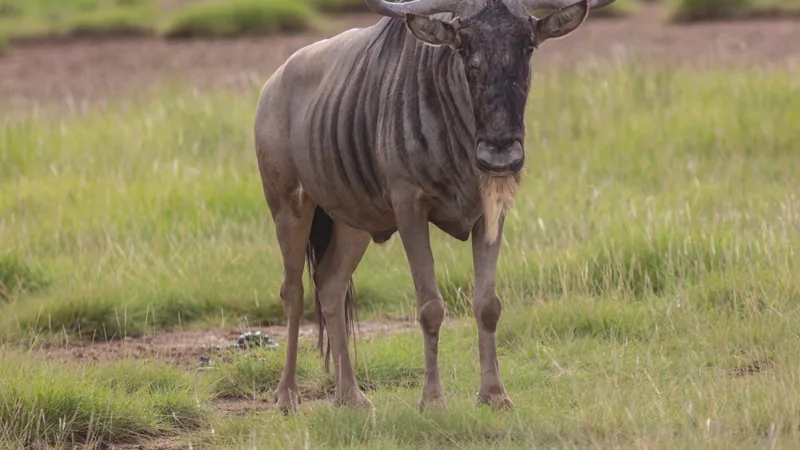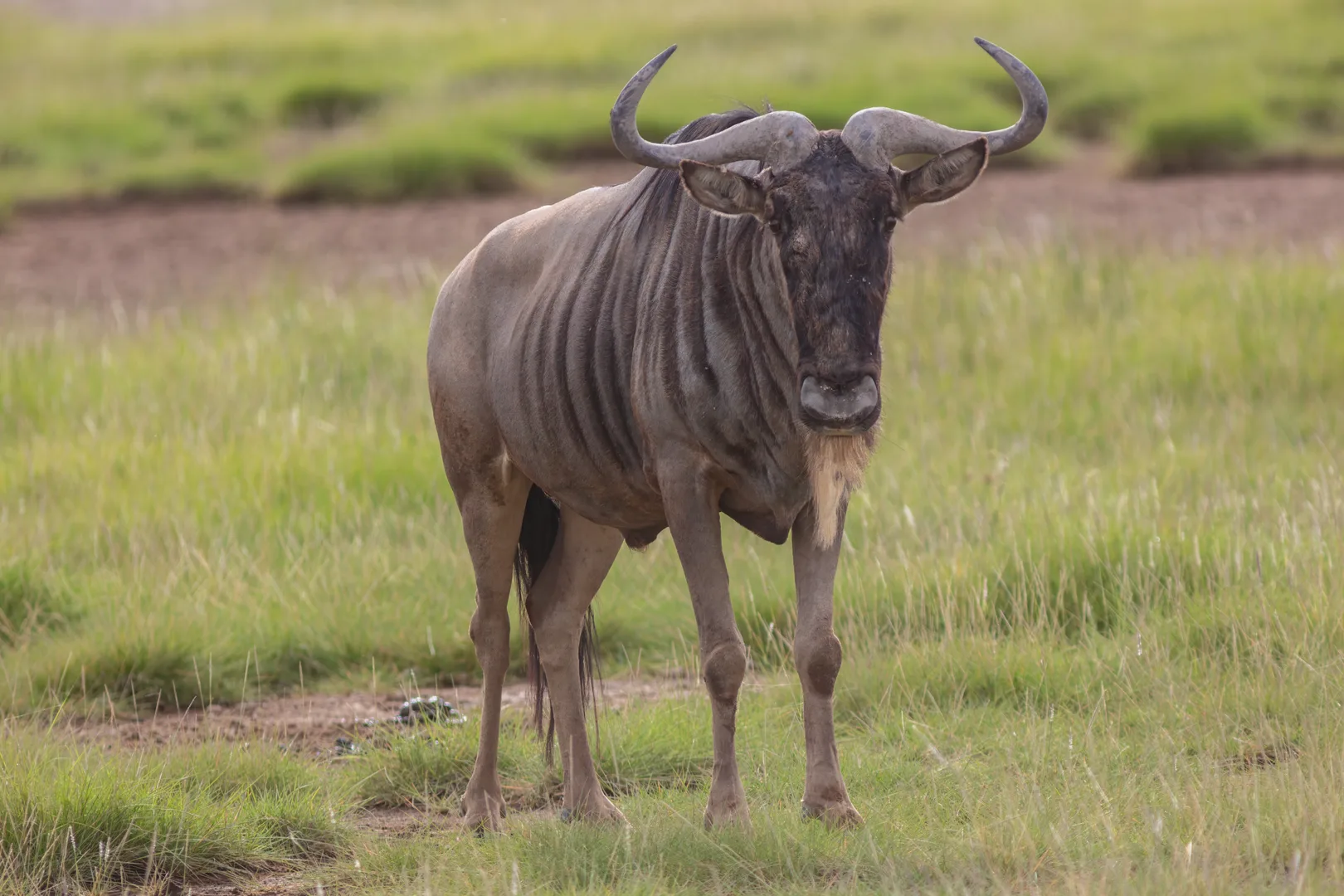
Amboseli National Park, Kenya
Field
notes
Built to March
In hot, dry Northern Botswana, GPS-collared wildebeest walked up to 80 km over five days without drinking. Scientists also measured the efficiency of a foreleg muscle from wildebeest and from domestic cows, which are much larger and relatively sedentary.
Efficient muscle Wildebeest muscle was substantially more efficient (62.6%) than the same muscle from much larger cows (41.8%).
Size and Looks
A blue wildebeest is slate gray with tan forelegs and dark vertical stripes on the shoulders and back. It has cow-like horns, a mane and a beard. Males stand about 130 cm tall at the shoulder and weigh 210 to 260 kg, and adult males are generally darker than females. Across the species, Animal Diversity Web gives a mass range of 118 to 270 kg. The AnAge database records one captive blue wildebeest that lived 24.3 years.
Grass, Range and Predators
Blue wildebeest are common in eastern and southern Africa, from Kenya to eastern Namibia. The Orange River in South Africa borders their southern range. They live in habitats from dense bush to open woodland floodplains, but seem to prefer acacia savannas and plains with fast-regrowing grass.
They are grazers. Their main food is rapidly growing grasses, and when grass is sparse they may eat leaves off shrubs and trees.
Lions, cheetahs, spotted hyenas and African wild dogs are their major predators. When one is spotted, wildebeest bunch together, stamp and give loud, shrill alarm calls. Herds are generally made up of about 8 females and their calves, with territorial bulls wandering among them. Mothers often defend their calves successfully against individual hyenas or cheetahs.
The Great Crossing
The annual migration of about 1.2 million wildebeest through the Serengeti Mara ecosystem is, a 2017 study says, the largest remaining overland migration in the world. When the migration crosses the Mara River, thousands drown each year. The same study found mass drownings of more than 100 animals in at least 13 of the 15 years before it, and on average 6,250 carcasses entering the river each year. Half of a wildebeest carcass’s dry mass is bone, which takes 7 years to decompose.
The IUCN Red List rates the blue wildebeest Least Concern.
Published
Traits
Intel
& FAQ
Guess
first
How big is a Blue Wildebeest, really? Slide, lock in, and see what the sources say. Every answer is a figure from this page, quoted from where it came from.
Sources
- 01Connochaetes taurinus. The IUCN Red List of Threatened Species 2016: e.T5229A163322525.
- 02Curtin et al. (2018). Remarkable muscles, remarkable locomotion in desert-dwelling wildebeest. Nature.
- 03Connochaetes taurinus (blue wildebeest). Animal Diversity Web, University of Michigan.
- 04Ackermann et al. (2010). Hybrid wildebeest (Artiodactyla: Bovidae) provide further evidence for shared signatures of admixture in mammalian crania. South African Journal of Science.
- 05AnAge entry for Connochaetes taurinus. AnAge: The Animal Ageing and Longevity Database, Build 15, Human Ageing Genomic Resources.
- 06Subalusky et al. (2017). Annual mass drownings of the Serengeti wildebeest migration influence nutrient cycling and storage in the Mara River. Proceedings of the National Academy of Sciences.
What the sources say: 39 claims checked word for word against these sources →