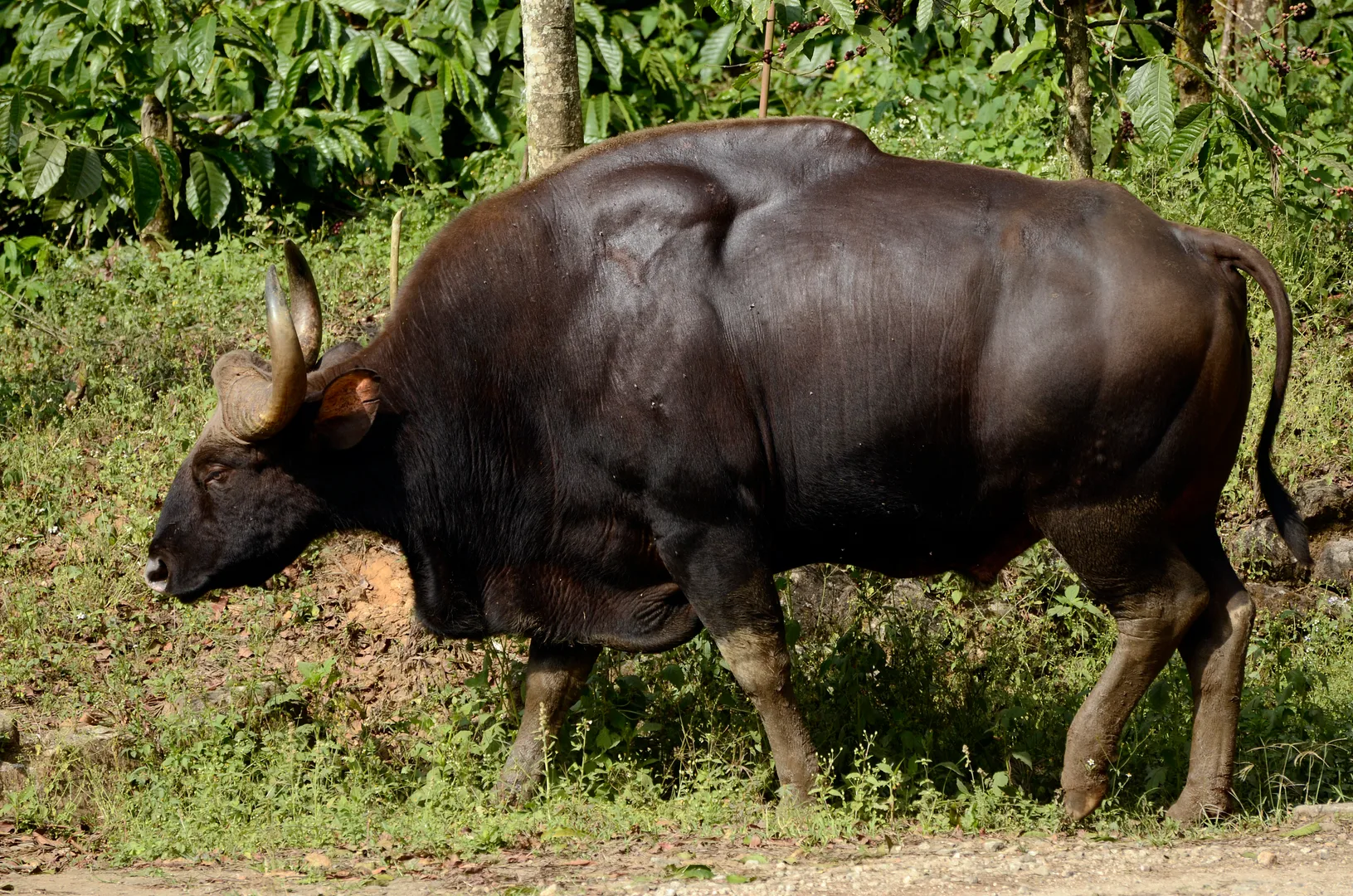
Anaimalai Hills, India
Field
notes
Standing Up to a Tiger
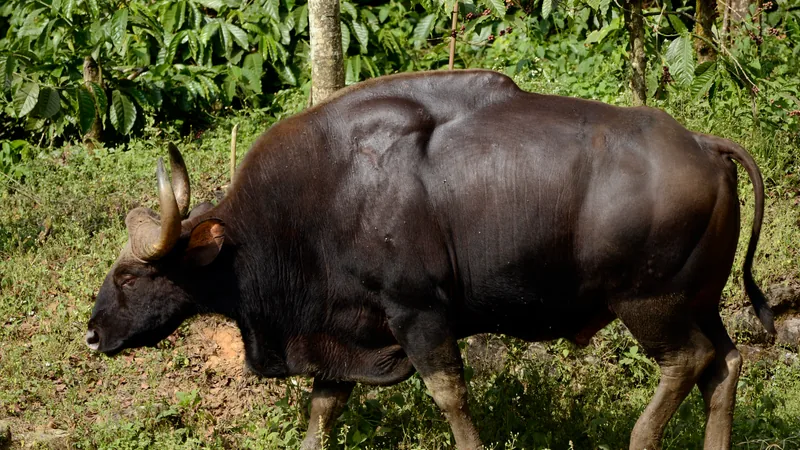
Faced with a tiger, a gaur herd may not scatter. A game warden in Malaya wrote in 1953 that the gaur, which he called seladang, may fear a tiger, but they know their combined strength and are prepared to stand and fight rather than run. In one encounter he described, the herd bunched up and moved forward toward the tiger’s angry voice.
People get a different reaction. Under normal conditions, he wrote, gaur fear man, and the sight or sound of one is enough to set them running. That does not make them harmless. In Tamil Nadu’s compensation records from 2016 to 2024, nearly a third of conflicts with gaur were human injuries, and about 9% were human deaths.
Wild Cattle, Built Big
The gaur is the largest living wild cattle species. An adult female weighs about 600 kg. AnAge, a database of animal lifespans, puts the average adult gaur at 825 kg. Researchers measured captive gaur in zoos in India and the USA and found that males top out at a shoulder height of 175 cm, and females at 147 cm.
The same study found that a gaur’s horns show its age: the more white on the horns, the older the animal. One gaur in captivity lived 26.2 years.
Grass, Leaves and Bark
Gaur once lived across mainland South and Southeast Asia and Sri Lanka. Now they survive in scattered areas of ten countries: Bhutan, Cambodia, China, India, Laos, Peninsular Malaysia, Myanmar, Nepal, Thailand and Vietnam. Around 85% of them live in India. They range from sea level to at least 2,800 m.
A gaur is both a grazer and a browser. It reportedly eats mostly young green grasses, plus leaves, fruit, twigs, bark and bamboo. In two reserves in Goa, 32 plant species made up the diet, with leaves the preferred food at 87%. Captive gaur are reported to eat about 20 kg of green fodder a day.
Night shift in disturbed areas In undisturbed areas, gaur are mainly active by day. Where human disturbance is high, they are reported to become mainly nocturnal.
Vulnerable and Shrinking
The IUCN rated the gaur Vulnerable in 2016. Its assessment says the gaur’s global distribution has shrunk by over 80% in the past 100 years, and that it is now mostly limited to habitats within protected areas. The main causes are hunting for wild meat and for the horn trade in Southeast Asia, and habitat loss and hunting for meat in South Asia.
Disease is a potential threat too. Rinderpest and foot-and-mouth disease, passed on by domestic cattle, are a potentially serious danger across the gaur’s range.
Published Updated
Traits
Intel
& FAQ
Guess
first
How big is a Gaur, really? Slide, lock in, and see what the sources say. Every answer is a figure from this page, quoted from where it came from.
Sources
- 01Duckworth et al. (2016). Bos gaurus. The IUCN Red List of Threatened Species 2016: e.T2891A46363646.
- 02Ogilvie (1953). The Behaviour of Seladang (Bibos gaurus). Oryx.
- 03Ahrestani et al. (2011). Contrasting timing of parturition of chital Axis axis and gaur Bos gaurus in tropical South India - the role of body mass and seasonal forage quality. Oikos.
- 04Ahrestani & Prins (2011). Age and sex determination of gaur Bos gaurus (Bovidae). Mammalia.
- 05Kamalakkannan et al. (2020). The complete mitochondrial genome of Indian gaur, Bos gaurus and its phylogenetic implications. Scientific Reports.
- 06Gad & Shyama (2009). Studies on the food and feeding habits of Gaur Bos gaurus H. Smith (Mammalia: Artiodactyla: Bovidae) in two protected areas of Goa. Journal of Threatened Taxa.
- 07Lanza et al. (2000). Cloning of an Endangered Species (Bos gaurus) Using Interspecies Nuclear Transfer.
- 08AnAge entry for Bos frontalis (Gaur). AnAge: The Animal Ageing and Longevity Database, Build 15, Human Ageing Genomic Resources.
- 09Shameer et al. (2025). Ecological and temporal drivers of human-gaur conflict in Tamil Nadu, India. Discover Animals.
What the sources say: 55 claims checked word for word against these sources →