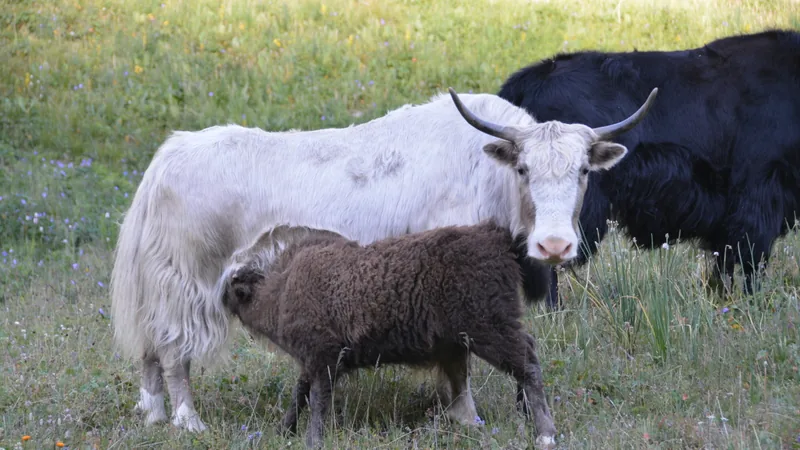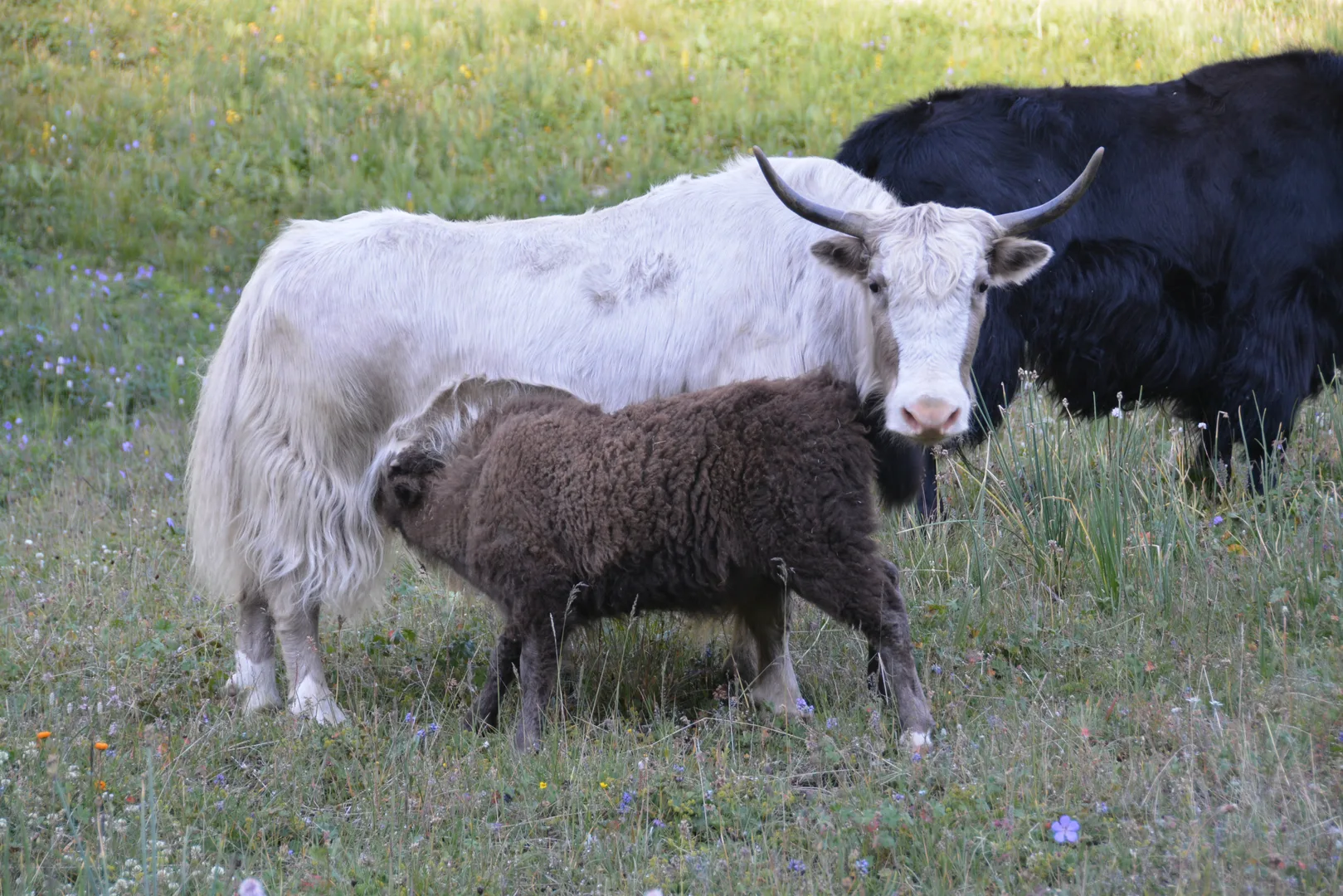
A white yak and its calf on summer pasture.
Field
notes
Lungs and a heart built for thin air
People raise the yak (Bos grunniens) 3,000 to 5,000 m above sea level in the highlands of Asia, where the air is thin. Its body answers with hardware. A yak has 15 chest vertebrae, one more than a cow, which makes its chest cavity bigger and leaves room for a large heart and lungs. A yak’s heart weighs 1.18% of its body weight, where a cow’s weighs 0.39%.
Oxygen grabber Yaks keep a high level of foetal haemoglobin throughout life, while it is generally present in other mammals for only 6 to 7 months after birth.
This form of haemoglobin, the blood’s oxygen carrier, holds oxygen more tightly and can bind and release more of it than other forms. Cattle have a reaction in which lung blood vessels clamp down in thin air, which is called hypoxic pulmonary vasoconstriction. Yaks have a greatly diminished response of this kind. A 2012 study comparing yak and cattle genomes found that the yak has more genes in families tied to the senses and to energy metabolism.
A coat with no sweat
Yaks have thick outer hair and no working sweat glands, and not sweating helps them cope with cold. The fleece has two layers: long outer hair, and an undercoat of dense, fine down that appears in the colder season. The body is compact, with relatively little skin for its weight. In winter, a compact body, thick coat and no sweating together minimize heat loss.
Grazing on scraps
A yak’s tongue is 4 cm long on average, shorter than a cow’s, and it grazes with its lips. That keeps the tongue out of the cold and lets the yak crop low plants. In one study of grazing yaks, they consumed forbs throughout the year, but especially during the winter. Forbs are flowering plants that are not grasses. Even so, winter is lean: a yak can lose 25 to 30% of its body weight, or even more.
Size, age and a long partnership
AnAge lists an adult weight of 667 kg for Bos grunniens, and a newborn weighs about 18 kg. The yak reaches full size in 6 to 8 years. One captive yak was still living after 26.3 years. Genome studies date the yak’s domestication to 7,300 years ago. A 2022 review counted approximately 16 million domestic yaks and 15 to 20 thousand wild yaks in the world.
Published
Traits
Intel
& FAQ
Guess
first
How big is a Domestic Yak, really? Slide, lock in, and see what the sources say. Every answer is a figure from this page, quoted from where it came from.
Sources
- 01Jing et al. (2022). The adaptive strategies of yaks to live in the Asian highlands. Animal Nutrition.
- 02Ayalew et al. (2021). Adaptation Mechanisms of Yak (Bos grunniens) to High-Altitude Environmental Stress. Animals.
- 03Qiu et al. (2012). The yak genome and adaptation to life at high altitude. Nature Genetics.
- 04AnAge entry for Bos grunniens. Human Ageing Genomic Resources, AnAge.
What the sources say: 37 claims checked word for word against these sources →