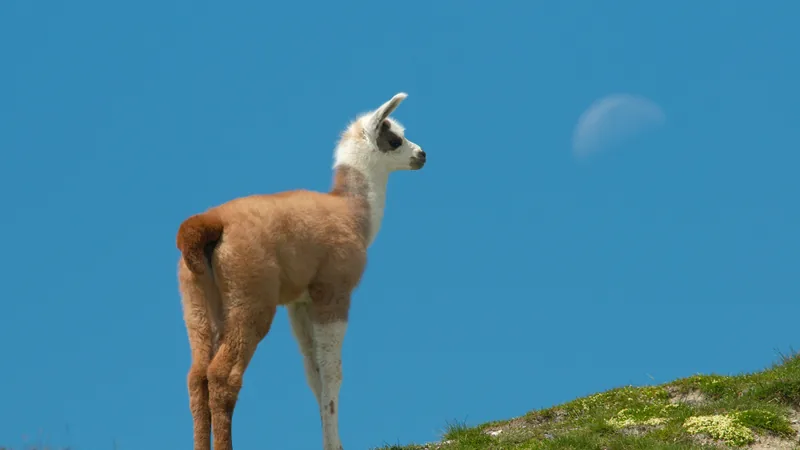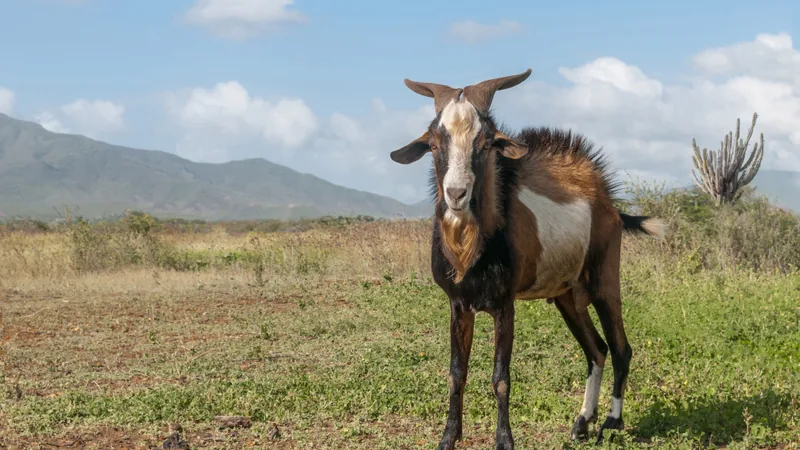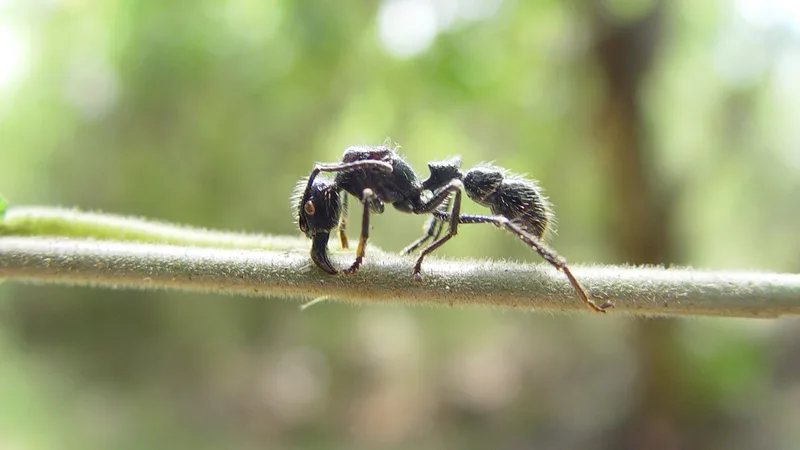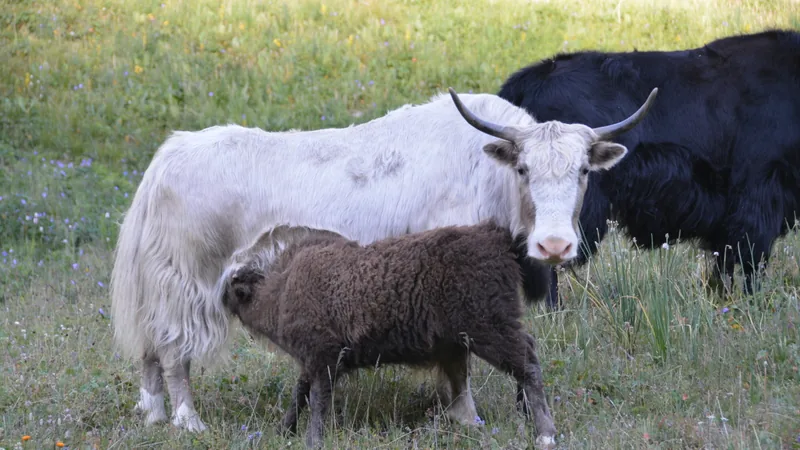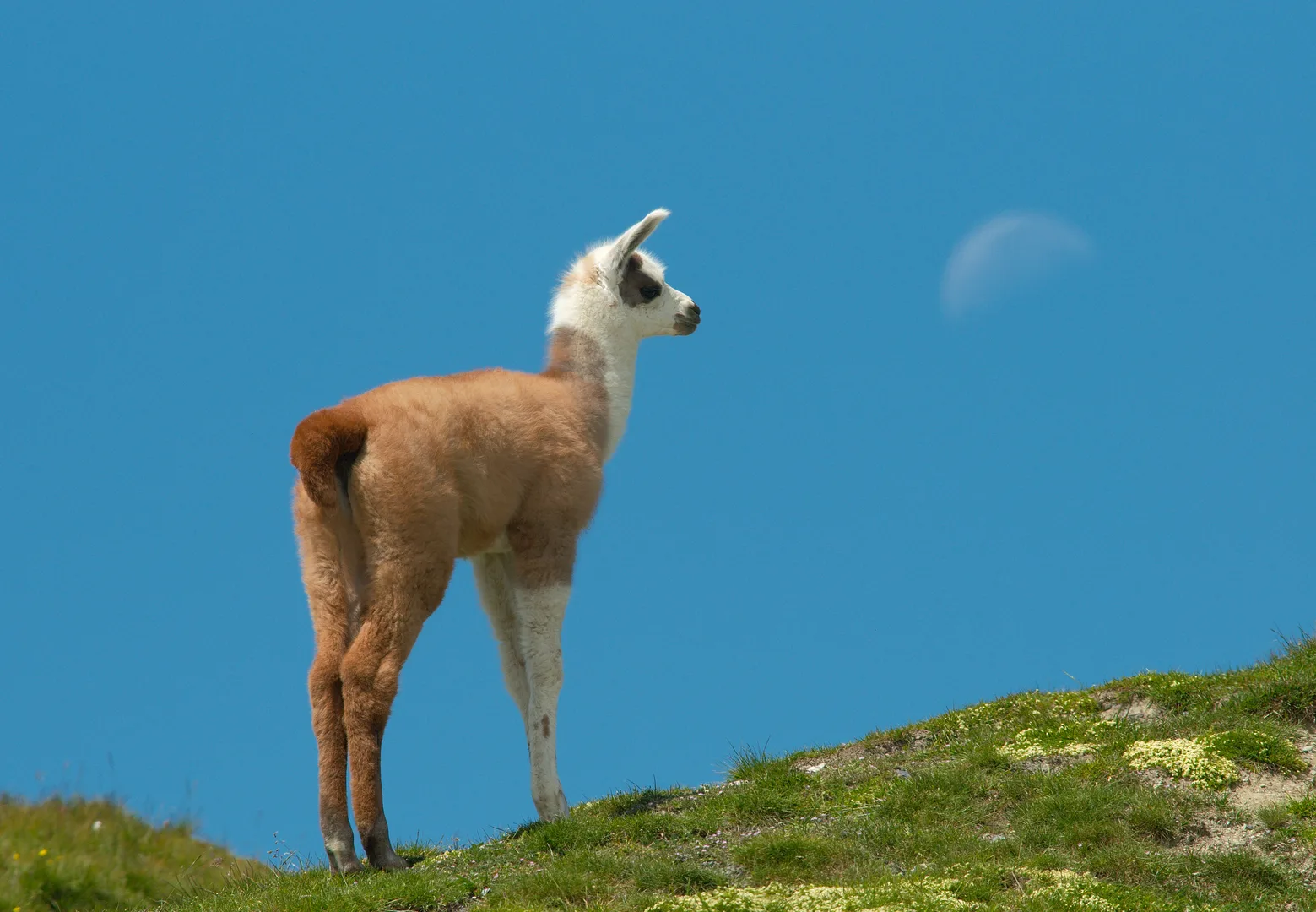
On a grassy ridge.
Field
notes
Antibodies made of heavy chains only
An antibody is a protein the immune system makes to lock onto an invader. Llamas (Lama glama) naturally make heavy chain-only antibodies as well as conventional ones. Their binding end, called a VHH, matches a conventional antibody for affinity and specificity despite being much smaller.
A llama was repeatedly immunized with HIV-1 envelope proteins, and its VHH library was then screened for the ability to block the virus.
Broad neutralizer One VHH, J3, neutralized 96 of 100 tested HIV-1 strains, covering subtypes A, B, C, D, BC, AE, AG, AC, ACD, CD, and G.
Big, woolly and built for altitude
A llama stands about 1.21 m at the shoulder and about 1.2 m from head to tail. Adults can weigh 130 to 155 kg. Animal Diversity Web calls the llama the largest of the South American camelids, which include alpacas and guanacos. Its blood has an unusually high content of hemoglobin and oval red blood cells, which Animal Diversity Web calls adaptations for oxygen-poor, high-altitude air. Each foot has two toes and a thick leathery pad.
Most llamas live about 15 years, and well cared for ones can pass 20. The oldest captive llama in one longevity database was still alive at 28.9 years.
The native range runs all along the Andes, though the llama is not found in the wild. Its natural habitat is the Andean highlands, especially the Altiplano plateau of southeast Peru and western Bolivia, at 2,300 to 4,000 m. Today it is kept commercially across North America, Europe and Australia.
Browser, brawler, bodyguard
Llamas browse on low shrubs, lichens and mountain vegetation. A group’s leading male defends his position by trying to wrestle a challenger to the ground, biting his limbs and wrapping his own long neck around the rival’s. The loser lies sideways on the ground with his neck lowered and his tail raised.
Against predators they have been reported charging, kicking, biting and spitting.
Guanaco roots and induced ovulation
Domesticated llamas are descended from the wild guanaco (Lama guanicoe). A study of mitochondrial DNA, the genetic code passed down from the mother, put 80% of llama and alpaca sequences in the guanaco lineage.
Females are induced ovulators: mating stimulates them to release an egg. In a study of 41 llamas, ovulation came on the 2nd day after mating in 26 of 27 ovulating animals.
Published
Traits
Intel
& FAQ
Guess
first
How big is a Llama, really? Slide, lock in, and see what the sources say. Every answer is a figure from this page, quoted from where it came from.
Sources
- 01Lama glama. Animal Diversity Web.
- 02AnAge entry for Lama glama. Human Ageing Genomic Resources, AnAge.
- 03McCoy et al. (2012). Potent and broad neutralization of HIV-1 by a llama antibody elicited by immunization. Journal of Experimental Medicine.
- 04Adams, Sumar & Ginther (1990). Effects of lactational and reproductive status on ovarian follicular waves in llamas ( Lama glama ). Reproduction.
- 05Kadwell et al. (2001). Genetic analysis reveals the wild ancestors of the llama and the alpaca. Proceedings of the Royal Society of London. Series B: Biological Sciences.
What the sources say: 51 claims checked word for word against these sources →