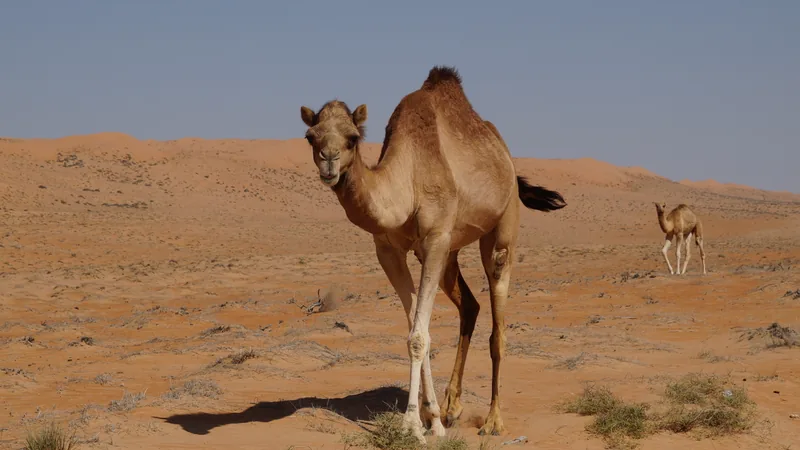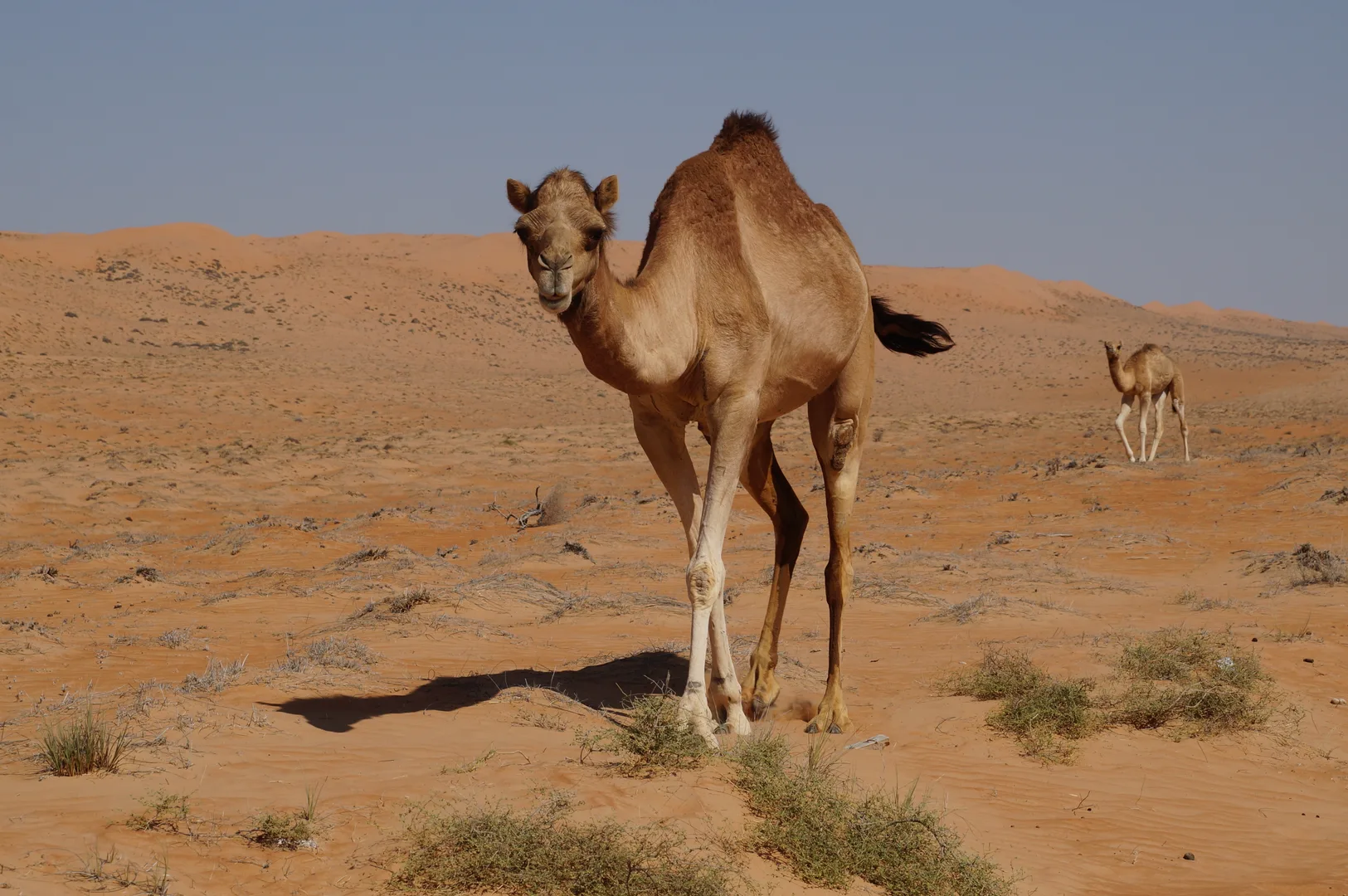
A dromedary in the Wahiba Sands, Oman.
Field
notes
Running hot to save water
A dromedary lets its body temperature climb and fall through the day, from 34 degrees Celsius to 41.7 degrees Celsius. That swing lets it conserve water by not sweating as the air heats up. It can also tolerate a water loss of more than 30%, a level that is lethal for most other mammals at 15%. Groups avoid excess heat by pressing against each other.
Antibodies with no light chains Antibodies are proteins the immune system uses to lock onto invaders. The serum of the dromedary holds antibodies made of paired heavy chains with no light chains, and they still bind a wide range of targets. The same paper reports that heavy-chain antibodies are a feature of all camelids.
Sand gear
Its eyes have a double row of eyelashes against blowing sand, and at the onset of a sandstorm it can close its nostrils. Its feet are pad-shaped and suited to sand, but sharp stones injure them easily. The lips are thickened for coarse, thorny plants, and the camel chews each bite 40 to 50 times. A 2014 genome study of the dromedary, Bactrian camel and alpaca found complex features related to desert adaptations, including fat and water metabolism.
The hump is fat bound together by fibrous tissue, stored for times of need.
Size and lifespan
Males weigh 400 to 600 kg and stand 1.8 to 2.0 m at the shoulder. The mass range for the species is 300 to 690 kg. The record life in captivity is 28.4 years. A potential lifespan of up to 50 years has been suggested, but AnAge notes that anecdotal reports of longer lives in domestic animals have not been verified.
Where it lives, and what it eats
Dromedaries occupy arid regions of the Middle East through northern India, and arid regions of Africa, notably the Sahara. They have also been introduced to arid central Australia. Because dromedaries are domesticated, they have no special conservation status. They eat mainly thorny plants, dry grasses and saltbush, and can browse up to 3.5 m high. They need 6 to 8 times as much salt as other animals to absorb and store water, so a third of their food must be halophytic plants, meaning plants that thrive in salty soil. Moving them to other climates has proven unsuccessful, because they are sensitive to cold and humidity.
Published Updated
Traits
Intel
& FAQ
Guess
first
How big is a Dromedary, really? Slide, lock in, and see what the sources say. Every answer is a figure from this page, quoted from where it came from.
Sources
- 01Camelus dromedarius. Animal Diversity Web.
- 02AnAge entry for Camelus dromedarius. Human Ageing Genomic Resources, AnAge.
- 03Hamers-Casterman et al. (1993). Naturally occurring antibodies devoid of light chains. Nature.
- 04Wu et al. (2014). Camelid genomes reveal evolution and adaptation to desert environments. Nature Communications.
What the sources say: 34 claims checked word for word against these sources →