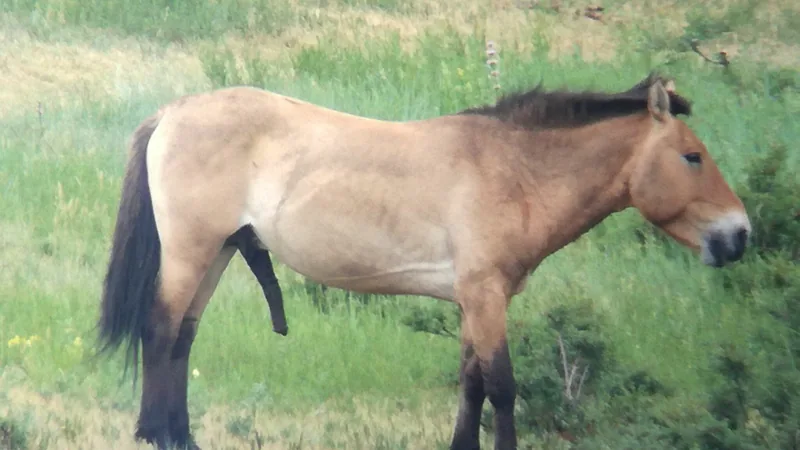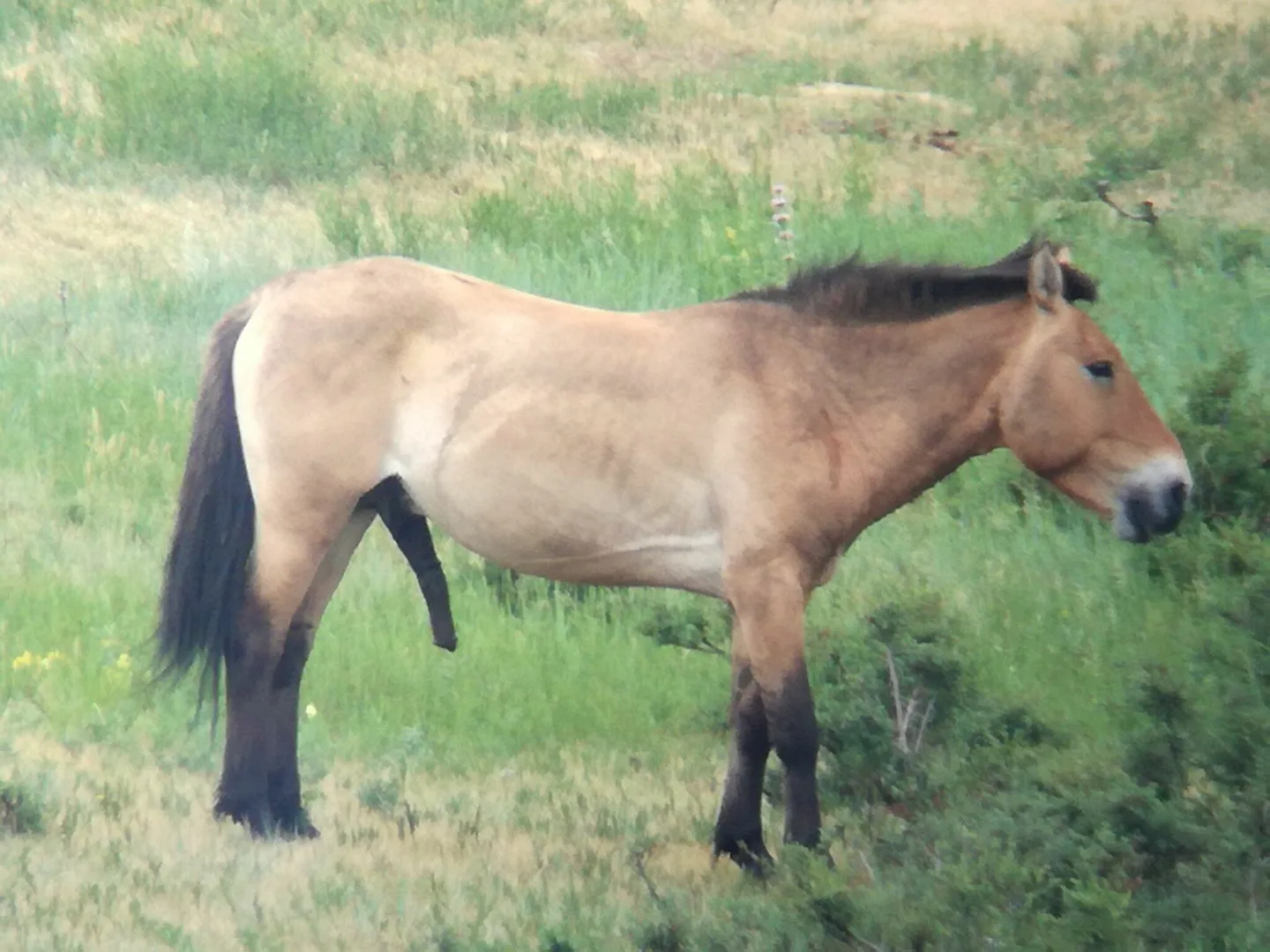
Reintroduced herd, Altanbulag, Töv, Mongolia
Field
notes
Sixty-Six Chromosomes
Przewalski’s horse (Equus ferus przewalskii) has 66 chromosomes, the bundles that carry an animal’s DNA. A domestic horse has 64. Unusually, the two can still cross: the hybrids have 65 chromosomes, are fertile and have young of their own. A hybrid looks like a Przewalski’s horse, and a chromosome test is the only way to tell.
It is a stocky, short, pot-bellied horse with a spiky, zebra-like mane and no forelock, the lock of hair on a domestic horse’s forehead. A dark stripe runs from the mane down the spine. Adults stand 1.3 to 1.5 m tall at the withers (the ridge above the shoulders), run 2.2 to 2.6 m long, and weigh 250 to 360 kg. One may live up to 36 years.
Spirit horse Przewalski’s horses are called “takhi,” which means “spirit” in Mongolia.
Gone From the Wild, Then Put Back
These horses once ranged across Europe and Asia. The last wild sightings came in the 1960s, from Mongolia’s Gobi Desert, which covers about the southern third of the country. Poaching, capture and military activity cut their numbers. Every Przewalski’s horse alive today descends from 14 founders caught in the wild between 1910 and 1960, and by 1945 the world held fewer than 20 that could breed.
Zoos kept the line going. In 1992, 16 horses went back to Mongolia. By 2014 there were nearly 2,000 of them worldwide, and 178 lived in the wild. Wild herds now live only at release sites in Mongolia, China and Kazakhstan.
The IUCN Red List rates Equus ferus, the species it belongs to, as Endangered.
Life on the Steppe
The steppe is a huge, sparse grassland, and Przewalski’s horses graze it on grass and leaves from shrubby trees. If they need water, they dig for it with their sharp hooves. Winter coats grow thick, with long beards and neck hair, and when a gale blows, a horse faces away from the storm and clamps its tail between its hind legs.
A harem rarely holds more than 10 mares and their young, and one dominant stallion leads it. Stallions old enough to challenge him are driven out to small bachelor groups, and a bachelor may cover more than 22 km in a day. Within about half an hour of birth, a foal has to be on its feet and travelling with the herd. Wolves are a foal’s greatest natural enemy.
Published
Traits
Intel
& FAQ
Guess
first
How big is a Przewalski's Horse, really? Slide, lock in, and see what the sources say. Every answer is a figure from this page, quoted from where it came from.
Sources
- 01Przewalski's horse. Smithsonian's National Zoo and Conservation Biology Institute.
- 02Przewalski's Horse. San Diego Zoo Wildlife Alliance.
- 03King et al. (2015). Equus ferus. The IUCN Red List of Threatened Species 2015: e.T41763A97204950.
What the sources say: 44 claims checked word for word against these sources →