Taman Negara NP, Pahang, MALAYSIA
Field
notes
A snout that grips
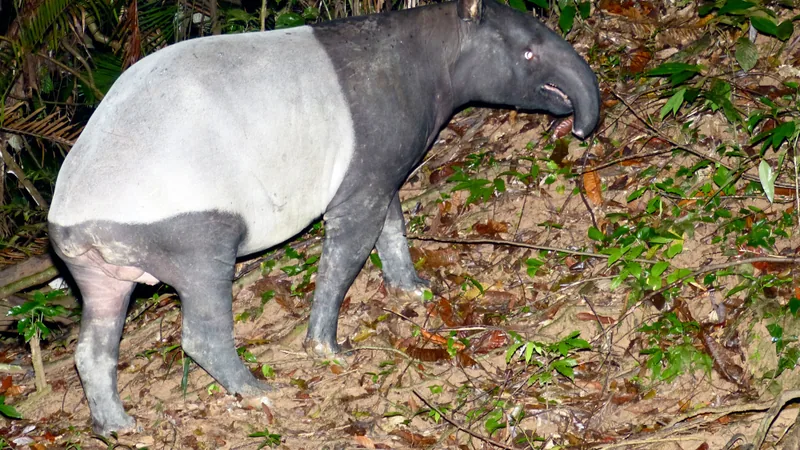
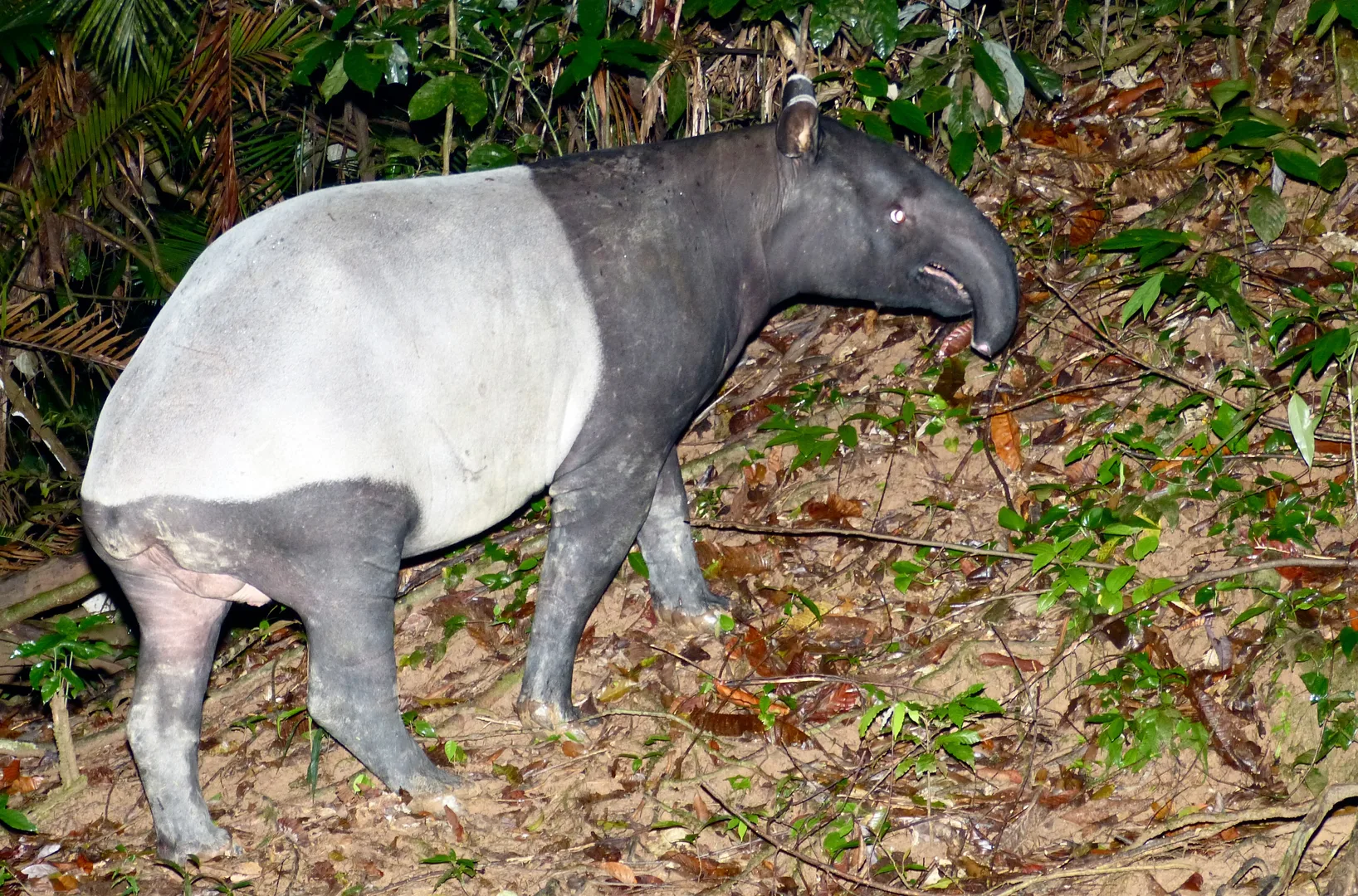
The Malayan tapir is the only tapir from Asia. It has a proboscis, a prehensile snout, meaning one that can grip, formed by an extended nose and upper lip. The proboscis plucks leaves from branches and places them in the tapir’s mouth. A study of the proboscis in tapirs as a group found that its evolution involved retraction and reduction of the bony and cartilaginous facial skeleton, while the soft tissue around the upper lip and nose became a mobile, fleshy proboscis. The authors conclude it is best interpreted as a muscular hydrostat, an organ whose muscle and connective tissue expanded as its bone and cartilage were reduced.
It eats leaves, buds, growing twigs, bark and fruit, and it feeds on more than 122 species of plants. A tapir eats between 4 and 5 percent of its body weight each day, and it travels upwards of 5 km to seek out salt licks.
Hiding in the dark
Adults have a black front half, white sides and black hind legs. That pattern disrupts the body lines and makes an adult harder to recognize as potential prey. In the dark, the white saddle does not suggest the form of the whole animal. Tigers and leopards are the major natural predators, but tapirs are not often preyed upon. Calves lack the adult coat pattern: they are born with whitish stripes and spots.
Thick nape Skin up to 2.5 cm thick covers the back of the head and nape, the back of the neck. It is thought to defend against fanged animals, and a tapir with a predator on its neck will attempt to bash it against a tree.
An attacked tapir will run away and find the nearest source of water to escape the chase.
Size and staying power
An adult Malayan tapir weighs 250 to 540 kg and is 1.8 to 2.5 m long, and females tend to be larger than males by about 25 to 100 kg. A female produces a single offspring every other year on average, although twins have been reported, and calves can swim at three weeks old. One captive tapir lived for 36.5 years.
Twilight swimmers
Malayan tapirs are generally considered solitary and nocturnal, but in undisturbed forests they are crepuscular, meaning active around twilight, rather than completely nocturnal. They seek out marshes and rivers for swimming, and they may walk along the bottom of deep rivers, holding their breath for up to 90 seconds. Their only calls are whistles, clicks and hiccup-like noises, often made in response to fear or pain, as a warning, or during mating.
The IUCN Red List rates the species Endangered. Its 2014 assessment lists the species in Malaysia, Sumatra in Indonesia, Myanmar and Thailand, from sea level up to 2,150 metres, and gives the population trend as decreasing. A camera-trap survey across 19 study areas found that tapir occurrence was significantly and negatively correlated with human disturbance.
Published
Traits
Intel
& FAQ
Guess
first
How big is a Malayan Tapir, really? Slide, lock in, and see what the sources say. Every answer is a figure from this page, quoted from where it came from.
Sources
- 01Gearty. Tapirus indicus (Malayan tapir). Animal Diversity Web, University of Michigan.
- 02Acrocodia indica (Malayan tapir) longevity, ageing, and life history. AnAge: The Animal Ageing and Longevity Database.
- 03Tapir. San Diego Zoo Wildlife Alliance.
- 04Witmer, Sampson & Solounias (1999). The proboscis of tapirs (Mammalia: Perissodactyla): a case study in novel narial anatomy. Journal of Zoology.
- 05Cryptic mammals caught on camera: Assessing the utility of range wide camera trap data for conserving the endangered Asian tapir. Biological Conservation, 2013.
- 06Traeholt et al. (2016). Tapirus indicus. The IUCN Red List of Threatened Species 2016: e.T21472A45173636.
What the sources say: 66 claims checked word for word against these sources →