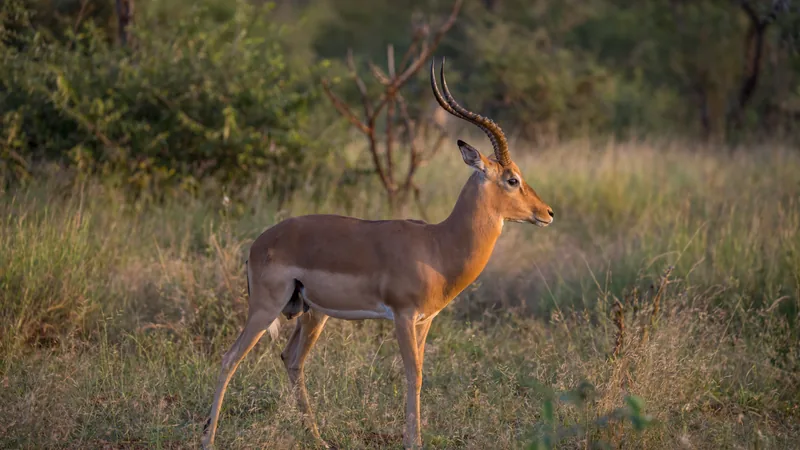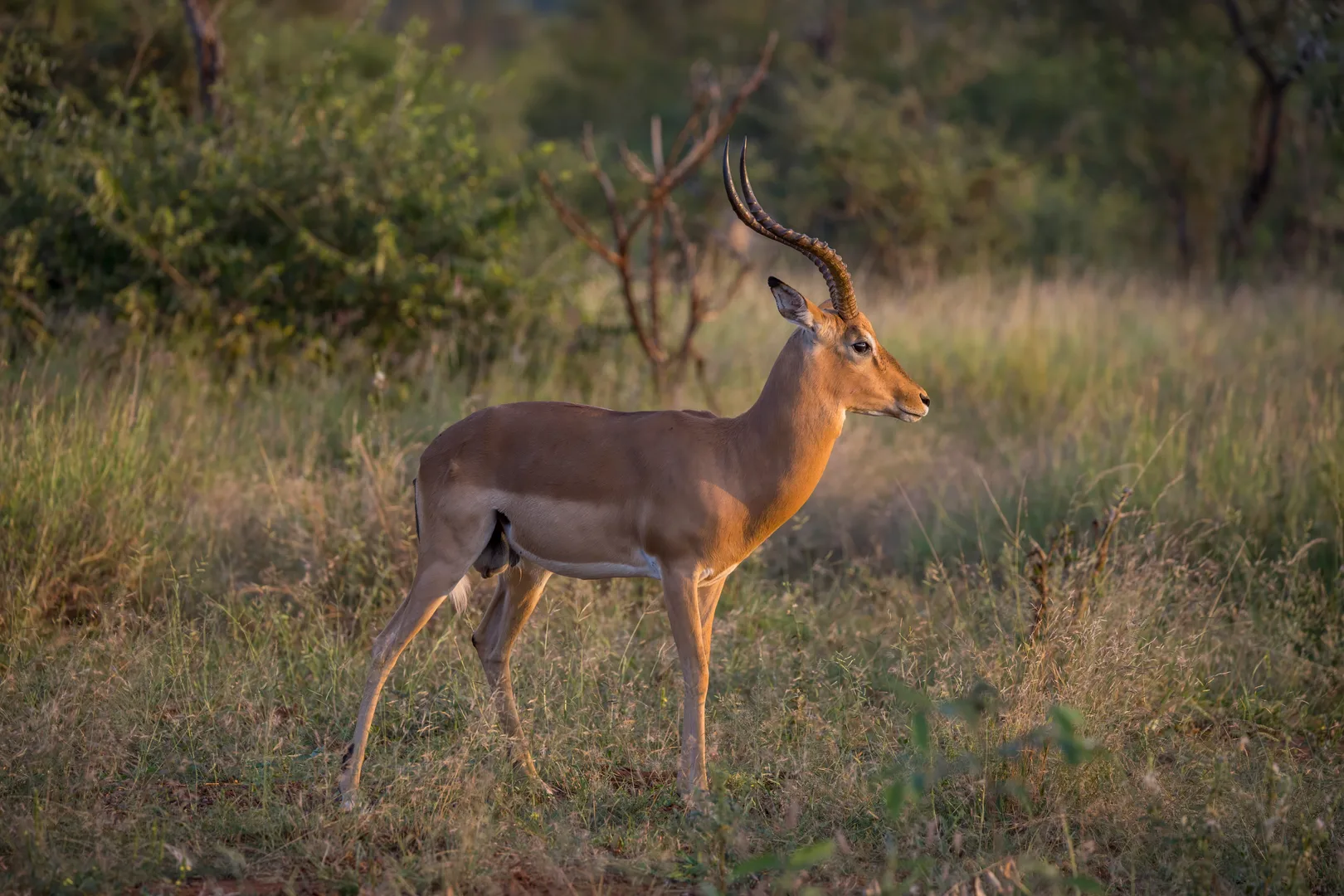
Male, Kruger National Park, South Africa
Field
notes
Built to Launch
The impala’s best-known move is the jump. A leap may run over 9 metres (30 feet) long and 2.5 metres (8 feet) high, and often sails over bushes and even other impala. To confuse a predator, impala often leap up or out in any direction, and a leap can end with the animal landing on its front legs and kicking its back legs into the air. Unlike many plains grazers, it flees into dense vegetation instead of out across open grassland.
It has plenty to flee from. Its main predators are lion, leopard, Cape hunting dog, spotted hyena, crocodile and python. Impala live in woodland with little undergrowth and in low to medium grassland, from northeast South Africa to Angola, Uganda and Kenya.
Size and Shape
An impala has a head-and-body length of 120 to 160 cm and stands 75 to 95 cm at the shoulder. Weight figures differ: Animal Diversity Web gives 45 to 60 kg, Ultimate Ungulate 40 to 80 kg, and the AnAge database an average adult weight of 52.5 kg. The coat is red-brown, paler on the sides, with white on the belly, chin and tail and black stripes down the tail, forehead and thighs.
Only males have horns. They are S-shaped, heavily ridged and 45 to 91.7 cm long. In captivity, one animal lived at least 25.6 years.
Scent on the Feet
Hind-foot scent glands Patches of black hair on an impala’s hind feet cover scent glands, and a study of those glands suggests they probably play a social role, helping herd members keep or regain contact.
The same study found that a male’s forehead glands change with the seasons, with the highest cellular activity during the rut, the breeding season, which fell in April and May. In females, the forehead glands stay modest and show no seasonal change.
Herds, Roars and Rivals
Female herds average 15 to 100 animals, depending on the space available. In the wet season, males split into territory holders and bachelor herds, and about a third of adult males hold a territory of 0.2 to 0.9 square kilometres, marked with urine and dung. Owners defend it with tail-raising, forehead marking, chasing, fighting and roaring.
Gestation lasts 194 to 200 days and there is usually only one calf. Calves join creches, groups of young that play and move together. Impala are ruminants that eat mostly grass after rain and switch to browse in the dry season.
Capture is hard on them. In a study of 26 impala fitted with temperature loggers, capture caused a sharp rise in body temperature, which the researchers put down mainly to stress.
Published
Traits
Intel
& FAQ
Guess
first
How big is a Impala, really? Slide, lock in, and see what the sources say. Every answer is a figure from this page, quoted from where it came from.
Sources
- 01Aepyceros melampus. The IUCN Red List of Threatened Species 2016: e.T550A50180828.
- 02Aepyceros melampus (impala). Animal Diversity Web, University of Michigan.
- 03Aepyceros melampus (Impala). Ultimate Ungulate.
- 04AnAge entry for Aepyceros melampus. AnAge: The Animal Ageing and Longevity Database, Human Ageing Genomic Resources.
- 05Welsch et al. (1998). Cutaneous glands of male and female impalas ( Aepyceros melampus ): seasonal activity changes and secretory mechanisms. Cell and Tissue Research.
- 06Meyer et al. (2008). Hyperthermia in captured impala (Aepyceros melampus): a fright not flight response. Journal of Wildlife Diseases.
What the sources say: 44 claims checked word for word against these sources →