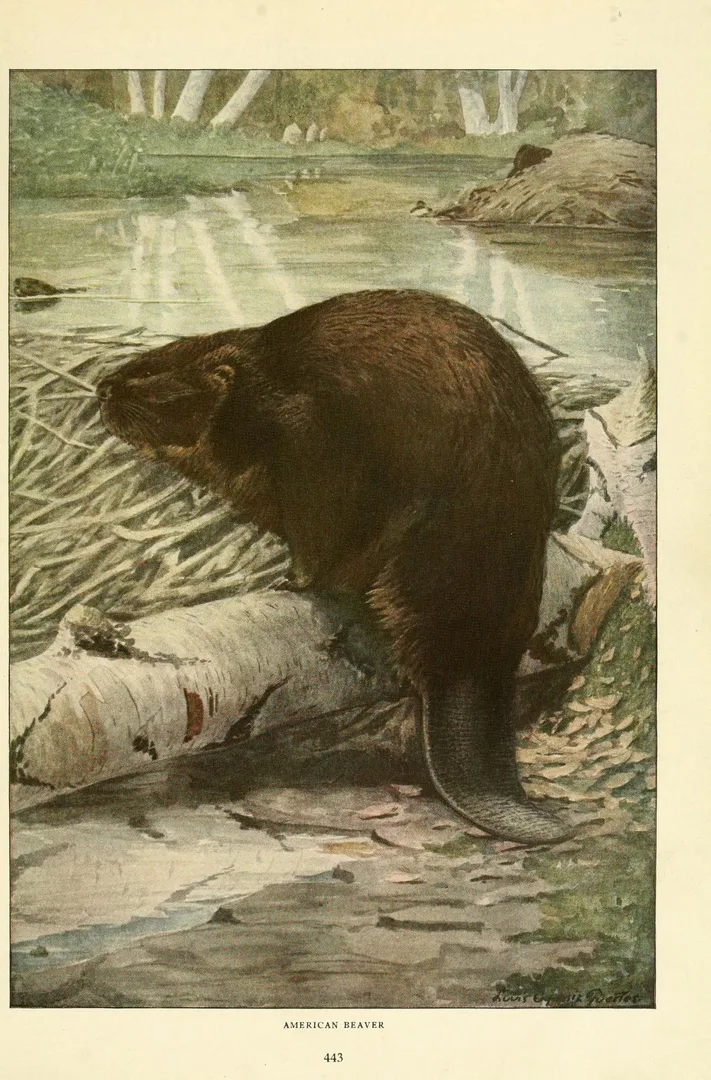
Castor canadensis
Field
notes
The Rodent With Iron in Its Teeth
The North American beaver (Castor canadensis) is the largest rodent in North America and the second largest in the world, behind the capybara. It weighs 35 to 65 pounds (16 to 30 kilograms) and runs 3 to 4 feet (1 to 1.2 meters) long, and the heaviest beaver on record weighed 110 pounds (50 kilograms). Beavers typically live 10 to 12 years; the oldest one on record reached 30 in human care.
A beaver’s incisors keep growing throughout its life, and daily use wears them down. The outer enamel is loaded with iron, which makes the teeth look dark orange and strengthens them, helping stop them cracking or breaking as the beaver gnaws. Beaver teeth are self-sharpening, and a single bite can cut through a sapling as thick as a finger, though incisors that grow too long to let the back molars meet can lead to starvation.
Built for Water
Underwater, a see-through nictitating membrane, a kind of built-in swim goggle, slides over each eye, valves close its ears, and its nostrils close too. It can swim at up to 6 mph (10 km/h) on webbed hind feet, and oversized lungs let it stay submerged for up to 15 minutes while traveling over half a mile.
A Tail With Four Jobs A beaver’s broad, flat, scaly tail steers it through the water, props it up while it works on land, and slaps the water as an alarm that tells nearby beavers to head for deep water. It also stores fat: beavers eat more in the fall so they can live off that fat through winter if food runs out.
A Rodent That Builds Wetlands
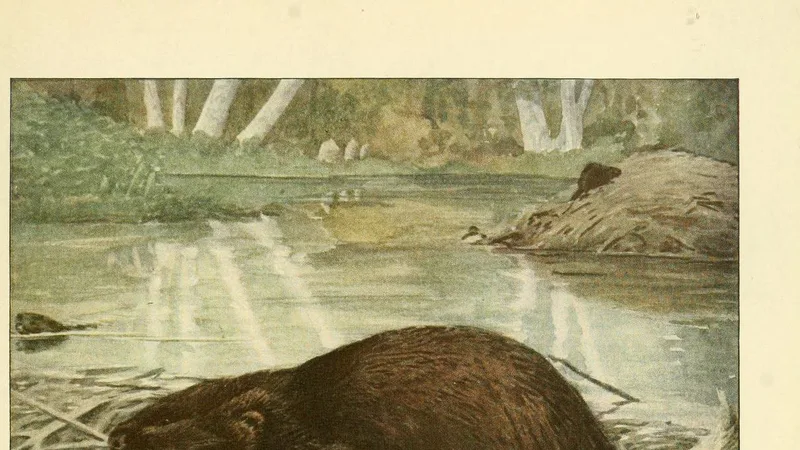
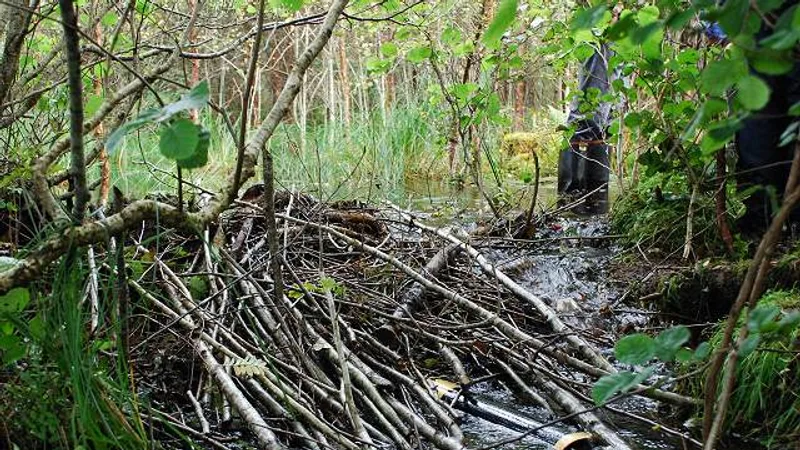
Beavers live in ponds, lakes, rivers, marshes and streams across most of North America. They eat bark and cambium, the soft growing layer just under a tree’s bark, along with leaves, woody stems, roots and aquatic plants. Their favorite trees for both food and building are poplar, aspen, willow, birch and maple. They build watertight dams of sticks woven with reeds, branches and saplings, caulked with mud, which turn streams into slow-moving ponds. Beavers also build dome-like lodges that rise 6.5 feet (2 meters) or more and can reach 39 feet (12 meters) wide. Often built away from the shore, a lodge forms an island that can only be entered from underwater, and walls a third of a meter thick can insulate the chamber inside.
In New York’s Adirondack Mountains, beavers create wetlands that can support herbaceous (non-woody) plants found nowhere else along the river. Counting stretches beavers had changed and stretches they had never occupied, a 2002 study found that beavers raised the number of herbaceous plant species in the riverside zone by more than 33%.
The Fur Trade and the Comeback
Beaver fur was once in constant demand for robes, coats and top hats. Wars, including the French and Indian War, were even fought over access to beaver trapping areas. In the early 1800s, beaver pelts were the single most valuable commodity in most of North America. With trapping totally unregulated well into the 20th century, beavers all but disappeared from most of their original range. Now protected from overexploitation, they have reestablished themselves over most of the continent and have even become an agricultural pest in some regions. The IUCN lists the species as Least Concern.
Published Updated
Traits
Intel
& FAQ
Guess
first
How big is a North American Beaver, really? Slide, lock in, and see what the sources say. Every answer is a figure from this page, quoted from where it came from.
Sources
- 01Beaver. Smithsonian's National Zoo and Conservation Biology Institute.
- 02Castor canadensis (American beaver). Animal Diversity Web, University of Michigan.
- 03Cassola (2016). Castor canadensis. The IUCN Red List of Threatened Species 2016: e.T4003A22187946.
- 04Wright, Jones & Flecker (2002). An ecosystem engineer, the beaver, increases species richness at the landscape scale. Oecologia.
What the sources say: 59 claims checked word for word against these sources →