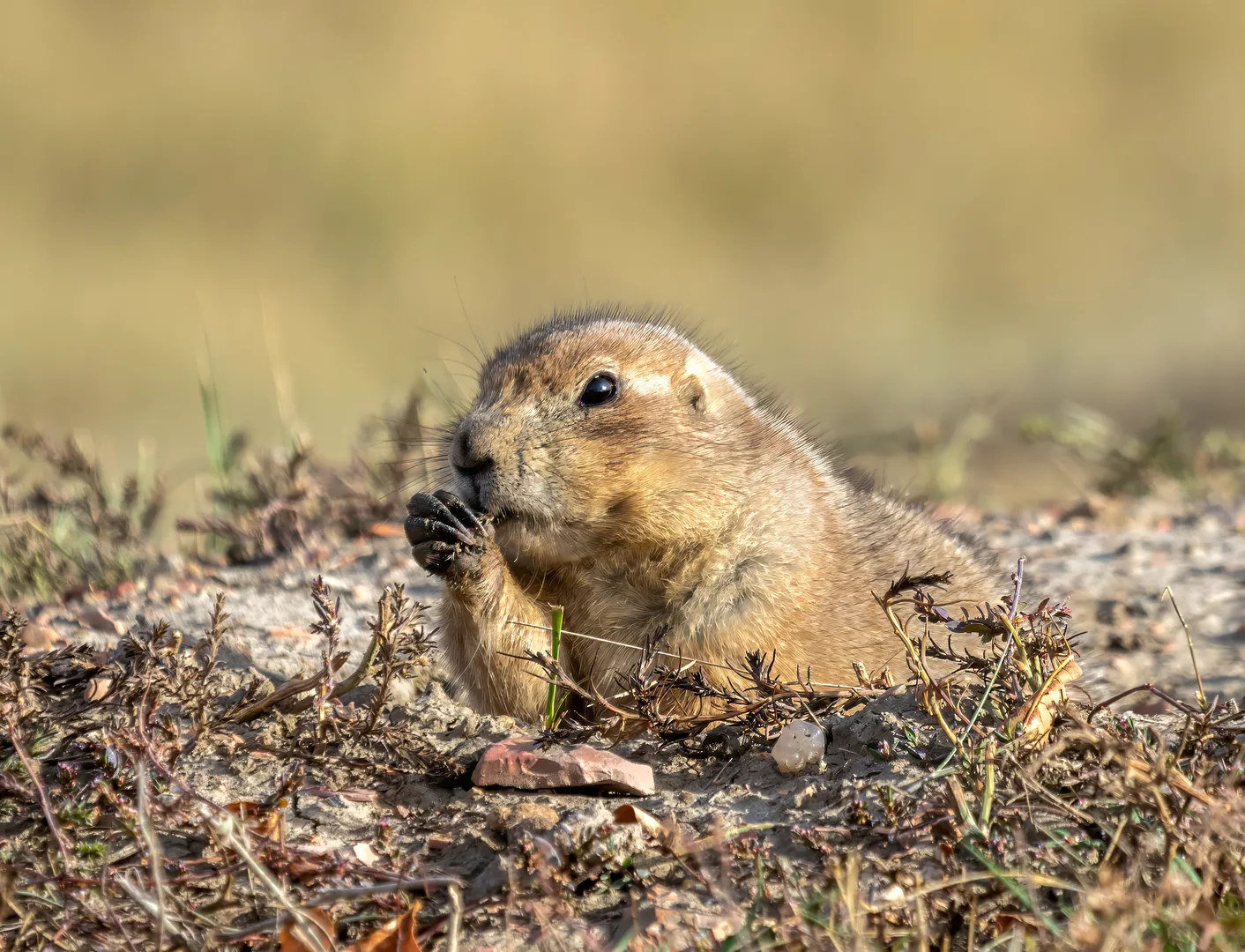
A black-tailed prairie dog at its burrow in Theodore Roosevelt National Park, North Dakota.
Field
notes
The Black-Tailed Prairie Dog (Cynomys ludovicianus) looks like a tan ground squirrel, because that is what it is. The “dog” in its name comes from its alarm bark. It measures 14 to 17 inches (36 to 43 centimeters) long and weighs 2 to 3 pounds, about a kilogram, and males tend to be heavier than females. In the wild, females live up to eight years and males around five. It lives on the Great Plains, from Saskatchewan in Canada south to Sonora and Chihuahua in Mexico, on dry, flat, sparsely vegetated grassland, and prefers fine or medium-textured soils, which work best for burrows.
A Rodent That Builds Underground Towns
And dig they do. They dig burrows close together, forming colonies called towns. Each burrow is usually U-shaped, with chambers connected by tunnels, and can go 2 to 4.5 meters (7 to 15 feet) deep. Near the bottom is a nesting chamber with dry grass bedding. Listening chambers near the entrance let prairie dogs listen for potential predators before heading outside, and multiple entrances give an escape route if a predator gets in. The mound of earth at each entrance helps keep the burrows from flooding. Across the town, they cut down anything growing taller than about 15 centimeters (6 inches), which helps them see predators.
They are active all year and, unlike many other prairie dog species, do not hibernate.
A Warning System With Local Dialects
Prairie dogs make a broad range of calls. Towns are split into family neighborhoods called coteries. One prairie dog acts as a lookout, standing on the mound and watching for predators such as coyotes, badgers and rattlesnakes. If it spots danger, it warns the others with a series of bark-like whistles before retreating into its burrow.
When a predator leaves, a prairie dog may give a “jump-yip”: it stretches to its full height on its hind legs, throws its front feet into the air, and gives a shrill yip. One jump-yip seems to set off others, both in the caller’s own coterie and in neighboring ones.
Prairie dog dialects A 2020 study of eight black-tailed prairie dog colonies in the southwestern United States found no significant difference in alarm-call structure between colonies within 30 kilometers of each other, while colonies farther apart differed significantly. The farther apart two colonies were, the more their calls differed, a pattern the researchers say is similar to human dialects.
A Keystone of the Grasslands
Black-tailed prairie dogs are a keystone species: they play an important role in the grassland ecosystem, and their towns support a number of other species. Biologists count more than 170 vertebrate species affected by prairie dogs. Burrowing owls and prairie rattlesnakes rely on the burrows for shelter, and pronghorn seek out the broadleaf shrubs in the center of towns. Black-footed ferrets rely on prairie dog colonies for food and shelter, and the large-scale killing of black-tailed prairie dogs on rangelands left the ferrets unable to sustain an effective wild population.
At the start of the twentieth century, prairie dogs occupied 100 million acres of the Great Plains. Today that range is under 2 million acres, a loss caused by agriculture and urban growth. Sylvatic plague, an accidentally introduced bacterial disease spread by fleas, can kill over 99 percent of a colony. The IUCN Red List rated the black-tailed prairie dog Least Concern in its 2016 assessment.
Published Updated
Traits
Intel
& FAQ
Sources
- 01Black-tailed prairie dog. Smithsonian's National Zoo and Conservation Biology Institute.
- 02Cynomys ludovicianus (black-tailed prairie dog). Animal Diversity Web, University of Michigan.
- 03Dennis, Shuster & Slobodchikoff (2020). Dialects in the alarm calls of black-tailed prairie dogs (Cynomys ludovicianus): A case of cultural diffusion? Behavioural Processes.
- 04Lee, Carey & LaMont (1981). Aspirin Prevention of Cholesterol Gallstone Formation in Prairie Dogs. Science.
- 05Cassola (2016). Cynomys ludovicianus. The IUCN Red List of Threatened Species 2016: e.T6091A115080297.