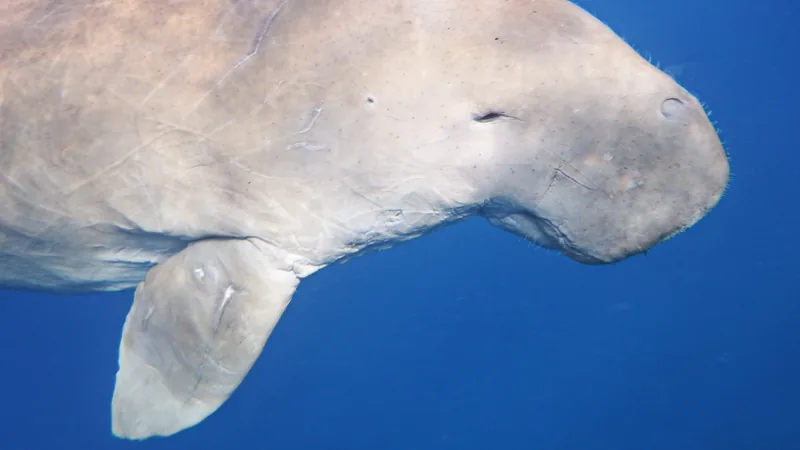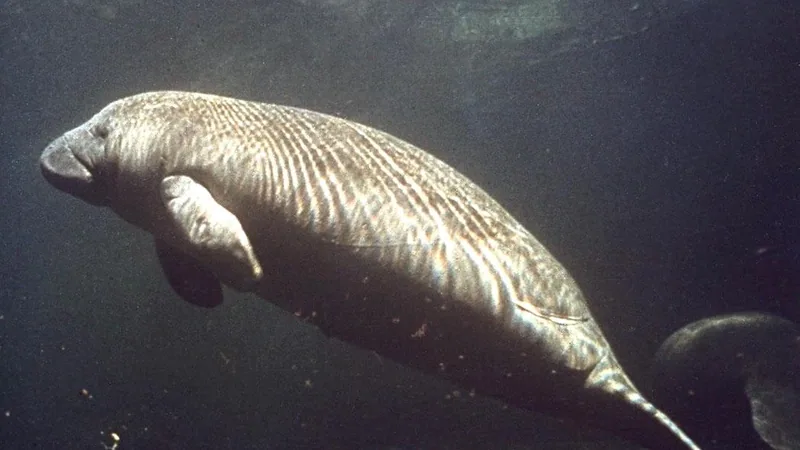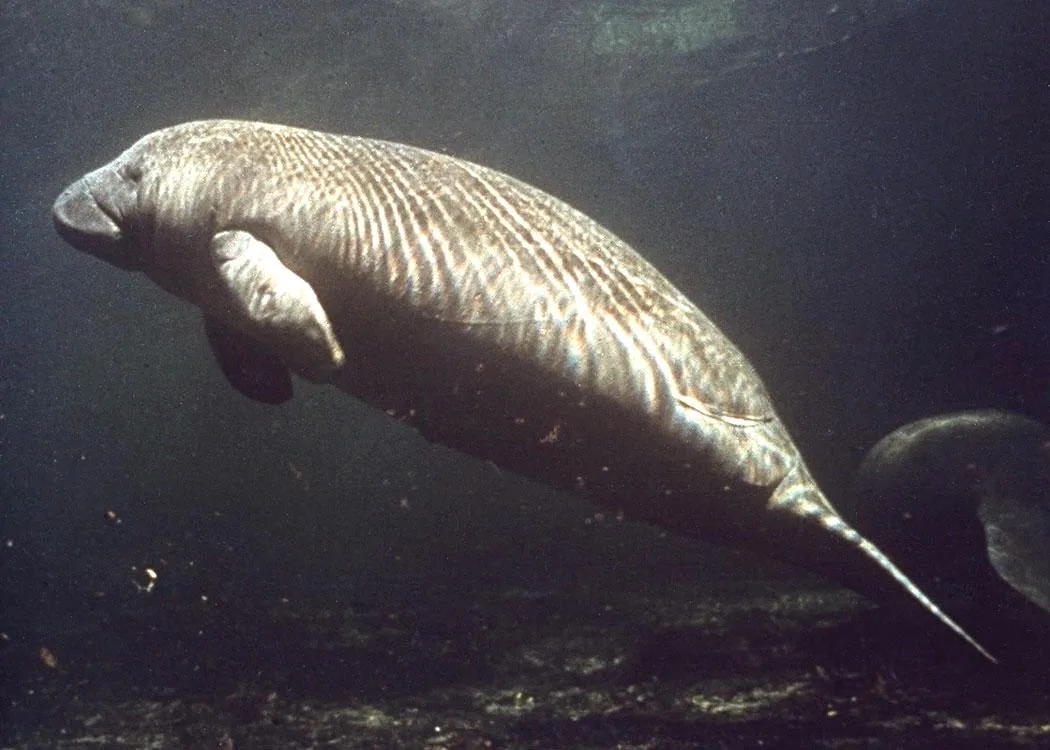
West Indian manatee (Trichechus manatus) at Merritt Island National Wildlife Refuge in Florida.
Field
notes
Deaf to the Low Notes
A manatee’s best hearing sits between roughly 6 and 20 kilohertz. Researchers who tested two adult manatees found that weak hearing at low frequencies may be a contributing factor in why the animals struggle to detect boat noise and avoid collisions. Ninety-six percent of Florida manatees have scars from at least one watercraft collision, and from 1990 through 2021 those collisions were the most prevalent cause of death for Florida manatees, behind 19.1 percent of all documented carcasses.
Big Bodies, Long Childhoods
A full-grown manatee typically runs 9 to 10 feet long and weighs around 1,000 pounds, though some individuals reach more than 13 feet and weigh as much as 3,500 pounds. A newborn calf weighs just 60 to 70 pounds and stays close to its mother for about two years while she teaches it how to migrate and where the warm water sites are. Manatees may live past 65 years in captivity, but life in the wild is rougher: of the wild manatees that reach adulthood, only about half are expected to survive into their early twenties.
Grazing, Then Chasing Warm Water
Manatees usually spend up to eight hours a day grazing on seagrass, mangrove leaves and algae, using an upper lip whose two sides move independently to grab plants and draw them into their mouths, the same trick an elephant, a distant relative, pulls off with the tip of its trunk. They range along the coasts and rivers of the southeastern United States, through the Caribbean and Central America, down to Brazil’s northeastern Atlantic coast, with a range-wide population estimate of at least 13,000. Temperature is what can undo all that space: Florida manatees, especially young ones, are vulnerable to death from cold stress once the water falls below about 18 to 20°C for long stretches, or drops to 10 to 12°C for even a few days. To survive those spells, almost all of Florida’s manatees stay near warm springs and power-plant outflows.
A Body Built Like a Submarine
A manatee’s ribs are solid bone with no marrow (its red blood cells form in its sternum instead), and its lungs run a meter or more along its backbone instead of around its ribcage. That unusually dense skeleton may contribute to a manatee’s neutral buoyancy: a body whose density equals the water it swims in. Manatees also wear down their molars on plants that often carry sand, so new teeth grow in at the back of the jaw and shuffle forward about a centimeter a month to replace the ones that fall out the front.
A manatee swaps out 90 percent of the air in its lungs with each breath. Humans manage about 10 percent, and a manatee can hold its breath for as long as 20 minutes.
Published Updated
Traits
Intel
& FAQ
Guess
first
How big is a West Indian Manatee, really? Slide, lock in, and see what the sources say. Every answer is a figure from this page, quoted from where it came from.
Sources
- 01West Indian Manatee (Trichechus manatus). U.S. Fish and Wildlife Service, Species Profile.
- 02Florida Manatee Facts and Information. Florida Fish and Wildlife Conservation Commission.
- 03Manatee. San Diego Zoo Wildlife Alliance.
- 04Trichechus manatus (West Indian Manatee). The Online Guide to the Animals of Trinidad and Tobago, The University of the West Indies, St. Augustine.
- 05Deutsch & Morales-Vela (2024). Trichechus manatus. The IUCN Red List of Threatened Species 2024: e.T22103A43792740.
- 06Laist, Taylor & Reynolds (2013). Winter Habitat Preferences for Florida Manatees and Vulnerability to Cold. PLoS ONE.
- 07Gerstein et al. (1999). The underwater audiogram of the West Indian manatee (Trichechus manatus). The Journal of the Acoustical Society of America.
- 08Gaspard et al. (2013). Detection of hydrodynamic stimuli by the Florida manatee (Trichechus manatus latirostris). Journal of Comparative Physiology A.
- 09Endangered and Threatened Wildlife and Plants; Threatened Status for the Florida Manatee and Endangered Status for the Antillean Manatee. Federal Register, U.S. Fish and Wildlife Service, 2025.
What the sources say: 49 claims checked word for word against these sources →