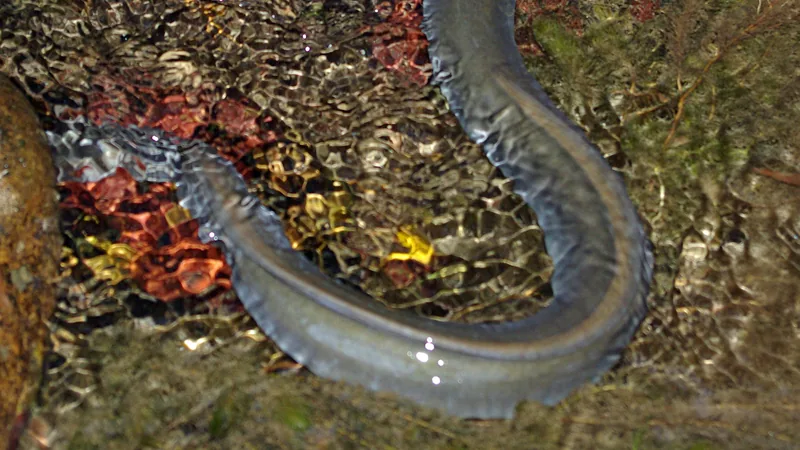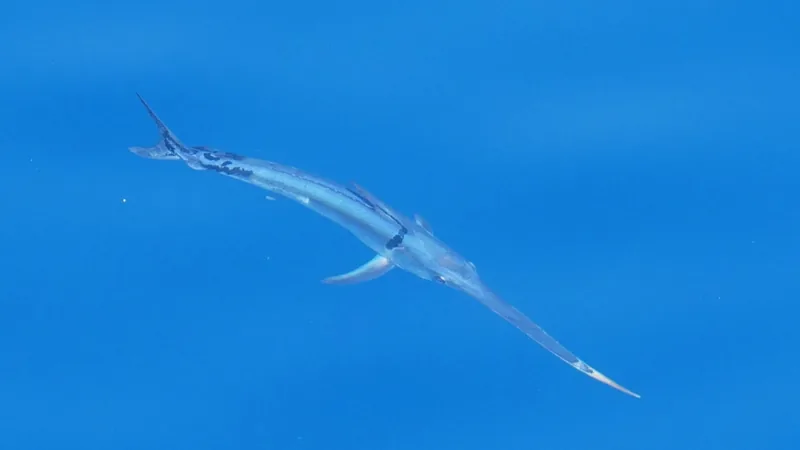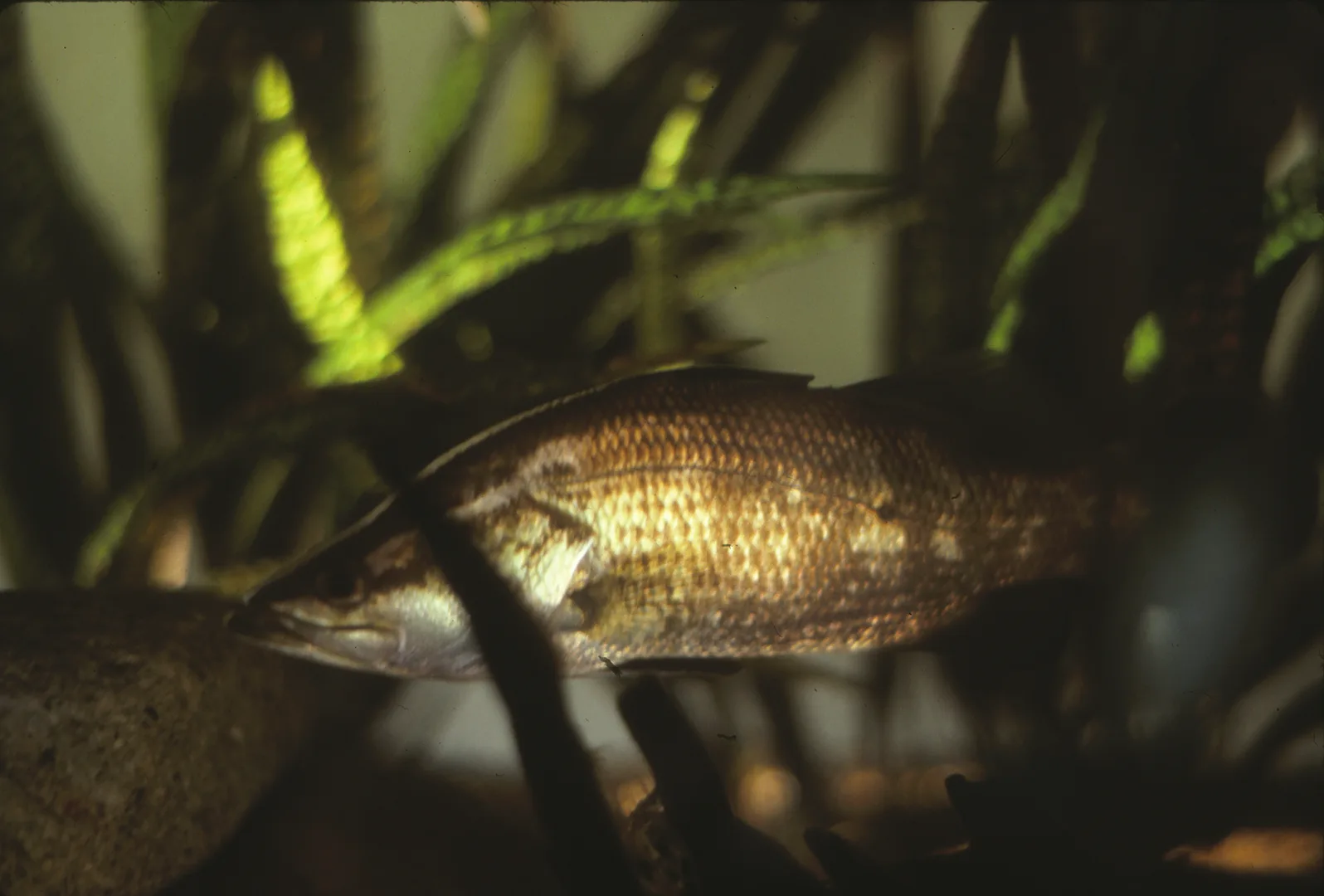
Jourama Falls National Park, Queensland, Australia
Field
notes
Male first, female later
Most barramundi mature as males. They spawn as males for one or more seasons, then go through “sex inversion” and become female. Fish that work this way are called protandrous hermaphrodites.
One study dissected 5,202 mature fish. The small ones were almost all male, and the share of females rose with length. Males bunched around 89.5 cm, females around 101.5 cm. Changing sex requires a complete rebuild of the gonad, the organ that makes eggs or sperm, in both structure and function. Few fish were caught mid-change, which the researchers put down to a rapid transition and to not sampling when changes are most likely. Some males may never switch.
Sex ratio Overall, males outnumbered females 3.8 to 1 in that study.
Big body, big mouth
The longest barramundi reach 200 cm, though 150 cm is more common, and the heaviest published weight is 60 kg. The oldest age reported is 35 years.
The body is long and slim, with a large mouth whose upper jaw reaches behind the eye. Larger fish get around 80% of their diet from bony fish. They swallow prey whole, sucking it into that big mouth. Moderate cannibalism is fairly common. Reflective eyes help them see better in the dark.
Rivers, estuaries and back
Their range spans the Indo-West Pacific, from the eastern Persian Gulf to southern Japan and south to northern Australia. They are demersal, living near the bottom, with a depth range of 10 to 40 m.
Spawning crowds gather in or around river mouths. Maturing males leave fresh water at the start of the wet (monsoon) season and head downstream to spawn with females already living in the estuaries. They spawn at full and new moon, mostly as a rising tide begins, and the incoming water carries the eggs into the estuary. Estimates of a female’s output run as high as 2.3 million eggs per kg of body weight. Adults and juveniles can live in fresh water, but the embryos need brackish water to develop.
Heat and hunters
Juvenile barramundi have an upper lethal limit of 40 to 41 degrees C, yet in a lab study, given a choice, they settled at a median of 31.7 degrees C.
Young barramundi are brown with three white stripes on the head, and they can dim or hide those markings at will. Both young and adult barramundi fall prey to Australian pelicans and file snakes.
Published
Traits
Intel
& FAQ
Guess
first
How big is a Barramundi, really? Slide, lock in, and see what the sources say. Every answer is a figure from this page, quoted from where it came from.
Sources
- 01Lates calcarifer (Bloch, 1790): Barramundi. FishBase.
- 02Lates calcarifer (Asian seabass). Animal Diversity Web, University of Michigan.
- 03Moore (1979). Natural Sex Inversion in the Giant Perch ( Lates calcarifer ). Australian Journal of Marine and Freshwater Research.
- 04Norin, Malte & Clark (2013). Aerobic scope does not predict the performance of a tropical eurythermal fish at elevated temperatures. Journal of Experimental Biology.
- 05Pal & Morgan (2019). Lates calcarifer. The IUCN Red List of Threatened Species 2019: e.T166627A1139469.
What the sources say: 46 claims checked word for word against these sources →