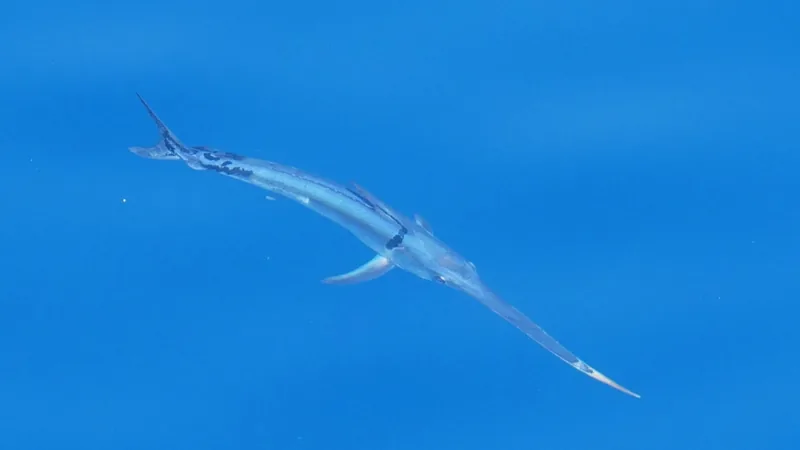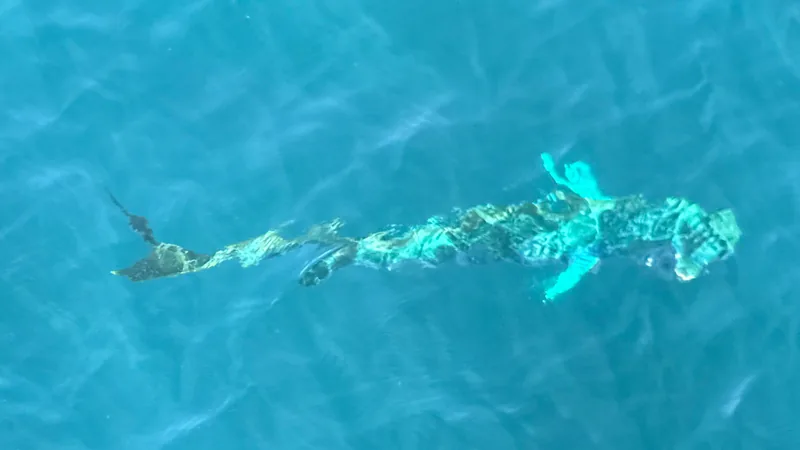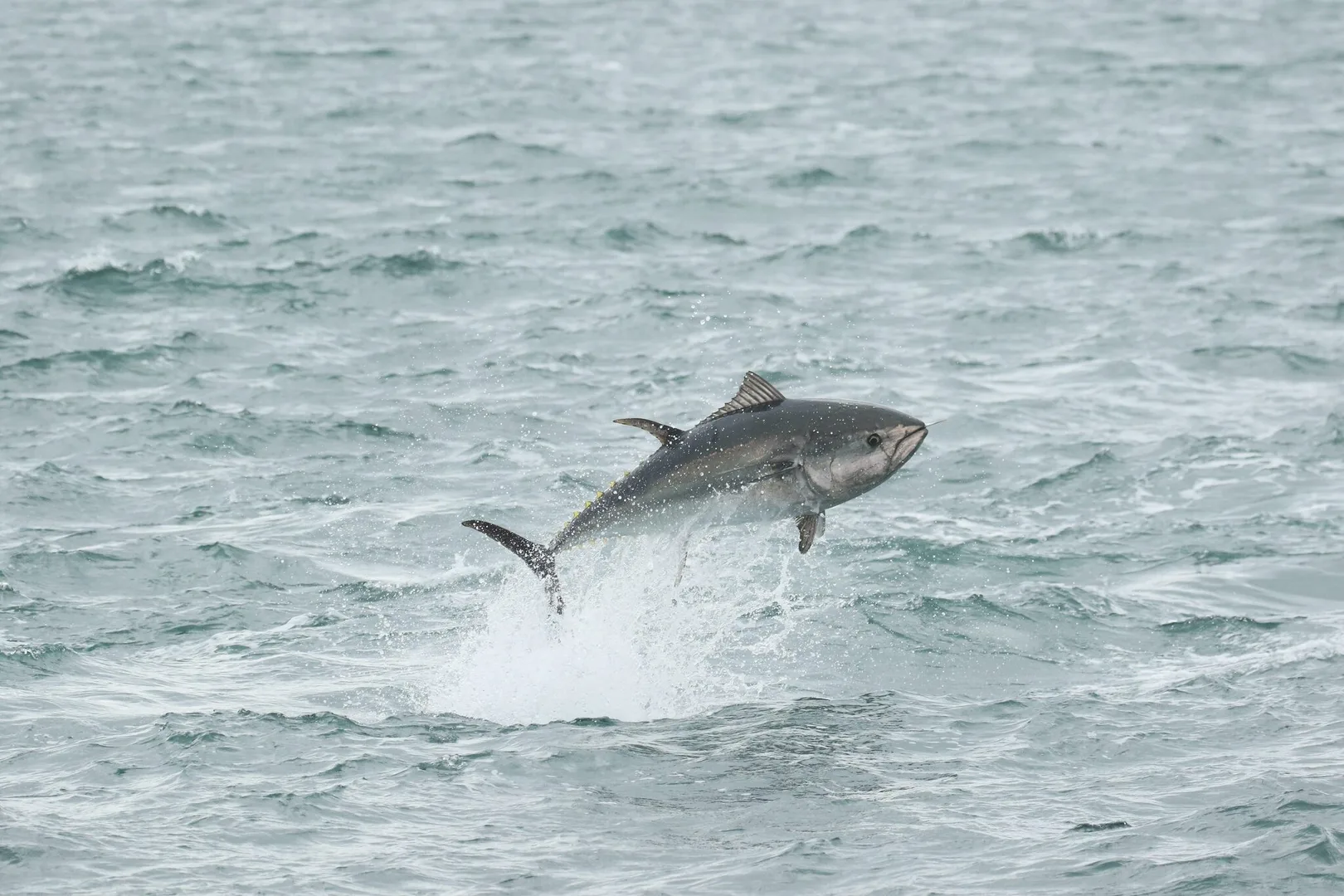
A wild bluefin breaching while feeding in the English Channel off south Devon, England.
Field
notes
A Fish That Runs Hot
The Atlantic bluefin tuna (Thunnus thynnus) is endothermic, conserving heat made by its own metabolism to hold its body or tissues above the temperature of its surroundings. Bluefin tunas are renowned for keeping their swimming muscle, gut, brain and eyes at elevated temperatures.
NOAA’s page on the western Atlantic stock says these fish live near the surface in temperate waters but often dive 500 to 1,000 meters, and can migrate thousands of miles across an entire ocean. Electronic tags on Atlantic bluefin recorded dives to depths of more than 1,000 meters, and the fish maintained a warm body temperature.
Ocean crosser Tagging studies show that a bluefin can cross the Atlantic in less than 60 days.
The Biggest Tuna
It is the largest of the tuna species. It has a torpedo-shaped body, dark blue-black on the back and white on the lower sides, where colorless lines alternate with rows of colorless spots. Its second back fin is reddish brown. Compared with other tunas, its head is long and somewhat pointed, and its eye is small. NOAA reports it can reach up to 13 feet and 2,000 pounds. The Florida Museum says bluefin commonly reach 200 cm, which is 78 inches.
In the western Atlantic stock, NOAA says, bluefin grow more slowly than other tuna and can live 20 years or more.
Predator and Prey
Bluefin show strong schooling behavior while they are young. In the western Atlantic, NOAA says, juveniles eat fish, squid and crustaceans, and adults feed mainly on baitfish such as herring, bluefish and mackerel. Sharks, large fish and marine mammals, including killer whales and pilot whales, feed on bluefin in turn.
Where It Roams and Spawns
Atlantic bluefin range from Labrador to northern Brazil on the western side of the ocean, and from Norway to the Canary Islands on the eastern side. The Mediterranean Sea is a home too: tagging indicates that part of the population stays there for much of the year.
Fish from the eastern stock spawn in the Mediterranean. Western fish spawn mainly in the Gulf of Mexico, from mid-April to June. Larval surveys found a spawning ground in the Slope Sea, between the Gulf Stream and the northeast United States continental shelf.
Published
Traits
Intel
& FAQ
Guess
first
How big is a Atlantic Bluefin Tuna, really? Slide, lock in, and see what the sources say. Every answer is a figure from this page, quoted from where it came from.
Sources
- 01Thunnus thynnus (Atlantic bluefin tuna). Animal Diversity Web, University of Michigan.
- 02Western Atlantic Bluefin Tuna. NOAA Fisheries.
- 03Bluefin Tuna (Thunnus thynnus). Florida Museum of Natural History, Discover Fishes.
- 04Block et al. (2001). Migratory Movements, Depth Preferences, and Thermal Biology of Atlantic Bluefin Tuna. Science.
- 05Ciezarek et al. (2018). Phylotranscriptomic Insights into the Diversification of Endothermic Thunnus Tunas. Molecular Biology and Evolution.
- 06Richardson et al. (2016). Discovery of a spawning ground reveals diverse migration strategies in Atlantic bluefin tuna (Thunnus thynnus). Proceedings of the National Academy of Sciences.
- 07Cermeño et al. (2015). Electronic Tagging of Atlantic Bluefin Tuna (Thunnus thynnus, L.) Reveals Habitat Use and Behaviors in the Mediterranean Sea. PLOS ONE.
- 08Collette et al. (2021). Thunnus thynnus. The IUCN Red List of Threatened Species 2021: e.T21860A46913402.
What the sources say: 45 claims checked word for word against these sources →