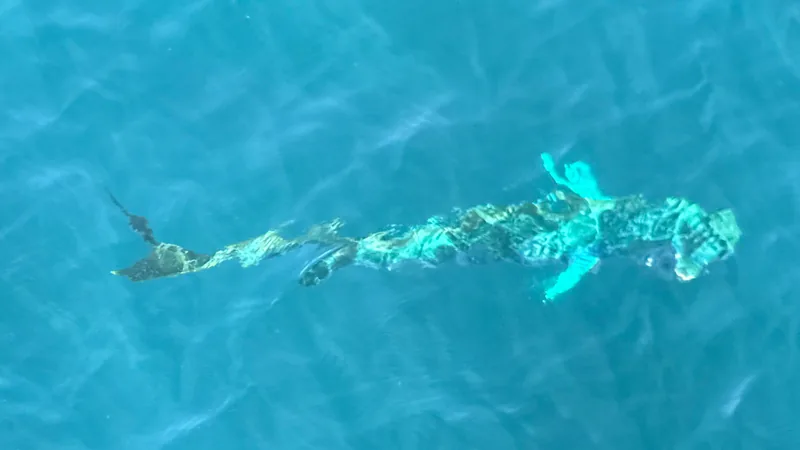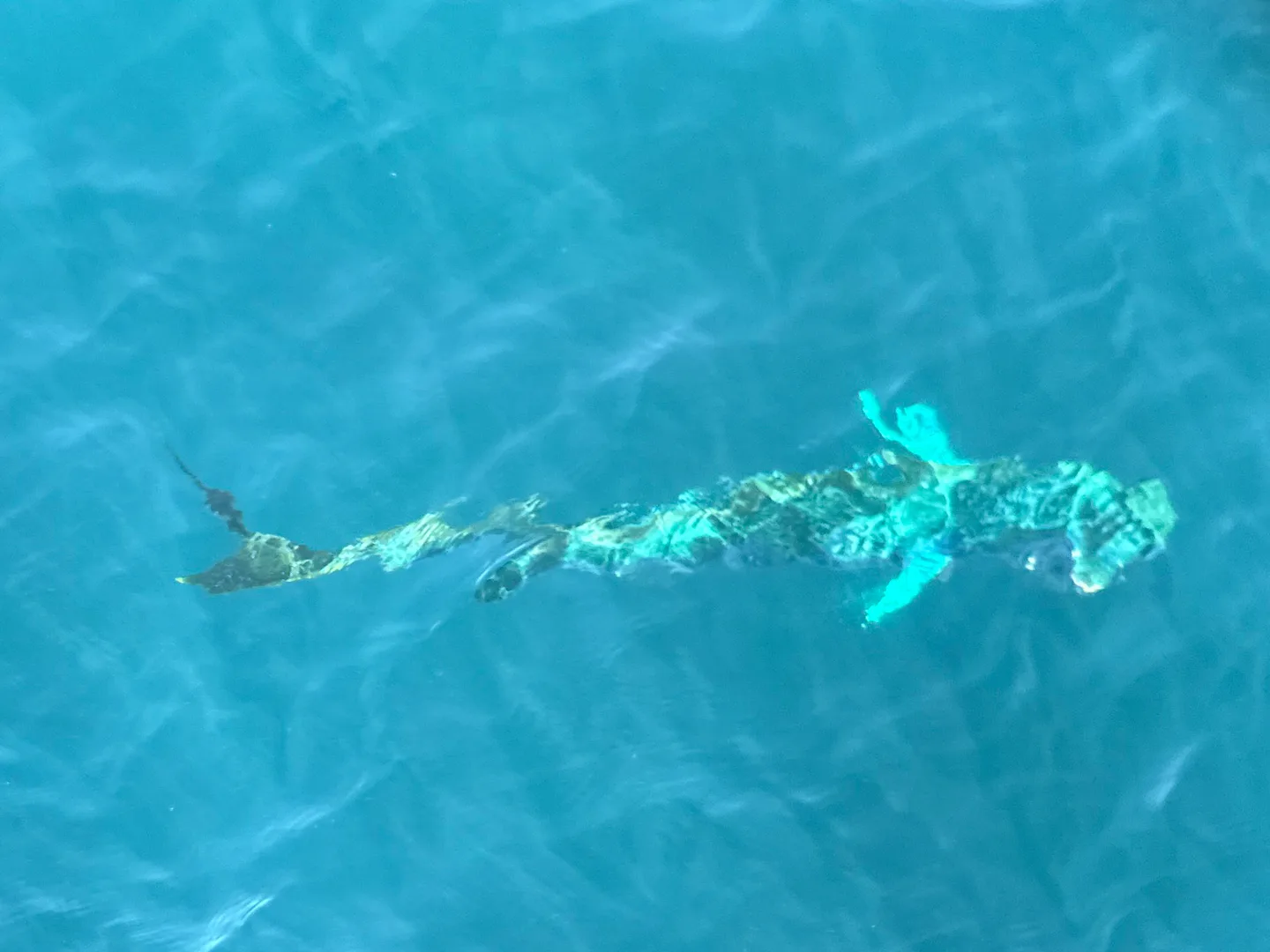
A wild dolphinfish swimming at the surface off Mexico.
Field
notes
Four feet in a year
NOAA Fisheries calls it one of the fastest-growing fish in the ocean, capable of passing 4 feet in its first year and 6 feet within four. The Coryphaena hippurus sprint ends early, though: NOAA Fisheries says they live up to 5 years.
A typical adult is about 3 feet (1 m) long and weighs 30 pounds (14 kg). The big ones are another story. The Florida Museum puts the world record at 87 pounds (39.5 kg), and FishBase lists a maximum length of 210 cm.
Gold, blue and fading fast
Underwater it is a lightning show: golden sides, with irregular patches of metallic blue and green on the back. The colour does not last once the fish is caught. The Florida Museum notes that a fresh-caught fish changes colour quickly, fading to uniform silver.
Mature males also grow a prominent bony ridge at the front of the head. Despite the nickname dolphin, the fish is not related to the marine mammals.
Hunting the weed line
Mahi-mahi live near the surface, at depths of 0 to 85 m. Floating mats of Sargassum weed (a drifting brown seaweed) and other floating objects draw them in. They feed mainly during the day and rely on vision to find prey.
Fast food for a fast fish Adults eat mostly bony fish, and flying fish make up approximately 25% of their food by weight.
The Florida Museum describes dolphinfish as swift-moving, agile predators that often hunt in pairs or small packs. Small ones travel in schools of a few fish to over 50, while the larger adults travel alone or in pairs. Life in the open ocean has its own danger: marlin, tuna and sailfish are among their predators, and the Florida Museum says dolphinfish are commonly seen with holes pierced through them by marlin bills.
Everywhere warm
The species lives in tropical and subtropical waters across the Atlantic, Indian and Pacific Oceans, and FishBase gives a range from 50°N to 40°S. NOAA says Atlantic mahi mahi can reproduce at 4 to 5 months old, and are believed to spawn every 2 to 3 days in the spawning season, releasing 33,000 to 66,000 eggs each time.
The IUCN Red List rates the species Least Concern. NOAA says mahi mahi are highly sought for sport fishing and commercial purposes.
Published
Traits
Intel
& FAQ
Guess
first
How big is a Mahi-Mahi, really? Slide, lock in, and see what the sources say. Every answer is a figure from this page, quoted from where it came from.
Sources
- 01Collette et al. (2011). Coryphaena hippurus. The IUCN Red List of Threatened Species 2011: e.T154712A4614989.
- 02Dolphinfish (Coryphaena hippurus). Florida Museum of Natural History, Discover Fishes.
- 03Pacific Mahimahi. NOAA Fisheries.
- 04Atlantic Mahi Mahi. NOAA Fisheries.
- 05Coryphaena hippurus, Common dolphinfish. FishBase.
What the sources say: 48 claims checked word for word against these sources →