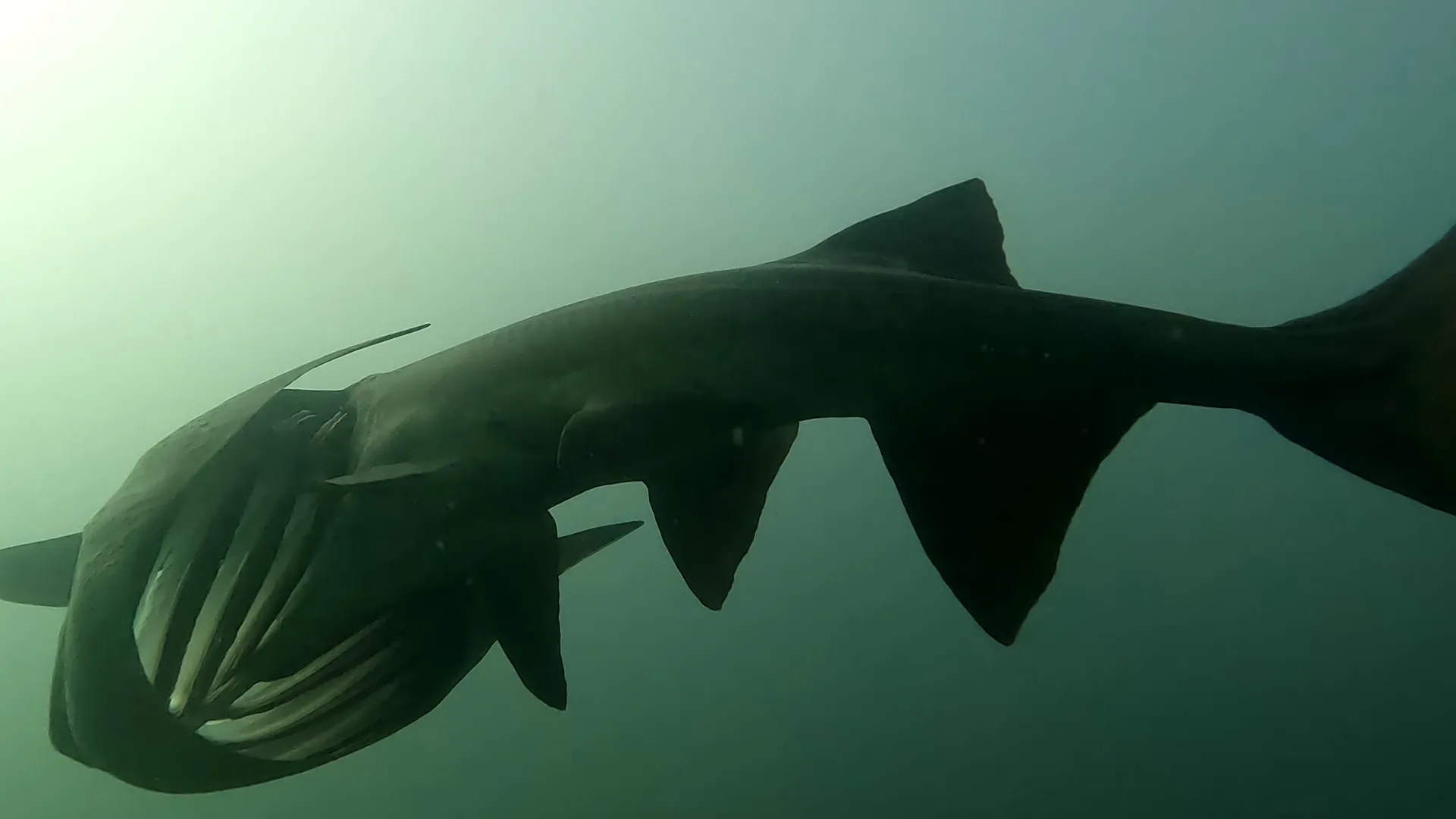
Seen from below, with the comb-like gill rakers that strain plankton from the water.
Field
notes
A Paddle Built Like an Antenna
The American paddlefish can grow up to seven feet long and weigh almost 200 pounds, with a flattened snout, or rostrum, that reaches up to a third of its total body length. The paddle is used as an electrosensory antenna, covered in ampullary organs, the sense organs that pick up weak electric fields in the water. An adult carries between 50,000 and 70,000 of them, the largest number of any living vertebrate species. They are confined to the head, and most numerous on the paddle and the flap that covers the gills.
Teeth are present and working in young paddlefish, and completely absent in adults, which filter-feed instead. The fish swims slowly with its mouth wide open, collecting tiny crustaceans and insects in closely set gill rakers, the toothbrush-like bristles in its gills.
Hunting by Electric Signal
Paddlefish generally live in large rivers with deep, slow-moving, muddy water, and they feed with passive electroreceptors on the paddle: the organs detect the electrical signals given off by planktonic prey instead of producing a current of their own.
Static widens the search Swarms of Daphnia, the tiny water fleas paddlefish eat, are a natural source of electrical noise, and adding a noise field of the right strength to the water broadens the range over which paddlefish detect plankton.
The Last of an Ancient Line
Its family, the Polyodontidae, goes back to the Early Cretaceous, 120 to 125 million years ago. The family was down to two living members. The other was the Chinese paddlefish of the Yangtze River, one of the largest freshwater fish species at up to seven meters long. A basin-wide capture survey in 2017 and 2018 found 332 fish species but not a single Chinese paddlefish, and researchers estimate it was extinct by 2005, and no later than 2010. The American paddlefish is the only member of its family left.
It ranges across the Mississippi River basin, from southwestern New York to central Montana and south to Louisiana, plus Gulf Slope drainages from Mobile Bay, Alabama, to Galveston Bay, Texas. Missouri’s conservation department says paddlefish can live to be 30 years old or more, and the U.S. Fish and Wildlife Service notes reports of some specimens living 50 years or longer. Paddlefish were once very abundant and have declined in numbers. Threats include dams that stop them moving upstream to spawning grounds and illegal harvest of adults for caviar, and in regions with large infestations of invasive zebra mussels those mussels filter out plankton that would otherwise feed paddlefish. The IUCN lists the species as Vulnerable.
Published Updated
Traits
Intel
& FAQ
Guess
first
How big is a American Paddlefish, really? Slide, lock in, and see what the sources say. Every answer is a figure from this page, quoted from where it came from.
Sources
- 01Moore & Rider (2022). Polyodon spathula. The IUCN Red List of Threatened Species 2022: e.T17938A81763841.
- 02AnAge entry for Polyodon spathula. AnAge: The Animal Ageing and Longevity Database, Build 15, 2023.
- 03Paddlefish (Polyodon spathula). U.S. Fish and Wildlife Service.
- 04Paddlefish. Missouri Department of Conservation, Field Guide.
- 05Polyodon spathula (American paddlefish). Animal Diversity Web, University of Michigan.
- 06Paddlefish. Oklahoma Department of Wildlife Conservation, Field Guide.
- 07Russell, Wilkens & Moss (1999). Use of behavioural stochastic resonance by paddle fish for feeding. Nature.
- 08Modrell et al. (2011). Electrosensory ampullary organs are derived from lateral line placodes in bony fishes. Nature Communications.
- 09Smith et al. (2015). Making teeth to order: conserved genes reveal an ancient molecular pattern in paddlefish (Actinopterygii). Proceedings of the Royal Society B: Biological Sciences.
- 10Zhang et al. (2020). Extinction of one of the world's largest freshwater fishes: Lessons for conserving the endangered Yangtze fauna. Science of The Total Environment.
What the sources say: 47 claims checked word for word against these sources →