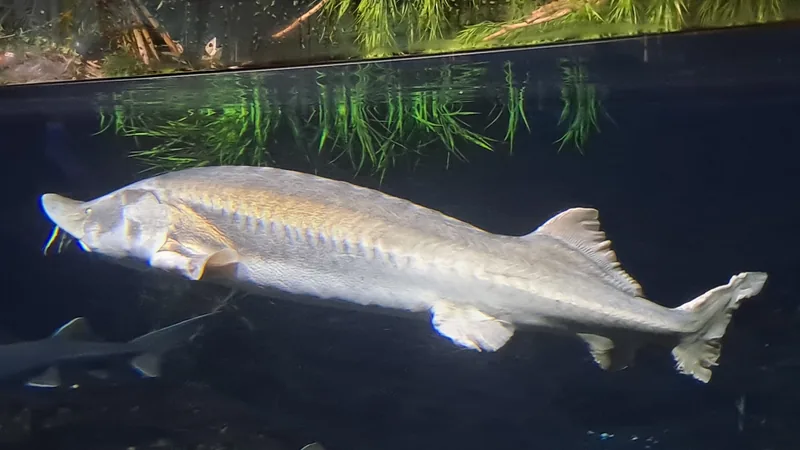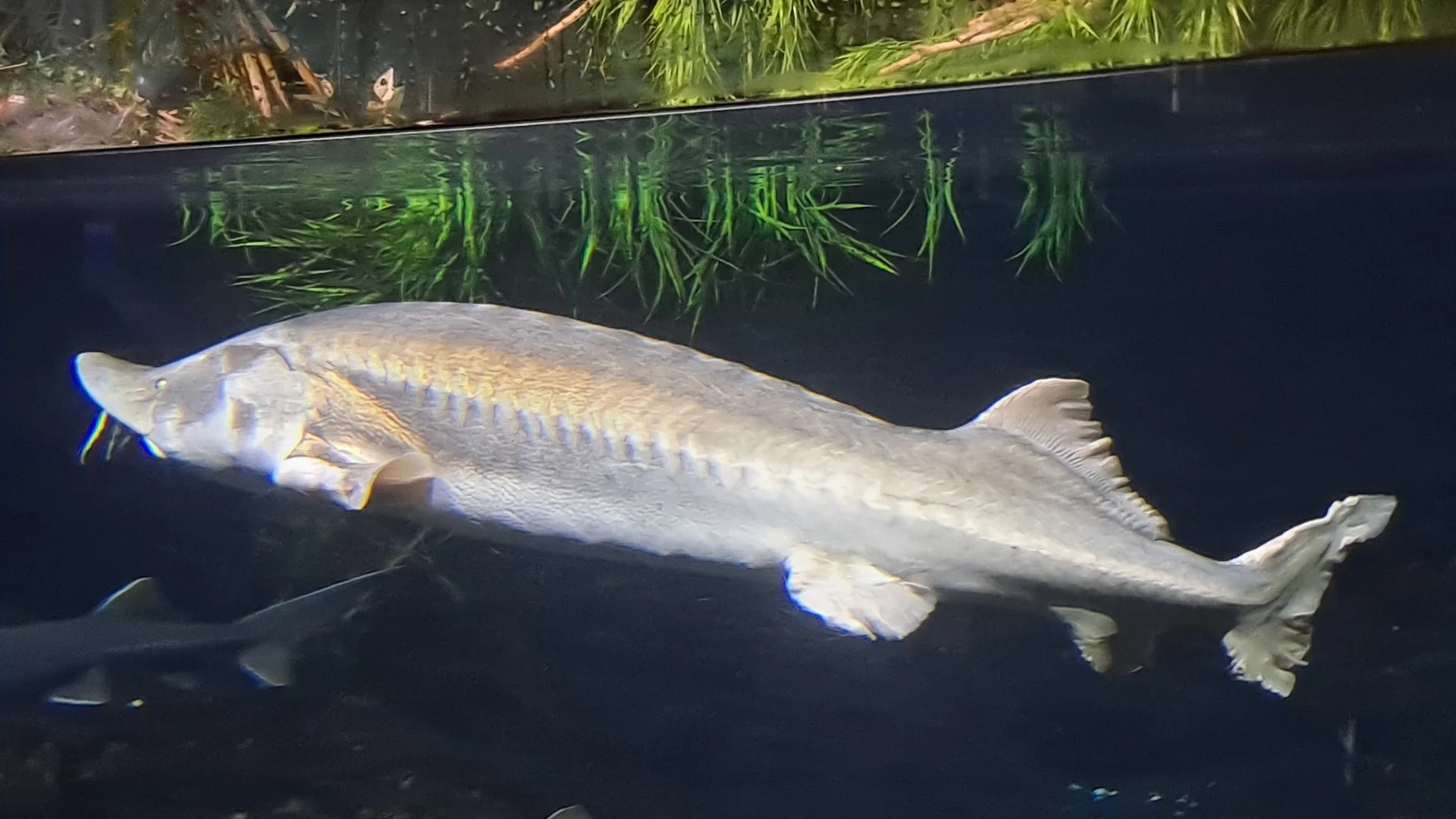
A beluga sturgeon in an aquarium, Barcelona.
Field
notes
The sturgeon that hunts like a predator
Most sturgeons swim along the bottom, feeding on invertebrates that live there. The beluga sturgeon (Huso huso) does not. Animal Diversity Web says adults are mainly piscivores, which means fish-eaters, swimming at middle depths and preying mostly on pelagic fish, the ones that live in open water. In the Black Sea its prey includes flounder and other flatfish, gobies and anchovies. FishBase adds that it also eats crustaceans and mollusks.
Old design Sturgeons and their relatives have a fossil record dating back to the Lower Jurassic, about 200 million years ago, and an inner skeleton of cartilage, a trait they share with sharks and rays.
Built on a huge scale
FishBase lists a maximum length of 800 cm and a maximum published weight of 3.2 tonnes. It calls the beluga the largest sturgeon and the largest European freshwater fish, with a common length of 215 cm. In 2003 Animal Diversity Web said belugas of 4 to 6 meters, a fifth of all catches in the 14th century, were extremely rare. Female spawners in the Volga River from 1987 to 1997 measured 199 to 236 cm and weighed 48 to 160 kg, much smaller than the sizes recorded in earlier years.
The maximum reported age is 118 years, according to FishBase. In 2003 Animal Diversity Web noted that most belugas were fished soon after they reached breeding age.
A very slow family life
The beluga lives in the Caspian, Black and Azov sea basins, and FishBase says it has been extirpated, meaning wiped out locally, from the Adriatic Sea. It is anadromous, which means it lives at sea and swims up rivers to breed. Animal Diversity Web calls its spawning migrations legendary, at over 2,500 km in the Danube and Volga basins.
Breeding takes patience. A beluga usually matures after its 12th year, and FishBase says females carry eggs only once every five to seven years. Each female holds about 360,000 to 7,700,000 eggs, and the parents give the eggs no care.
Running out of river
The IUCN lists the beluga sturgeon as Critically Endangered. FishBase says it is threatened by overfishing for meat at sea and for caviar in the estuaries, and that it survives largely by artificial propagation, meaning hatchery breeding. Animal Diversity Web reported in 2003 that most populations were supported solely by hatchery-released fish: in the 1980s, 19.4 million young were released from the Volga each year, and an estimated 0.1 percent survived.
Published
Traits
Intel
& FAQ
Guess
first
How big is a Beluga Sturgeon, really? Slide, lock in, and see what the sources say. Every answer is a figure from this page, quoted from where it came from.