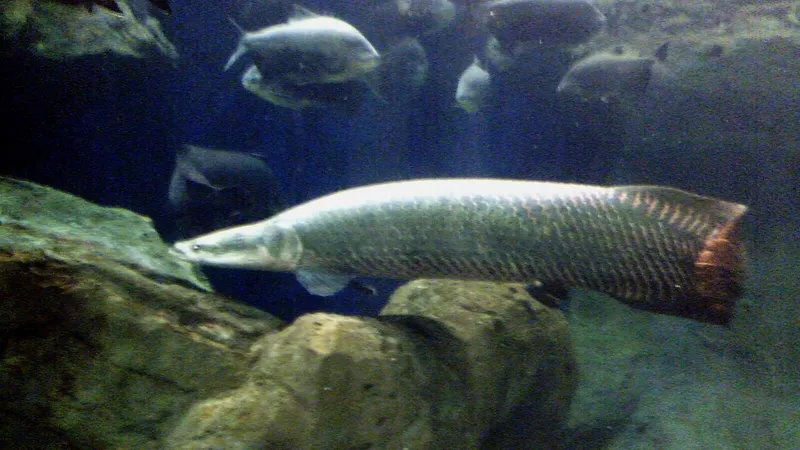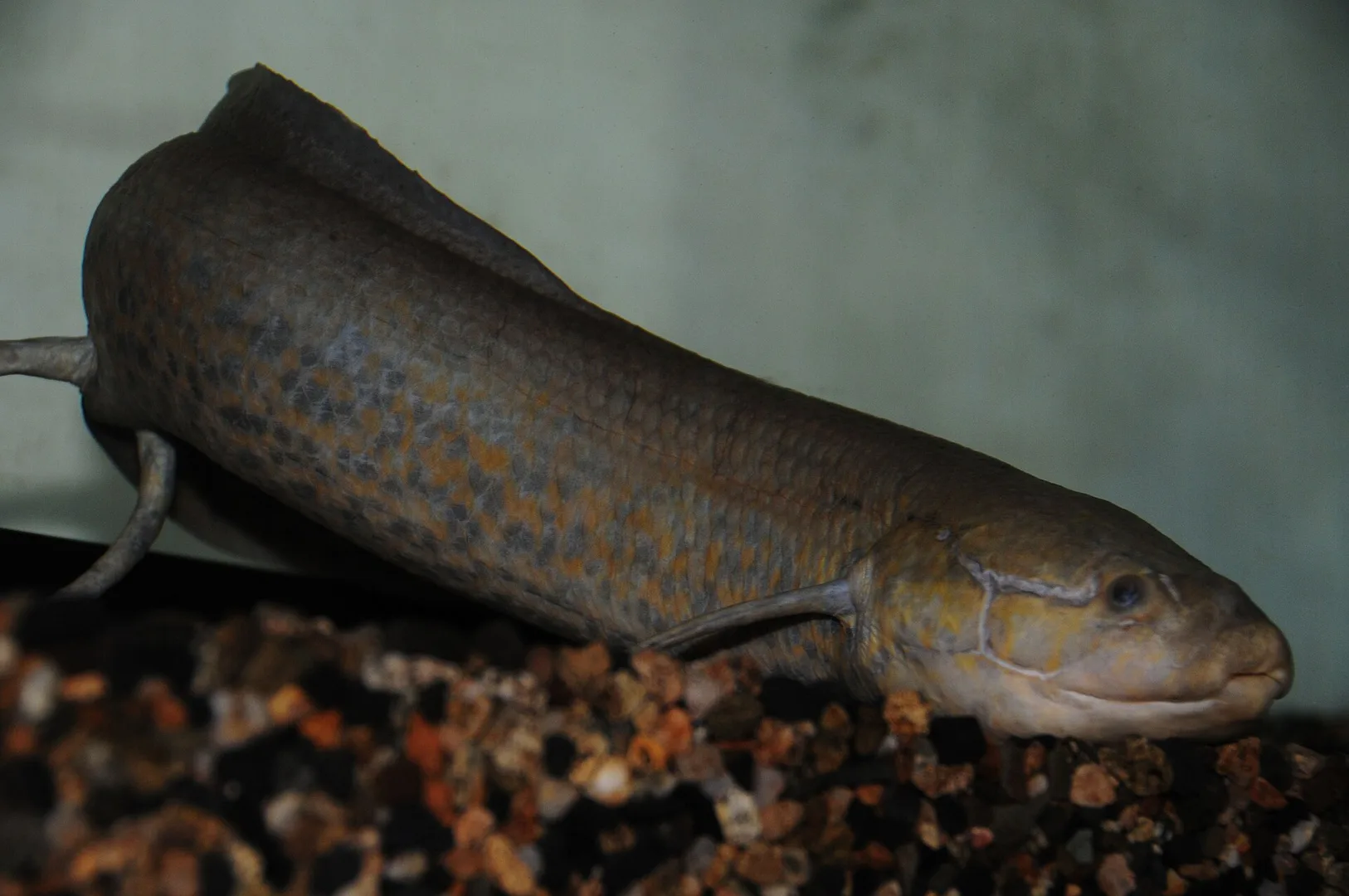
An African lungfish in an aquarium, showing its thread-like fins.
Field
notes
A Fish That Breathes Air Like We Do
The African lungfish grows up to 100 centimeters long and can weigh as much as 4 kilograms. It lives in marginal swamps and the backwaters of rivers and lakes across a wide stretch of Africa, from the large Sahelian basins to the upper Congo River, the middle and lower Zambezi basin, and east coast rivers south to the Limpopo River. Its food includes molluscs, frogs, fish, and seeds, though in Kenya it feeds mostly on plant material such as roots. In captivity it has been recorded living 18 years, and the IUCN rates the species Least Concern.
It has two lungs, like ours. It has gills as well, but it is an obligate air breather, which means breathing air is not optional. It needs access to air, or it will drown.
A Cocoon of Its Own Slime
It normally lives on flood plains. When these dry up in the dry season, the lungfish digs into the mud, chewing its way down and pushing mud out through its gill openings. It reaches a depth of 3 to 25 centimeters below the surface, depending on the length of the fish. It wriggles out a bulb-shaped chamber and comes to rest with its nose pointing upward. A thin slime around its body dries into a fragile cocoon, and air reaches the fish through a tube to the surface. It normally stays there until the start of the next wet season, but it can live in its cocoon for over a year.
Even Without a Cocoon Kept in water with no food, this lungfish can survive more than three and a half years of starvation, lying motionless in the same body posture as a lungfish resting in its burrow through the dry season.
A Slow Suction Strike
Lungfish are skilled suction feeders: a wave of skull movements pulls water, and the prey, into the mouth. X-ray motion tracking shows that lungfishes perform one of the slowest suction feeding strikes among aquatic animals. Feeding on prey that does not try to escape, the African lungfish takes 273 milliseconds on average to open its mouth fully, and a whole strike lasts about 465 milliseconds. In fishes such as catfish, wrasses, and bass, opening and closing the jaws more typically takes 50 to 100 milliseconds. Slow still works. Moving its hyoid, the throat bones that support the tongue, and pulling back its clavicle, part of its shoulder girdle, is what mainly expands its mouth cavity and creates suction.
Walking Gaits Underwater
Scientists class lungfish as the sister group to tetrapods, the backboned animals with limbs, such as frogs, lizards, and humans. In water, this species used its rear (pelvic) fins for walking and bounding gaits, and even lifted its body clear of the bottom, an ability thought to be a tetrapod innovation. The researchers suggest that some basic features of tetrapod walking probably arose in lobe-finned fishes, the group lungfish belong to, before fingers and toes evolved and before vertebrates lived on land.
Published Updated
Traits
Intel
& FAQ
Sources
- 01Protopterus annectens (West African lungfish). FishBase.
- 02Protopterus annectens. AnAge: The Animal Ageing and Longevity Database, Human Ageing Genomic Resources.
- 03Diouf et al. (2020). Protopterus annectens. The IUCN Red List of Threatened Species 2020: e.T169408A135027770.
- 04King et al. (2011). Behavioral evidence for the evolution of walking and bounding before terrestriality in sarcopterygian fishes. Proceedings of the National Academy of Sciences.
- 05Gartner et al. (2022). Suction feeding of West African lungfish (Protopterus annectens): An XROMM analysis of jaw mechanics, cranial kinesis, and hyoid mobility. Biology Open.
- 06West African Lungfish. San Diego Zoo Wildlife Alliance.