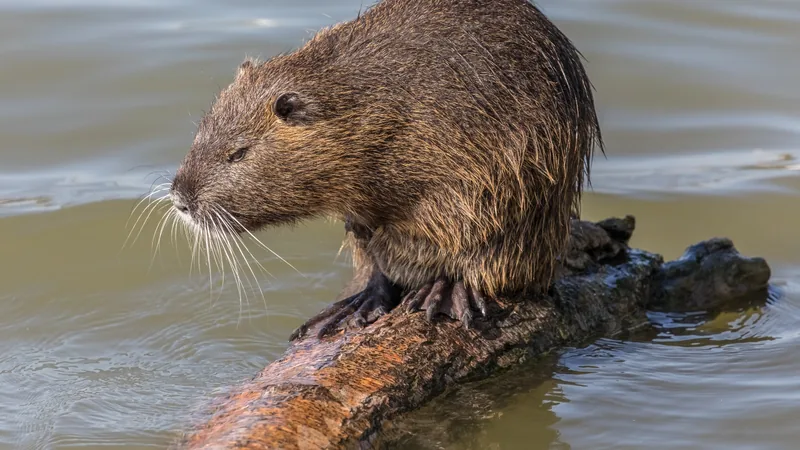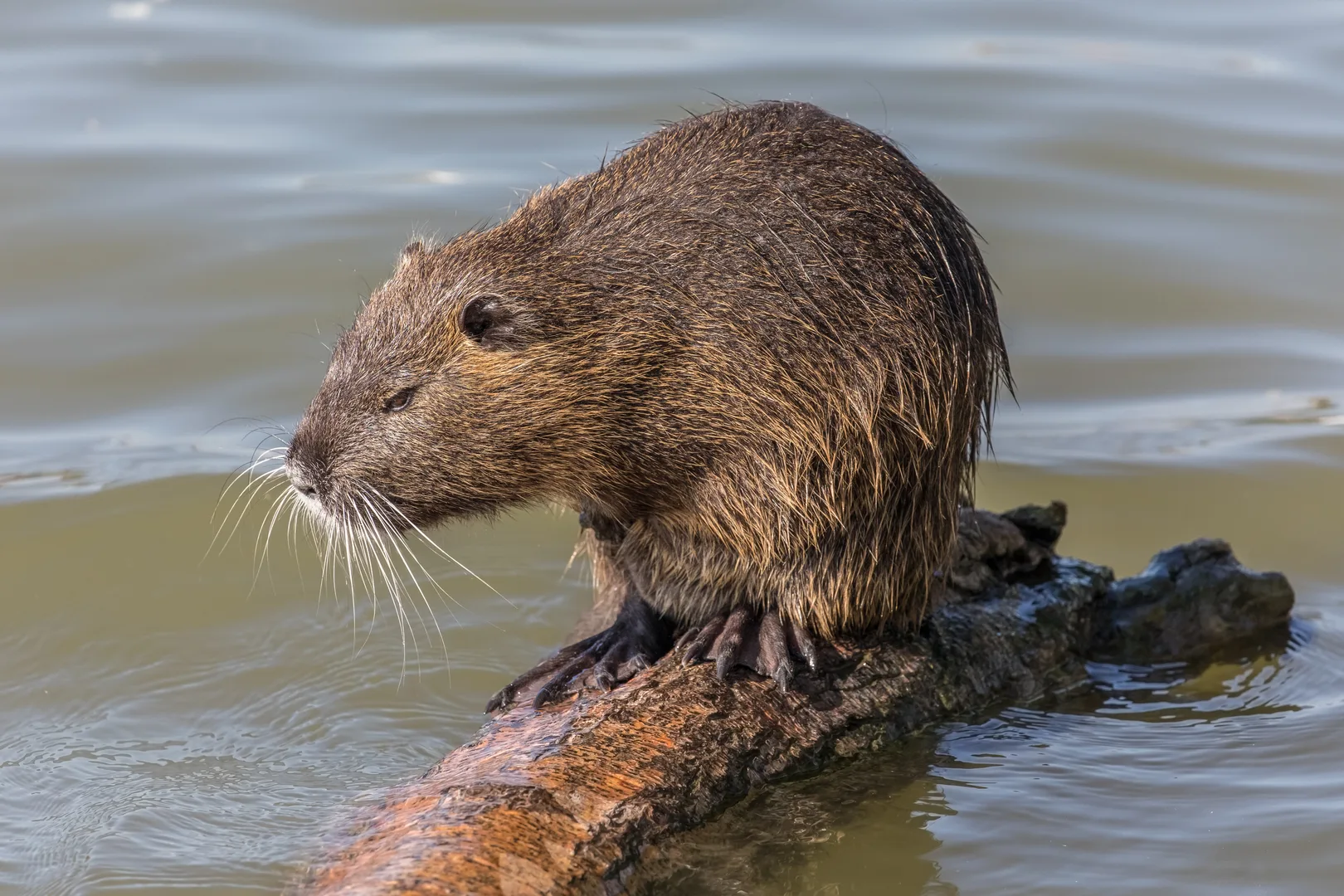
Wild coypu on the Oise River, Compiègne, France
Field
notes
A face on top of its head
The coypu, called the nutria in the United States, is a big semi-aquatic rodent with an unusual layout. Its eyes, ears and nostrils all sit towards the top of the skull, which suits a life in the water. Webbing joins four toes on each hind foot for swimming, while the fifth toe stays free for grooming. The front teeth, the incisors, are broad and orange.
How big, how old
A wild adult measures 47 to 57 centimetres from nose to rump, and its tail averages 37 centimetres. Males can reach 9.1 kilograms (20 pounds) and females 8.2 kilograms (18 pounds). Females are sexually mature at 152 days, and a newborn weighs about 225 grams. The longevity database AnAge lists a record of 19 years in captivity, set by one zoo animal.
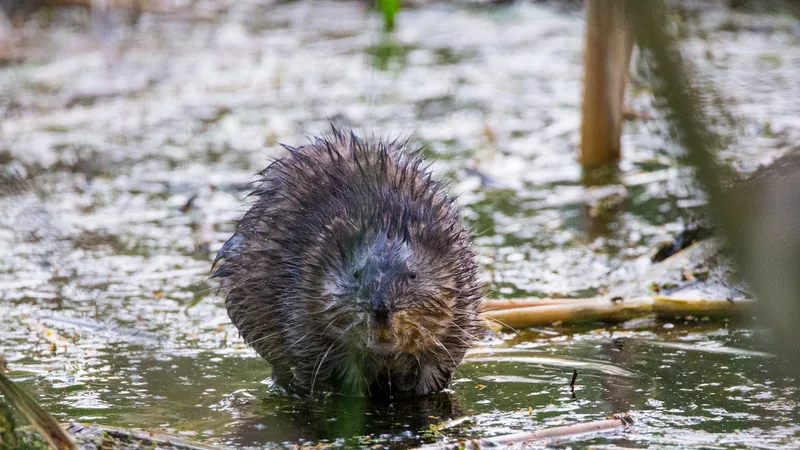
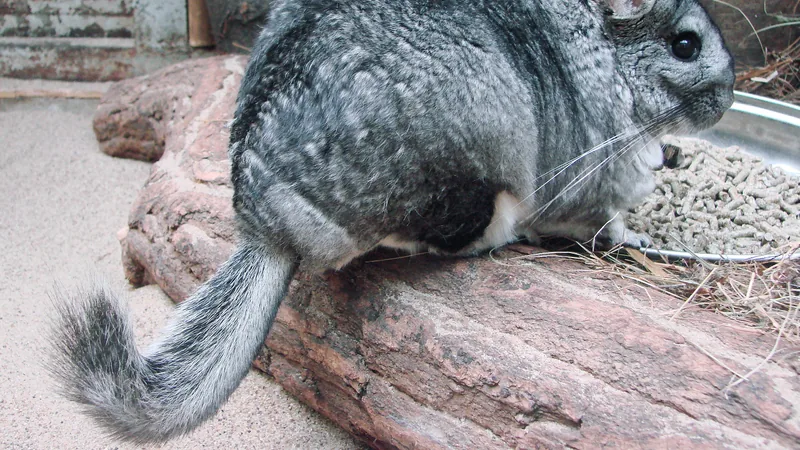
Spot the difference It looks like a beaver, but white whiskers and a big, rounded tail give it away. A beaver’s tail is broad and flat.
Home ground and menu
Its native range covers South America south of latitude 23 degrees, taking in parts of Argentina, Bolivia, Brazil, Chile, Paraguay and Uruguay. It prefers freshwater marshes, but it lives in many types of wetlands, including bayous, drainage canals, swamps and coastal brackish and saltwater marshes. It mostly eats roots, rhizomes and tubers, which it digs up with dexterous forepaws, and it eats insects incidentally as it feeds. When food is plentiful it tends to be nocturnal, with activity peaking near midnight.
An escaped fur crop
Demand for its fur led people to introduce it almost worldwide, and escapes and releases from fur farms left wild populations in Europe, Asia and North America. The first recorded US introduction was in California in 1899, but that population failed to reproduce and establish. Later populations took hold in Louisiana and California, and businesses selling them as “weed cutters” spread them further across the country. When the fur market crashed in the 1980s, far fewer were trapped in Louisiana, which left the population’s growth largely unchecked. One estimate in the USGS profile is that each animal removes about 15.1 kilograms of carbon from a marsh every year, and its burrows can damage levees and irrigation canals.
Britain had its own escapees, introduced in the 1920s for their pelts. The eradication campaign that began in 1981 used a long study of the animal’s ecology, and added an incentive bonus scheme for trappers, who would otherwise be reluctant to work themselves out of a job.
Published
Traits
Intel
& FAQ
Guess
first
How big is a Coypu, really? Slide, lock in, and see what the sources say. Every answer is a figure from this page, quoted from where it came from.
Sources
- 01Myocastor coypus (nutria). USGS Nonindigenous Aquatic Species Database.
- 02Myocastor coypus (coypu). Animal Diversity Web, University of Michigan.
- 03AnAge entry for Myocastor coypus. AnAge: The Animal Ageing and Longevity Database, Build 15.
- 04Gosling & Baker (1989). The eradication of muskrats and coypus from Britain. Biological Journal of the Linnean Society.
- 05Ojeda, Bidau & Emmons (2016). Myocastor coypus. The IUCN Red List of Threatened Species 2016: e.T14085A115119712.
What the sources say: 46 claims checked word for word against these sources →