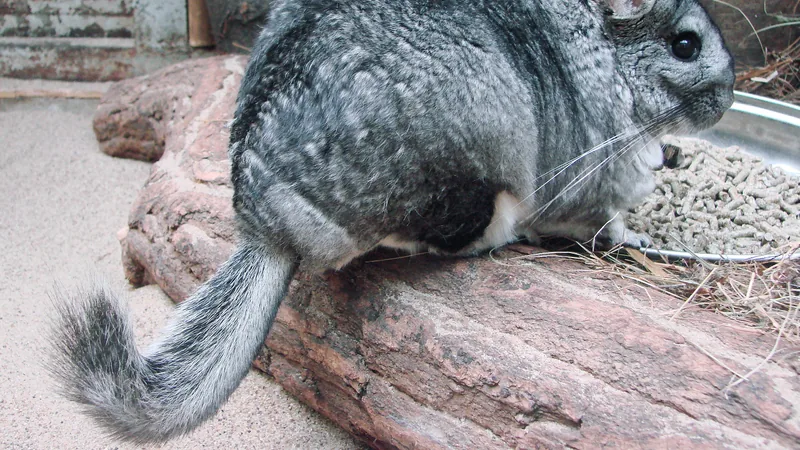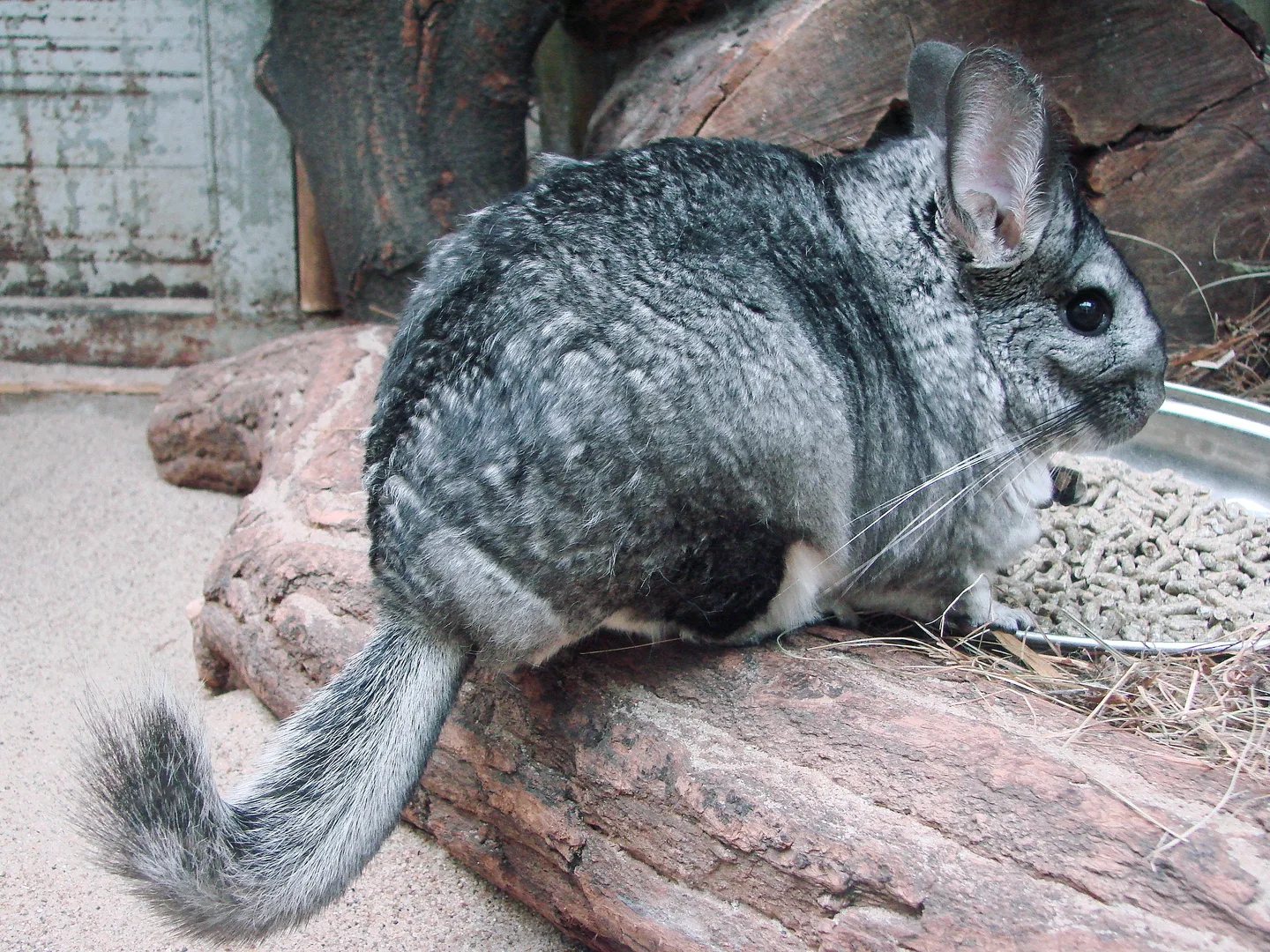
Picture taken in the zoo of Wrocław (Poland): Chinchilla lanigera (Molina, 1782)
Field
notes
Up to 60 hairs from one follicle
The long-tailed chinchilla, Chinchilla lanigera, wears a very soft, dense coat. Up to 60 hairs can grow out of one follicle, the tiny pocket in the skin that a hair grows from. Each hair usually has a black tip, and this thick fur keeps the animal warm high in the Andes. Chinchillas’ teeth are dark orange.
Fur slip If a chinchilla is threatened or under attack, it may do a “fur slip” and release clumps of fur, leaving a potential predator empty handed.
With a coat this dense and no way to pant or sweat, chinchillas can easily overheat in human care. Their only cooling mechanism is to pump blood through their large ears, which have less hair.
Size, weight and lifespan
A chinchilla has a body 9 to 14 inches (23 to 36 centimeters) long and a bushy tail of 3 to 6 inches (7 to 15 centimeters). Females weigh up to 1.76 pounds (800 grams), while males weigh only about 1 pound (0.5 kilogram).
In the wild, chinchillas live about 10 years. In human care they can live over 20 years.
Life on a rock face
This species is found only in the Andes Mountains of northern Chile. It lives in rocky, mountainous areas from 9,800 to 16,400 feet (3,000 to 5,000 meters) in elevation, and dens in crevices and holes. Chinchillas are nocturnal, meaning active at night.
They are mostly herbivores. They eat seeds, grass, leaves, roots, lichen and mosses, plus insects and eggs when they can get them. The most common food is the perennial Chilean needlegrass, and cactus is likely its main source of water. While eating, a chinchilla sits erect and holds the food in its forepaws.
Chinchillas can jump across a six-foot crevice, and they take regular dust baths to keep their coats healthy.
Chinchillas live in colonies of a few individuals to hundreds. Females are the dominant sex and are very aggressive toward one another and toward males during estrus, yet serious fights rarely happen.
A coat that nearly doomed them
Around 1900, Chile exported about 500,000 chinchilla skins each year. The IUCN, which files the species as Chinchilla laniger, rated it Endangered in its 2025 global assessment. Mining is a significant threat to this once widespread rodent.
Published Updated
Traits
Intel
& FAQ
Guess
first
How big is a Long-Tailed Chinchilla, really? Slide, lock in, and see what the sources say. Every answer is a figure from this page, quoted from where it came from.
Sources
- 01Long-tailed chinchilla. Smithsonian's National Zoo and Conservation Biology Institute.
- 02Chinchilla lanigera. Animal Diversity Web, University of Michigan Museum of Zoology.
- 03Chinchilla. San Diego Zoo Wildlife Alliance.
- 04Jiménez, Deane, Salazar-Bravo & Hurtado Materon (2025). Chinchilla laniger. The IUCN Red List of Threatened Species 2025: e.T4652A271314552.
What the sources say: 46 claims checked word for word against these sources →