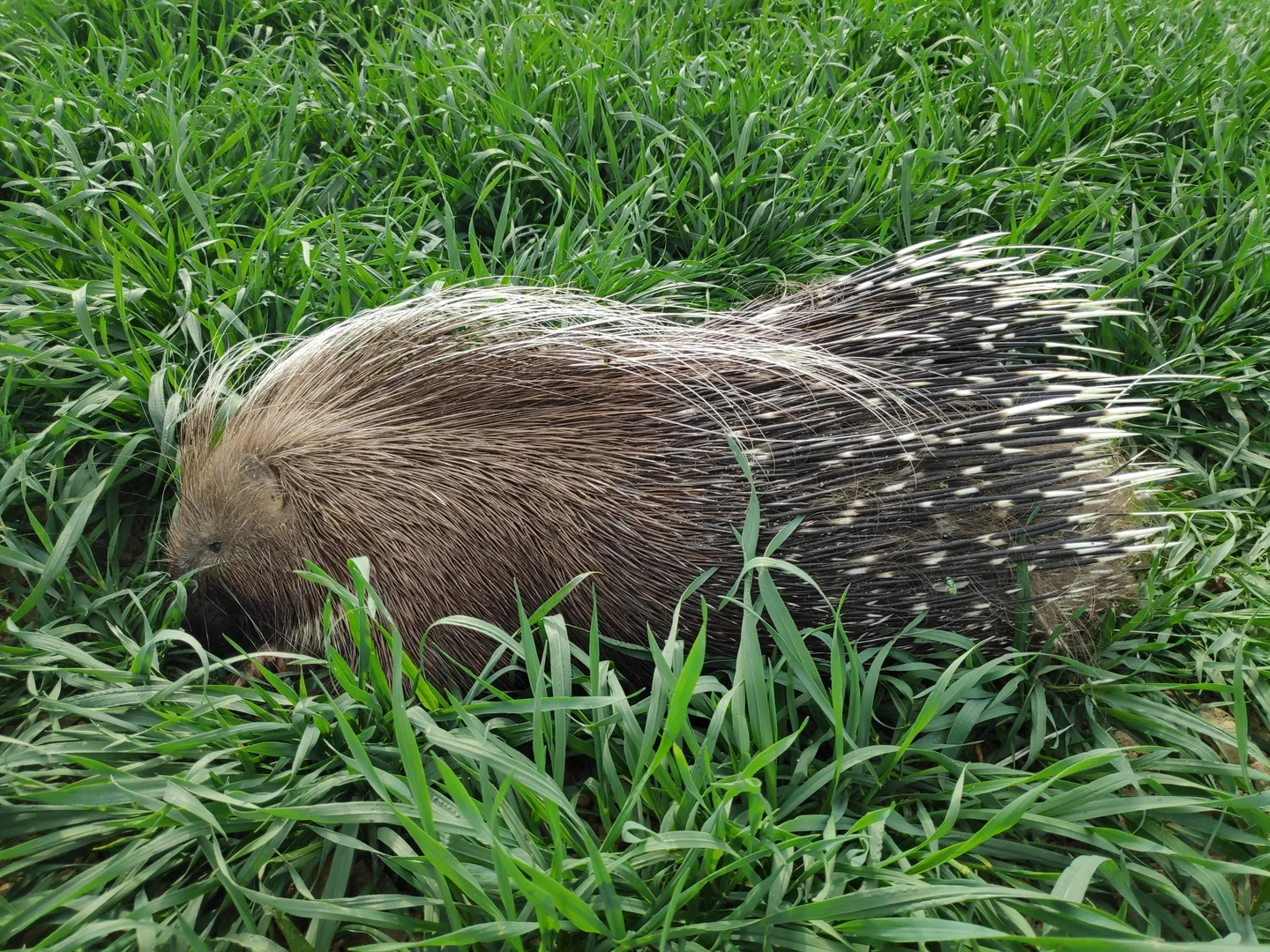
A wild crested porcupine in Italy.
Field
notes
The African crested porcupine is the longest of the world’s porcupine species, reaching up to 90 centimeters (36 inches), and it can weigh up to 30 kilograms (66 pounds). One wild-born porcupine lived to about 28 years old in captivity, making it one of the longest-lived rodents. It spends its nights foraging in forests, rocky areas, mountains and croplands, gnawing on roots and bark, and its days sheltering in caves, rock crevices or burrows it digs itself. Then there are the quills.
The Reverse Charge
A crested porcupine cannot launch its quills through the air. Quills are modified hairs made of keratin, the same material as human hair and fingernails. When disturbed, the porcupine raises and fans its quills to look bigger. A crest of black-and-white banded quills runs from the top of its head to its shoulders, and a skirt of long, bendy quills can make it look two to three times its size. If the disturbance continues, it stamps its feet and vibrates the hollow, broad-tipped quills at the end of its tail into a hissing rattle.
Reverse Gear as a Weapon Ignore the rattle, and the porcupine charges backward, trying to stab the attacker with its thicker, shorter quills.
Attacks like this are known to have killed lions, leopards, hyenas and people.
Roots, Bark and Bones
Despite the weaponry, the crested porcupine eats mostly plants: bark, roots, tubers, rhizomes, bulbs and fallen fruit, plus farm crops such as corn, pumpkin, sweet potatoes and cassava. It occasionally eats insects, small vertebrates and carrion too. The crop raids make it a target for farmers, and its meat is considered a delicacy. All porcupines have sharp, chisel-like front teeth, and this one also gnaws on bones, for calcium and to keep its teeth sharp.
From Africa to a Roman Banquet
The species is native to sub-Saharan Africa, from Senegal to Ethiopia and Tanzania, and to North Africa. Italy’s porcupines were brought in. A genetic study of three mitochondrial genes pointed to Tunisia as the most likely source and estimated that they arrived between 2,500 and 1,500 years ago, very likely brought over by the Ancient Romans as an exotic pet and a delicacy for banquets. A 2016 study found that their range in Italy had expanded dramatically over the previous 40 to 50 years: they crossed the Apennines, passed the Po river and reached the southern edge of the Alps. Meanwhile, native populations in North Africa were declining under heavy human pressure and a drying climate.
Published Updated
Traits
Intel
& FAQ
Guess
first
How big is a African Crested Porcupine, really? Slide, lock in, and see what the sources say. Every answer is a figure from this page, quoted from where it came from.
Sources
- 01Hystrix cristata (North African crested porcupine). Animal Diversity Web, University of Michigan.
- 02Porcupine. San Diego Zoo Wildlife Alliance.
- 03Hystrix cristata. AnAge: The Animal Ageing and Longevity Database, Human Ageing Genomic Resources.
- 04Trucchi et al. (2016). Long live the alien. Molecular Ecology.
- 05Coppola et al. (2020). Evidence of scavenging behaviour in crested porcupine. Scientific Reports.
- 06Ori et al. (2018). Crested porcupines (Hystrix cristata): mycophagist spore dispersers of the ectomycorrhizal truffle Tuber aestivum.
- 07Gazzard & Mori (2024). Hystrix cristata. The IUCN Red List of Threatened Species 2024: e.T10746A226926731.
What the sources say: 53 claims checked word for word against these sources →