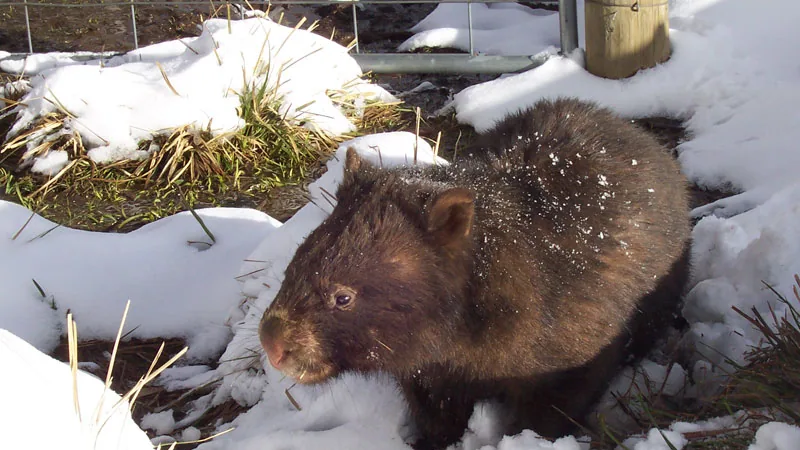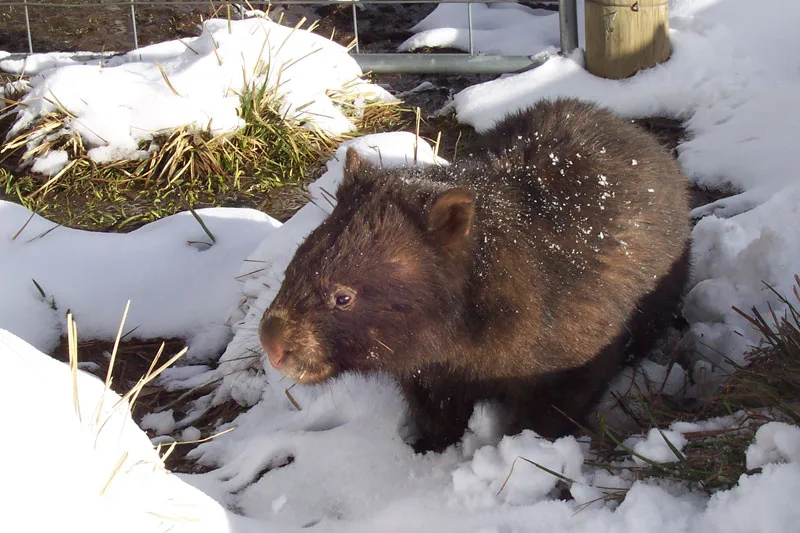
Bare-nosed wombat grazing on Maria Island, Tasmania
Field
notes
Built Like a Bulldozer
The bare-nosed wombat (Vombatus ursinus) is one of the largest burrowing plant-eaters: a squat, bear-like body, small eyes and ears, and a large bare nose that gives the species its name. It lives in Tasmania, southern Queensland, eastern New South Wales and eastern Victoria, with leftover populations in south-eastern South Australia and south-western Victoria. Mainland wombats average about 1 meter long and 27 kilograms, and can reach up to 35 kilograms. Tasmanian wombats run smaller, averaging 85 centimeters and 20 kilograms, and the Flinders Island population is smaller again. Wild wombats live for more than five years. The longevity record is a captive wombat that was still alive when it was estimated to be at least 30 years old.
Wombats dig with their front paws, then back out, bulldozing the loose dirt backwards with their rump. Their burrows can be up to 20 meters long and more than 2 meters below the ground, with numerous tunnels and entrances and sometimes more than one nest of sticks, leaves and grass. Other animals use them too: camera traps at wombat burrows have recorded rabbits, possums, foxes, cats and birds going inside to shelter or hunt, and foraging at the entrance and in the spoil, the heap of dug-out soil.
Rear-End Defense
A wombat’s back end is covered in very tough, thick skin. If threatened, it dives into a nearby burrow or hollow log and uses its rump to shield itself from an attacker’s teeth and claws. With a predator inside its burrow, a wombat can back up at the attacker and use its strong back legs to crush its head against the roof. In Tasmania, its natural predators are Tasmanian devils and eagles.
A Built-In Traffic Sign Wombat droppings come out as cubes, and the reason is inside the gut. Dissections show the cubes form in the last 17 percent of the intestine, and tests on the gut wall found regions twice as thick and four times as stiff as others. Researchers think those stiff regions help the gut’s squeezing contractions form the corners. A wombat marks new objects in its home range with its scats, especially raised ones: fallen trees, rocks and even fresh mushrooms have been found with scats on top, and the cube shape makes them less likely to roll off.
A Slow Metabolism, a Long Gut
A wombat’s diet is entirely plants, mostly grass. One DNA study of droppings from five sites in New South Wales identified 209 plant species in the diet, and most of the plants identified were introduced species (ones brought in by people) rather than native ones. Their food is poor in nutrients, and their intestine is 9 meters long. A review of the species’ biology puts their metabolism, the rate at which the body burns energy, among the lowest of any mammal over 10 kilograms. That slow metabolism may give wombats an edge over animals competing for the same food, and a burrowing life may protect them from predators, fires and climate extremes.
Published Updated
Traits
Intel
& FAQ
Guess
first
How big is a Bare-Nosed Wombat, really? Slide, lock in, and see what the sources say. Every answer is a figure from this page, quoted from where it came from.
Sources
- 01Bare-nosed Wombat. Department of Natural Resources and Environment Tasmania.
- 02Vombatus ursinus (coarse-haired wombat). Animal Diversity Web, University of Michigan.
- 03Wombat. San Diego Zoo Wildlife Alliance.
- 04AnAge entry for Vombatus ursinus. Human Ageing Genomic Resources, AnAge Build 15.
- 05Yang et al. (2021). Intestines of non-uniform stiffness mold the corners of wombat feces. Soft Matter.
- 06Carver, Stannard & Martin (2024). The Distinctive Biology and Characteristics of the Bare-Nosed Wombat (Vombatus ursinus). Annual Review of Animal Biosciences.
- 07Old et al. (2024). DNA metabarcoding analysis of the bare-nosed wombat (Vombatus ursinus) diet. Ecology and Evolution.
- 08Old, Hunter & Wolfenden (2018). Who utilises bare-nosed wombat burrows? Australian Zoologist.
- 09Old et al. (2025). Vombatus ursinus. The IUCN Red List of Threatened Species 2025: e.T40556A258654868.
What the sources say: 38 claims checked word for word against these sources →