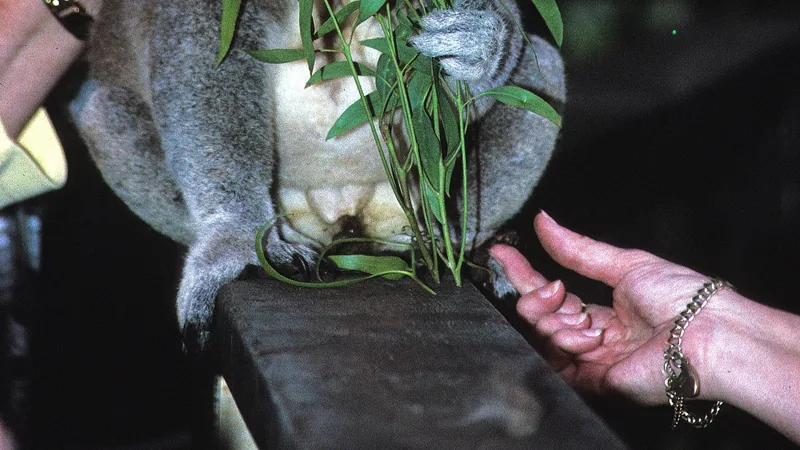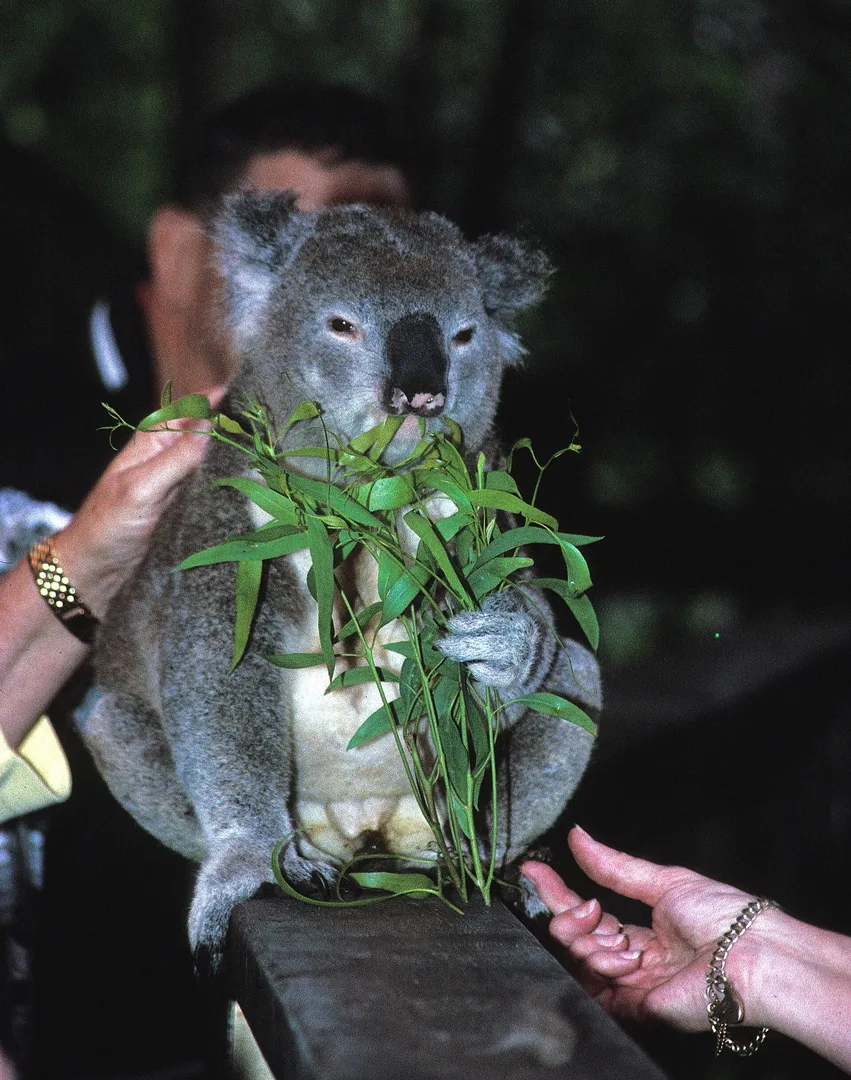
A koala climbing a tree in Great Otway National Park, Victoria, Australia.
Field
notes
Running on Low Power
The koala (Phascolarctos cinereus) has built its lifestyle around a bad diet. Eucalyptus leaves are tough and low in calories, so koalas save energy by moving only occasionally and sleeping 18 to 22 hours a day. Average weights run from 5.1 kilograms for northern females to 11.8 kilograms for southern males, with males running up to 50% heavier than females. In the south of their range, where koalas are generally larger, males average 78 centimeters in head-body length to females’ 72. Koalas usually live 10 to 15 years.
A Gut Built to Handle Poison
Eucalyptus leaves carry chemical defenses, including tannins, phenolic compounds and terpenes, that most herbivores can’t tolerate. Koalas manage on almost nothing else: an adult can eat 500 grams of leaves a day, and koalas prefer about three dozen of the more than 600 kinds of eucalypt.
The trick is a supersized gut and the bacteria inside it. A koala’s caecum is huge, and one of the bacteria living in the mucus around it is Lonepinella koalarum.
A Tannin-Busting Bacterium Lonepinella koalarum was first isolated from the mucus around a koala’s caecum, and it has been shown to break down the tannin-protein complexes in eucalyptus leaves, complexes that koalas cannot digest.
Life Up a Tree
Koalas live in eucalyptus forests below 600 meters in elevation, spread from northern Queensland to southwestern Victoria in eastern Australia. Two opposable thumbs on each hand and sharp claws give them their grip, and strong arm and shoulder muscles help them climb up to 46 meters to the top of a tree. Koalas cool off by licking their arms and stretching out while they rest.
A Species Under Real Pressure
Koalas were hunted hard for their fur: eight million were killed between 1919 and 1924 alone. Public outcry won them legal protection after 1927, but today they face other threats: dog attacks, cars that hit some of them, disappearing habitat, and chlamydia, a common infection whose primary culprit, Chlamydia pecorum, causes eye infections, reproductive disease and even death. The IUCN now lists the species as Vulnerable.
Published Updated
Traits
Intel
& FAQ
Guess
first
How big is a Koala, really? Slide, lock in, and see what the sources say. Every answer is a figure from this page, quoted from where it came from.
Sources
- 01Phascolarctos cinereus (koala). Animal Diversity Web, University of Michigan.
- 02Koala. San Diego Zoo Wildlife Alliance.
- 03Woinarski & Burbidge (2020). Phascolarctos cinereus. The IUCN Red List of Threatened Species 2020: e.T16892A166496779.
- 04Charlton et al. (2013). Koalas use a novel vocal organ to produce unusually low-pitched mating calls. Current Biology.
- 05Dahlhausen et al. (2020). Isolation and sequence-based characterization of a koala symbiont: Lonepinella koalarum. PeerJ.
- 06Waugh et al. (2017). Infection with koala retrovirus subgroup B (KoRV-B), but not KoRV-A, is associated with chlamydial disease in free-ranging koalas (Phascolarctos cinereus). Scientific Reports.
What the sources say: 60 claims checked word for word against these sources →