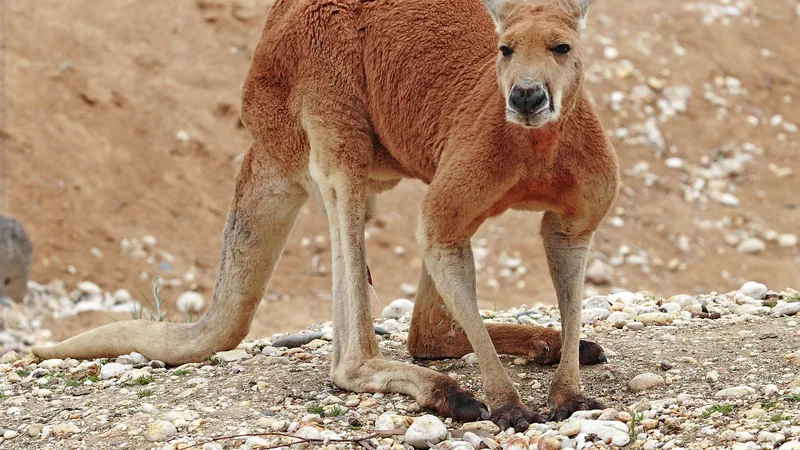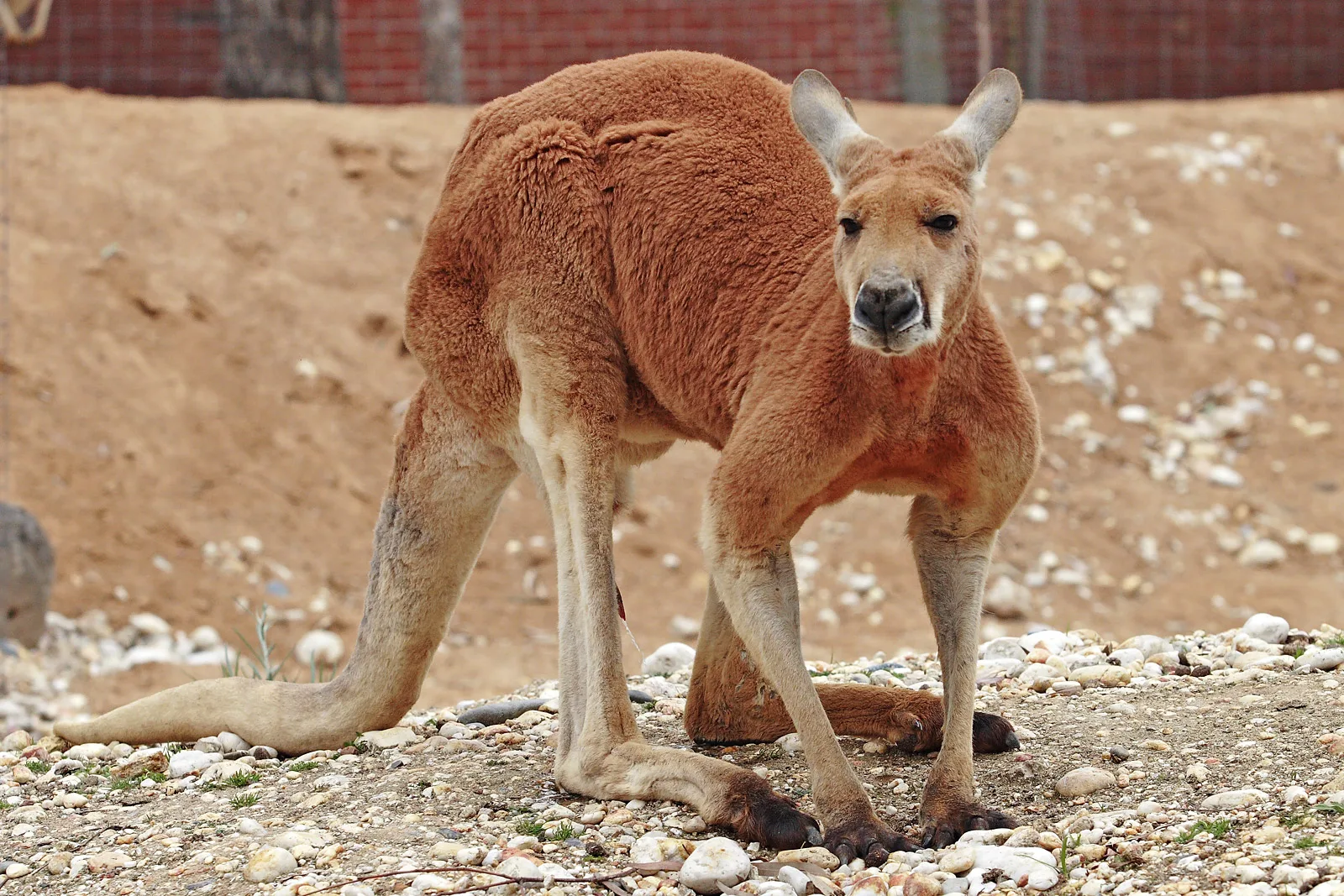
Red Kangaroo (Osphranter rufus), Tibooburra NSW 2880, Australia
Field
notes
Hopping at 64 km/h
A red kangaroo’s powerful hind legs drive it forward in a bipedal hop, while its tail balances the body. At full stretch it can hop at 64 km/h (about 40 mph). As it hops faster on level ground, its energy use stays nearly the same. Scientists have credited that to long, stretchy tendons in its legs that store elastic energy and give it back. A 1998 study tested a rival explanation, exceptionally efficient muscles, and found their efficiency was normal: about 30%. It also has an odd five-legged gait, balancing on its forelimbs and tail while both back legs swing forward together.
A Built-In Third Leg The tail is strong enough to support the kangaroo’s own body weight. It works as a balance beam mid-jump, and together with the two legs it forms a tripod the kangaroo rests on.
Australia’s Biggest Marsupial
The red kangaroo is the largest living marsupial. A male’s body can reach 1.4 meters long, plus a tail of up to 1 meter, and a female’s body up to 1.1 meters. Adult males can weigh up to 92 kg, and females up to 39 kg, though in moderate seasons a female’s growth levels off at 28 to 30 kg by 6 to 8 years old. Males usually wear reddish-brown fur and females blue-gray, though in some areas those colors swap. Red kangaroos can live up to 20 years in the wild, and up to 23 years in care.
Life in the Red Centre
Red kangaroos live across the dry, inland heart of Australia, where rainfall averages less than 500 millimeters a year. They prefer to feed on open plains, but are seldom found anywhere without scattered trees for shade and shelter. That shade matters: a 2021 study in the Strzelecki Desert found kangaroos were about three times more likely to shelter under mulga trees carrying mistletoe than under trees stripped of it, and that the shade under the mistletoe trees was cooler by day.
Red kangaroos are exclusively plant-eaters, grazing mainly on grasses but also eating forbs and the leaves of shrubs. Grass made up around 90% of one studied population’s diet in a good season, but in the dry spell that followed, adult females switched to a diet of about half chenopod shrubs. They can go without drinking for long stretches by drawing moisture from succulent plants instead.
Mobs, Boxing, and Life as Prey
Red kangaroos usually live in small groups called mobs, made up mostly of females and their young with one or more males; groups average around 10 animals. Among males, competition for mates sometimes turns into a boxing match, where they hit at each other with their forepaws and kick with their feet.
A grown red kangaroo’s size reduces the predation risk it faces, and it can fight back with powerful kicks from its clawed feet. Dingoes may prey on red kangaroos, and large raptors may take very young joeys just out of the pouch. Humans have long hunted kangaroos for meat and hides. Every Australian state regulates that hunting, and the IUCN Red List rates the red kangaroo Least Concern.
Published Updated
Traits
Intel
& FAQ
Guess
first
How big is a Red Kangaroo, really? Slide, lock in, and see what the sources say. Every answer is a figure from this page, quoted from where it came from.
Sources
- 01Macropus rufus (red kangaroo). Animal Diversity Web, University of Michigan.
- 02Red Kangaroo. Australian Museum.
- 03Dawson et al. (2021). The burden of size and growth for the juveniles of large mammalian herbivores: Structural and functional constraints in the feeding biology of juveniles relative to adults in red kangaroos, Osphranter rufus. Ecology and Evolution.
- 04Chu, Cornwell & Letnic (2021). Mistletoes Facilitate a Desert Herbivore by Improving the Quality of Shade. Ecosystems.
- 05Ellis et al. (2016). Macropus rufus. The IUCN Red List of Threatened Species 2016: e.T40567A21953534.
- 06Red Kangaroo. Taronga Conservation Society Australia.
- 07Kram & Dawson (1998). Energetics and biomechanics of locomotion by red kangaroos (Macropus rufus). Comparative Biochemistry and Physiology Part B: Biochemistry and Molecular Biology.
What the sources say: 63 claims checked word for word against these sources →