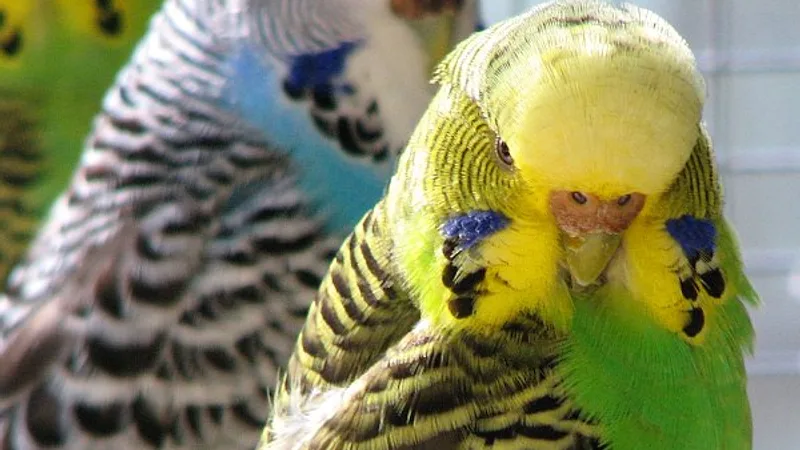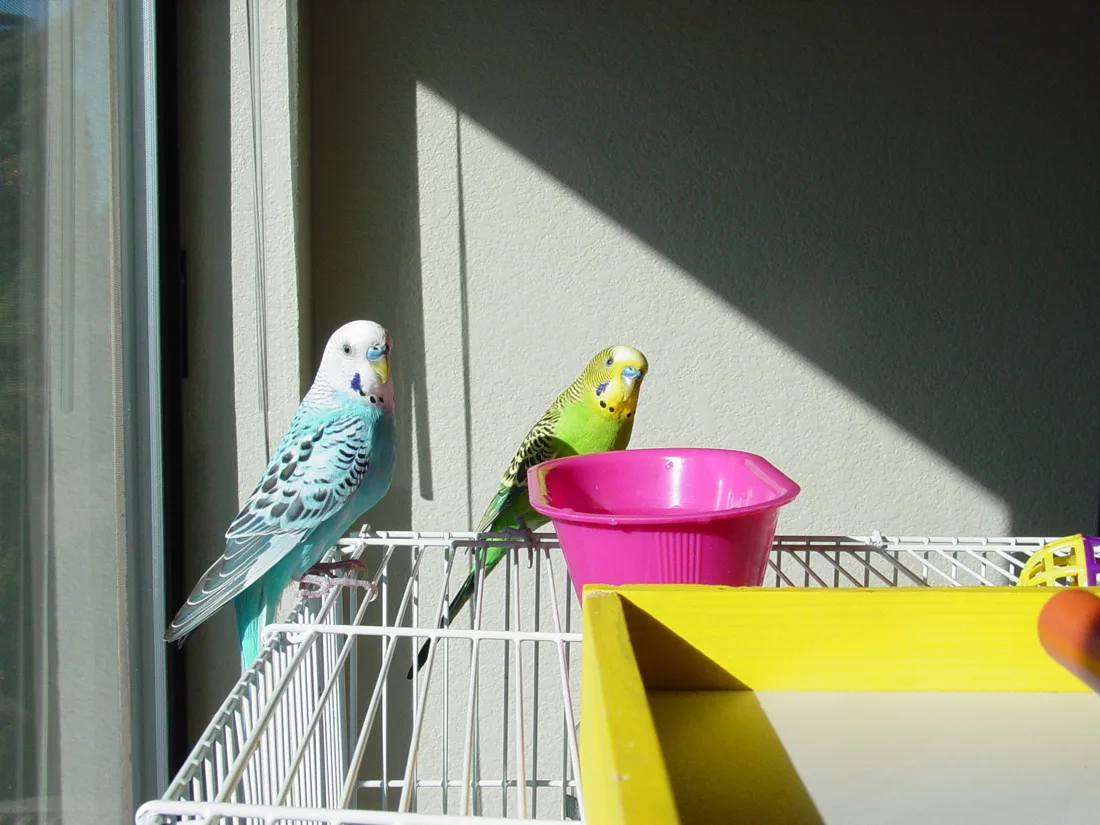
Budgerigars at Innamincka, South Australia.
Field
notes
A Small Green Nomad
The Budgerigar (Melopsittacus undulatus) is a small Australian parrot, 17 to 18 cm long and about 30 g as an adult. In the wild it’s green and yellow with black barring across the back, a small blue patch on the cheek, and a dark blue cere, the fleshy patch at the base of the beak, in males; a breeding female’s cere turns brownish instead. Young budgies are duller than adults, with a dark brown eye that turns white or yellow as they mature. In captivity, a budgerigar can live up to 21 years.
Chasing the Rain
Budgerigars occur naturally throughout much of mainland Australia, absent from the far south-west, the north of the Northern Territory, Tasmania and the majority of the east coast. They occupy semi-arid and sub-humid habitats, mainly in the interior. They’re nomadic, and large flocks can be seen in most open habitat types: a flock usually runs from as few as three birds up to 100 or more, but occasionally numbers in the tens of thousands after a season of abundant rainfall and food. They feed almost exclusively on the seeds of native herbs and grasses, such as porcupine grass and saltbush, mostly eaten straight off the ground, and although they rarely settle anywhere for long, they are seldom far from water. Budgerigars breed in response to rainfall and may raise several broods if conditions permit; the nest is a bare cavity in a tree branch or trunk.
Copycat Calls
Adult budgerigars keep learning new contact calls, the chirps a bird uses to announce where it is. When researchers caged six unrelated adult males where they could hear, but not see, birds in a neighbouring cage, the birds in each cage shared the same dominant call type eight weeks later, with the first copy showing up after just a week. The pattern also shows up between mates: when researchers introduced strangers as pairs, all of them developed a shared call within an average of 2.1 weeks, usually with the male reworking his call to match hers.
Males copied their mate’s call, not the other way round. Eight of nine paired males imitated their partner’s contact call, while none of the nine females copied theirs.
In the brain, hearing another budgie’s warbles and vocalizing itself switch on gene activity in distinctly separate regions, in a bird order whose ability to learn vocalizations is thought to have evolved independently of songbirds.
Seeing What We Can’t
Budgerigar feathers reflect near-ultraviolet light, wavelengths invisible to humans, and they also glow yellow under intense UV. Researchers who used filters to remove and restore that reflectance found that females consistently prefer UV-reflecting males, and that the preference comes from UV changing the perceived hue rather than the brightness. The glow is a separate matter: enhancing a male’s yellow through fluorescence had no effect on his attractiveness. There’s no evidence the yellow fluorescence is itself important as a signal, though it may absorb UVA and so increase the contrast with nearby UV-reflecting plumage.
Published Updated
Traits
Intel
& FAQ
Guess
first
How big is a Budgerigar, really? Slide, lock in, and see what the sources say. Every answer is a figure from this page, quoted from where it came from.
Sources
- 01Budgerigar. Australian Museum.
- 02Melopsittacus undulatus (budgerigar). Animal Diversity Web, University of Michigan.
- 03Melopsittacus undulatus. AnAge: The Animal Ageing and Longevity Database, Human Ageing Genomic Resources.
- 04Farabaugh, Linzenbold & Dooling (1994). Vocal plasticity in budgerigars (Melopsittacus undulatus): Evidence for social factors in the learning of contact calls. Journal of Comparative Psychology.
- 05Hile, Plummer & Striedter (2000). Male vocal imitation produces call convergence during pair bonding in budgerigars, Melopsittacus undulatus. Animal Behaviour.
- 06Jarvis & Mello (2000). Molecular mapping of brain areas involved in parrot vocal communication. The Journal of Comparative Neurology.
- 07Pearn, Bennett & Cuthill (2001). Ultraviolet vision, fluorescence and mate choice in a parrot, the budgerigar Melopsittacus undulatus. Proceedings of the Royal Society of London. Series B: Biological Sciences.
- 08Melopsittacus undulatus. The IUCN Red List of Threatened Species 2018: e.T22685223A132056957.
What the sources say: 42 claims checked word for word against these sources →