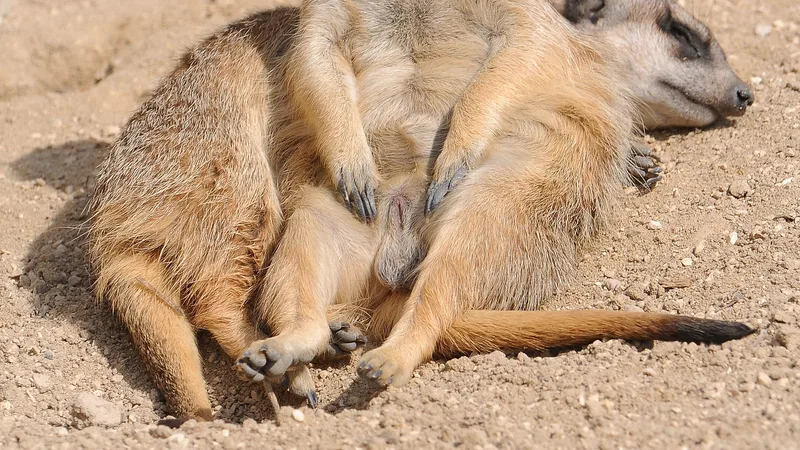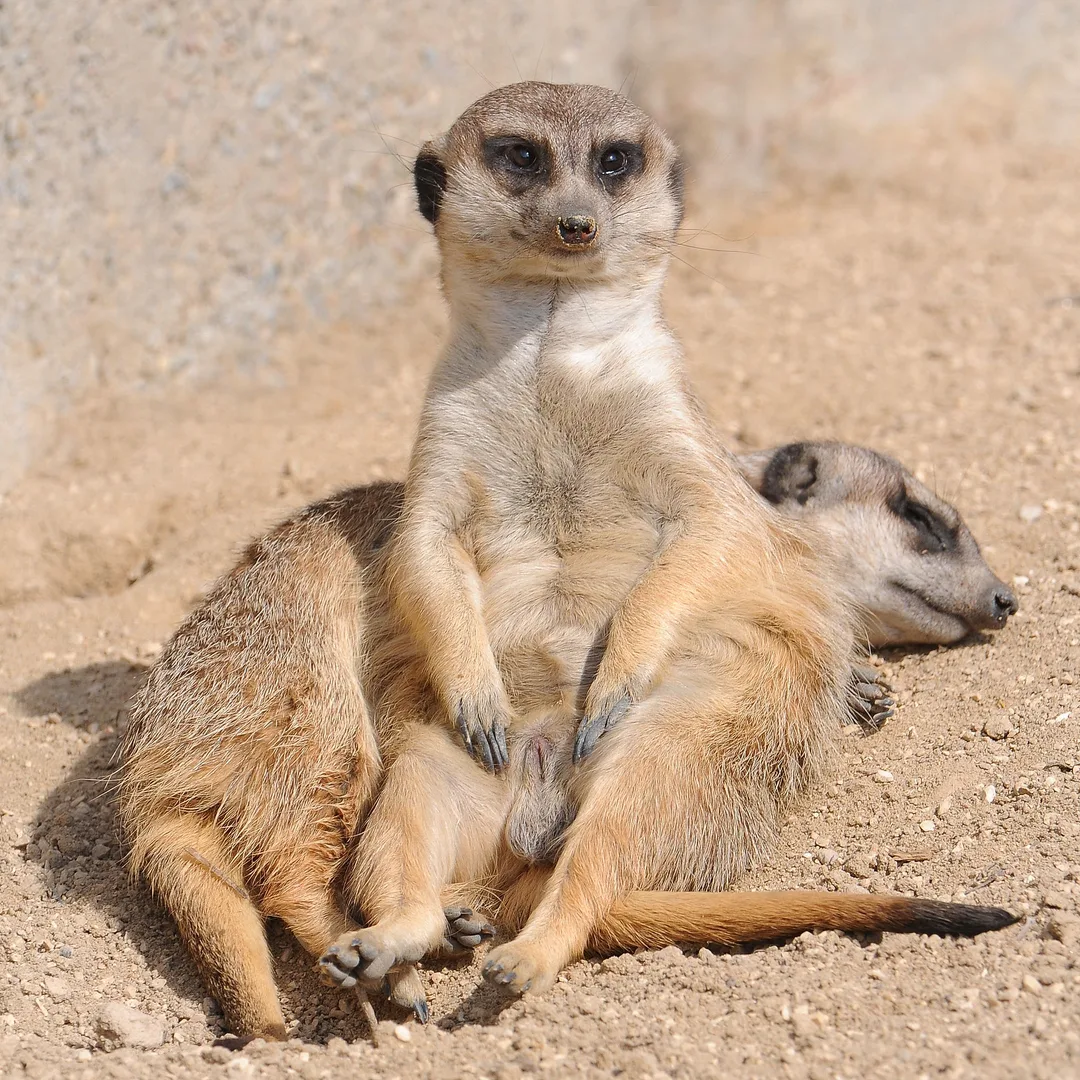
Two Meerkat in Knies Kinderzoo, a zoo in Rapperswil-Jona, Switzerland.
Field
notes
Built for the Kalahari Grind
A meerkat is small and slight: adults run about 24 to 29 centimeters (9 to 11.5 inches) long, plus a tail that adds another 18 to 25 centimeters, and weigh just 620 to 969 grams (1.4 to 2.1 pounds). Dark patches around each eye work like built-in sunglasses, cutting down the sun’s glare, and each foot carries four long, non-retractable claws built for digging. Even so, meerkats usually move into burrows dug by other animals, such as ground squirrels. These average 15 entrances and exits, with tunnels and chambers on several levels, some as deep as 2 meters (6.5 feet), and the deeper tunnels stay at a steady, comfortable temperature whether it is hot or cold outside.
The Lookout Takes Turns
Meerkats live in mobs of up to 40, and while the others forage, one adult stands sentry on the highest rock or mound it can find, upright on its hind legs. A low, steady peeping called the “watchman’s song” means the coast is clear; spotting a predator switches it to a bark or whistle, with separate calls for danger on the ground and danger from the air, and the calls turn noisier the more urgent the danger gets. Guard duty is not pure self-sacrifice, either: one study backs the idea that once a meerkat’s own stomach is full, and no one else is on guard, keeping watch is its best use of time, and meerkats given extra food did more guarding.
A Scorpion With the Safety On A mother meerkat brings her pups scorpions with their tails already bitten off, so they can learn to kill them without getting hurt. As pups grow older, the mob’s helpers change how they serve up prey, which speeds up the pups’ learning.
Scorpions for Lunch, Snake Mobs for Defense
Meerkats hunt small prey, some of it dangerous. A 1994 study found insects made up 82 percent of their diet, with spiders, centipedes, millipedes, reptiles, amphibians, and birds filling out the rest, and meerkats also eat eggs. They dig holes deep enough to trap whistling geckos and giant ground geckos. They also eat several kinds of scorpion, and have been seen disabling one with a bite, then eating it head first. Adults have some immunity to a scorpion’s sting, though its large pincers can still do plenty of damage. Meerkats rarely need to drink: they get their fluids from their prey instead, and sometimes chew on tsama melons or dig up roots for water. Venomous snakes are a job for the whole mob. Meerkats mob some of their predators as a group, Cape cobras included, and they do not tolerate any snake in their midst: the mob attacks at once, biting the snake wherever it can, and the snake soon tires and is overwhelmed.
On Plenty of Menus
Meerkats are rated Least Concern on the IUCN Red List, and their mobs range across the dry, open plains, grasslands, and scrub of Namibia, Botswana, and South Africa. To larger carnivores, especially jackals, eagles, and falcons, a meerkat is a tasty treat. In human care, meerkats typically live to about 10 years old.
Published Updated
Traits
Intel
& FAQ
Guess
first
How big is a Meerkat, really? Slide, lock in, and see what the sources say. Every answer is a figure from this page, quoted from where it came from.
Sources
- 01Suricata suricatta (meerkat). Animal Diversity Web, University of Michigan.
- 02Meerkat. San Diego Zoo Wildlife Alliance.
- 03Meerkat. Smithsonian's National Zoo and Conservation Biology Institute.
- 04Jordan & Do Linh San (2015). Suricata suricatta. The IUCN Red List of Threatened Species 2015: e.T41624A45209377.
- 05Clutton-Brock et al. (1999). Selfish Sentinels in Cooperative Mammals. Science.
- 06Thornton & McAuliffe (2006). Teaching in Wild Meerkats. Science.
- 07Manser (2001). The acoustic structure of suricates' alarm calls varies with predator type and the level of response urgency. Proceedings of the Royal Society of London. Series B: Biological Sciences.
What the sources say: 49 claims checked word for word against these sources →