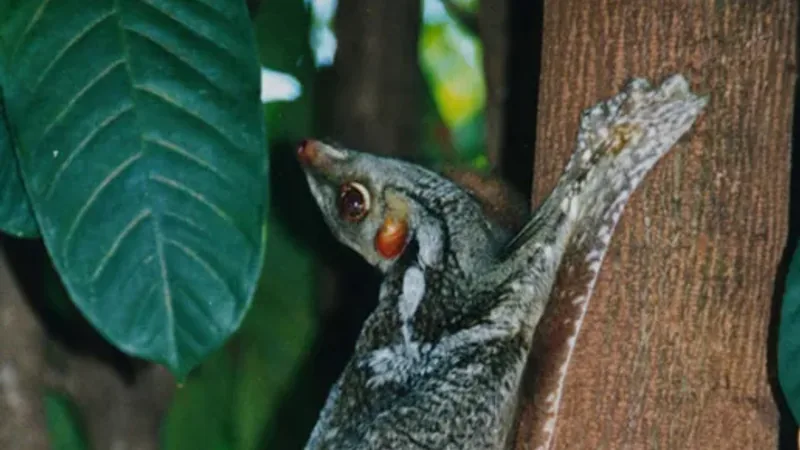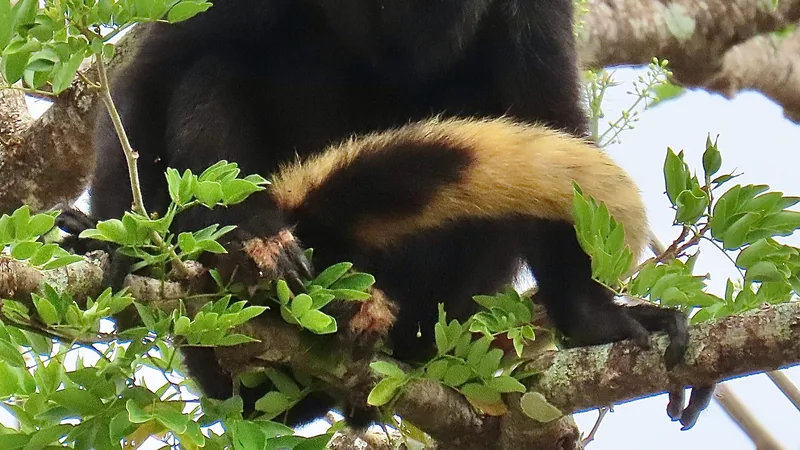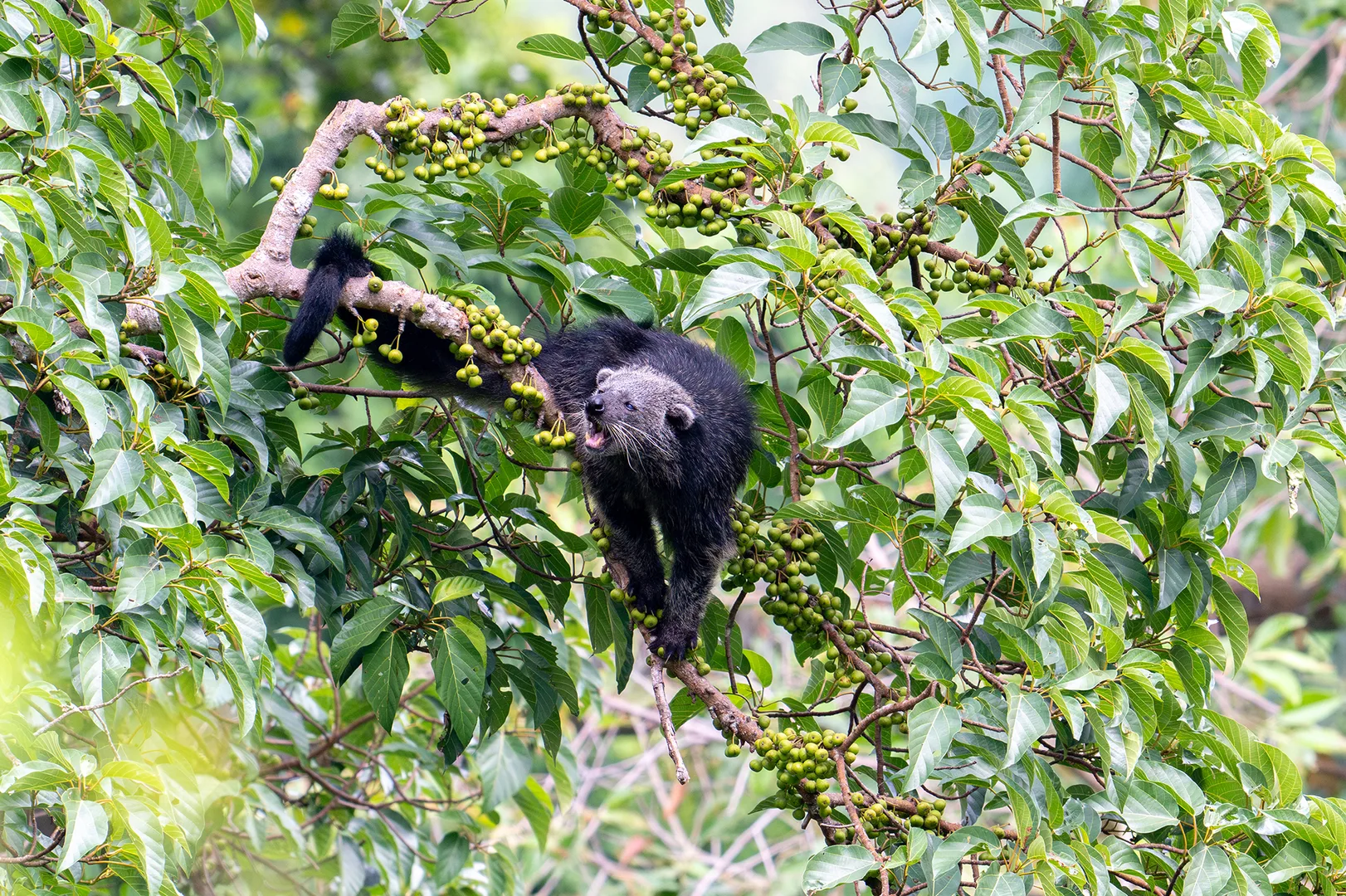
A wild binturong (Arctictis binturong) feeding on fig fruits in Khao Yai National Park, Thailand.
Field
notes
The Popcorn Mystery
Many people who meet a Binturong (Arctictis binturong) notice its smell, and most describe it as hot buttered popcorn. Earlier studies found nothing in its tail-gland secretions to explain the smell. In 2016 a Duke University team analyzed urine from 33 captive binturongs and found 2-acetyl-1-pyrroline, or 2-AP, the compound that gives popcorn its scent, in every sample, with more in males than females.
The team found no 2-AP in the binturongs’ kibble, the one cooked item they ate. The researchers think it more likely that microbes on the skin or fur or in the gut make 2-AP from urine, as bacteria make smelly compounds from armpit sweat. Binturongs pee in a squat, soaking their feet and tails, and drag their tails through the trees, leaving a scent trail on the branches behind them.
No Stove Required Popcorn gets its 2-AP from the heat of popping, at temperatures above what most animals’ bodies can reach, yet 2-AP was the only compound found in every binturong tested.
A Tail That Works Like a Fifth Hand
Binturongs grow 60 to 90 centimeters long, plus a tail nearly as long, and weigh 13 to 22 kilograms. In the wild they live about 16 to 18 years, and up to 25 in human care.
The tail is thick and muscular at the base and prehensile along its last third, and a leathery patch at the tip helps it grip branches. Binturongs can also turn their ankles 180 degrees, so their claws can still grip when they climb down a trunk headfirst.
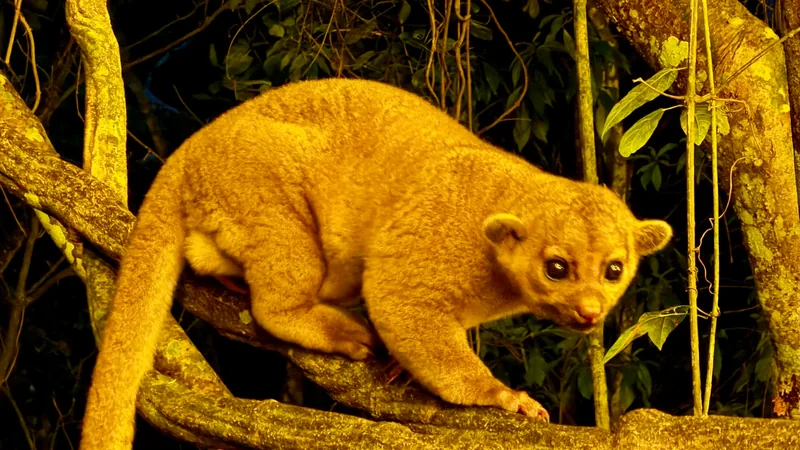
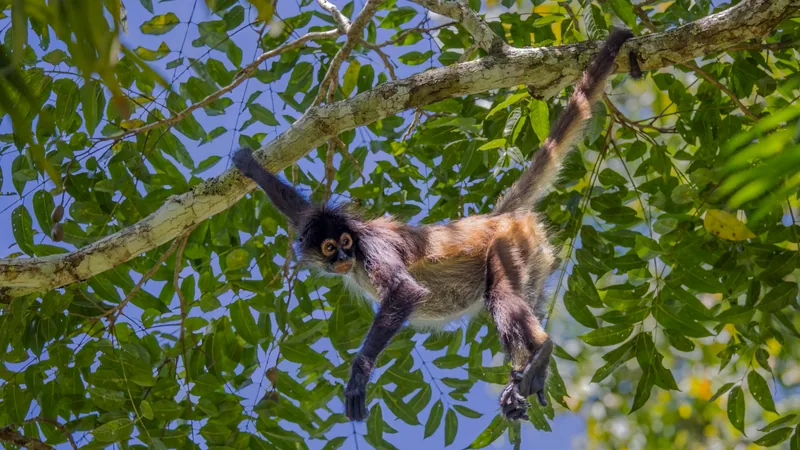
The binturong is one of only two carnivores in the world with a prehensile tail; the other is the kinkajou. Youngsters have been seen hanging upside down, supported by the tail alone, but adults are a bit too heavy to do it without a paw or two for extra grip. Not nearly as acrobatic as monkeys, binturongs usually have to climb down to get from one tree to the next.
Figs, Fast Guts and Sticky Poop
In Borneo, figs make up nearly 90 percent of a binturong’s diet. In captive binturongs, food passes through the gut in about 6.5 hours, fast for a mammal that eats mostly plants.
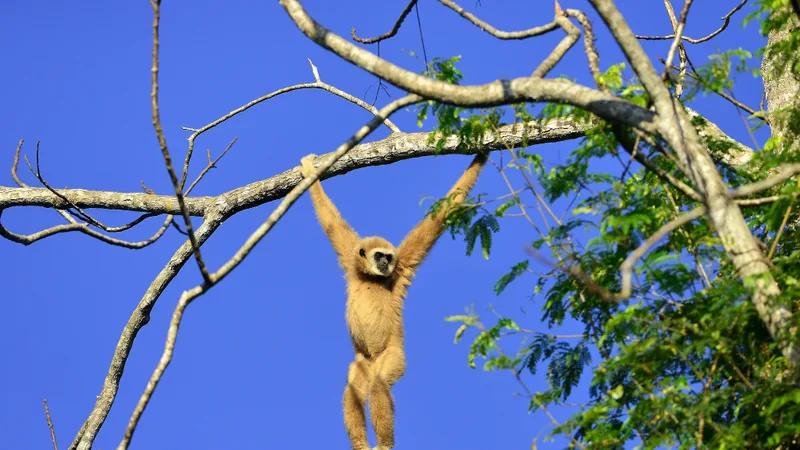
Binturongs digest fruit inefficiently, and their watery droppings stick easily to tree bark. A 2019 study in Sabah, Borneo, found them defecating mainly on tree forks and branches, rarely on the forest floor. Seeds of two of the three fig species tested germinated at higher rates after passing through a binturong than seeds taken straight from the fruit. Against Mueller’s gibbons and helmeted hornbills, binturongs scored by far the highest seed dispersal effectiveness for hemi-epiphytic figs, which sprout high on host trees.
Not a Bear, Not a Cat
Despite the nickname “bearcat,” a binturong is not closely related to bears or cats. It belongs to the civet family, Viverridae. It lives in tropical forests from India and Nepal to Indonesia and the Philippines.
Tigers and dholes are known predators, but as tree-dwellers binturongs are rarely threatened by other predators. The IUCN lists the species as Vulnerable. Deforestation removes both its habitat and its main foods, it is poached for traditional Asian medicine, and in some areas it is hunted for meat and for the pet trade.
Published Updated
Traits
Intel
& FAQ
Guess
first
How big is a Binturong, really? Slide, lock in, and see what the sources say. Every answer is a figure from this page, quoted from where it came from.
Sources
- 01Arctictis binturong (binturong). Animal Diversity Web, University of Michigan.
- 02Binturong. San Diego Zoo Wildlife Alliance.
- 03Binturong. Smithsonian's National Zoo and Conservation Biology Institute.
- 04Lambert et al. (2014). Binturong (Arctictis binturong) and Kinkajou (Potos flavus) Digestive Strategy: Implications for Interpreting Frugivory in Carnivora and Primates. PLoS ONE.
- 05Nakabayashi et al. (2019). Limited directed seed dispersal in the canopy as one of the determinants of the low hemi-epiphytic figs' recruitments in Bornean rainforests. PLOS ONE.
- 06Greene et al. (2016). Reproductive endocrine patterns and volatile urinary compounds of Arctictis binturong: discovering why bearcats smell like popcorn. The Science of Nature.
- 07Why Bearcats Smell Like Buttered Popcorn. Duke Today, Duke University.
- 08Willcox et al. (2016). Arctictis binturong. The IUCN Red List of Threatened Species 2016: e.T41690A45217088.
What the sources say: 72 claims checked word for word against these sources →