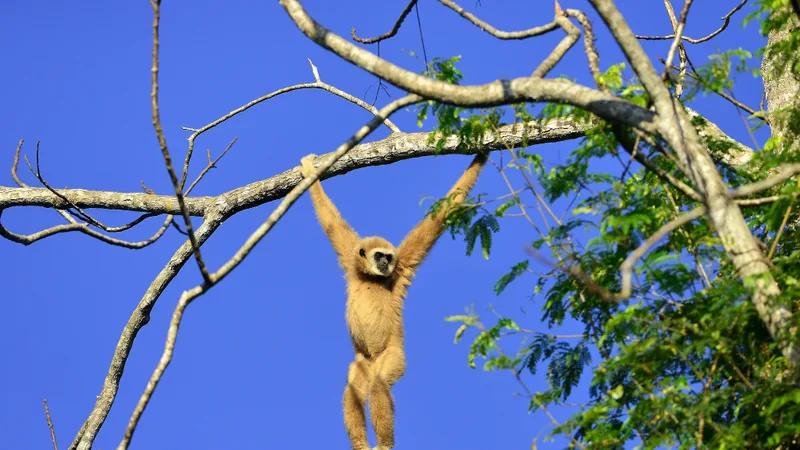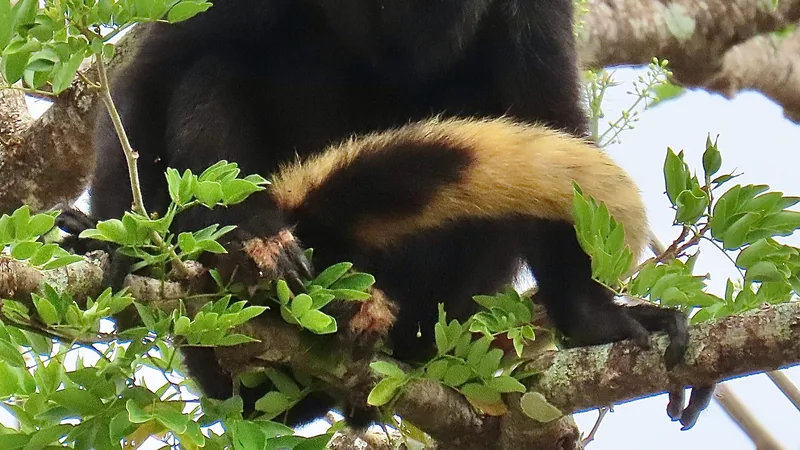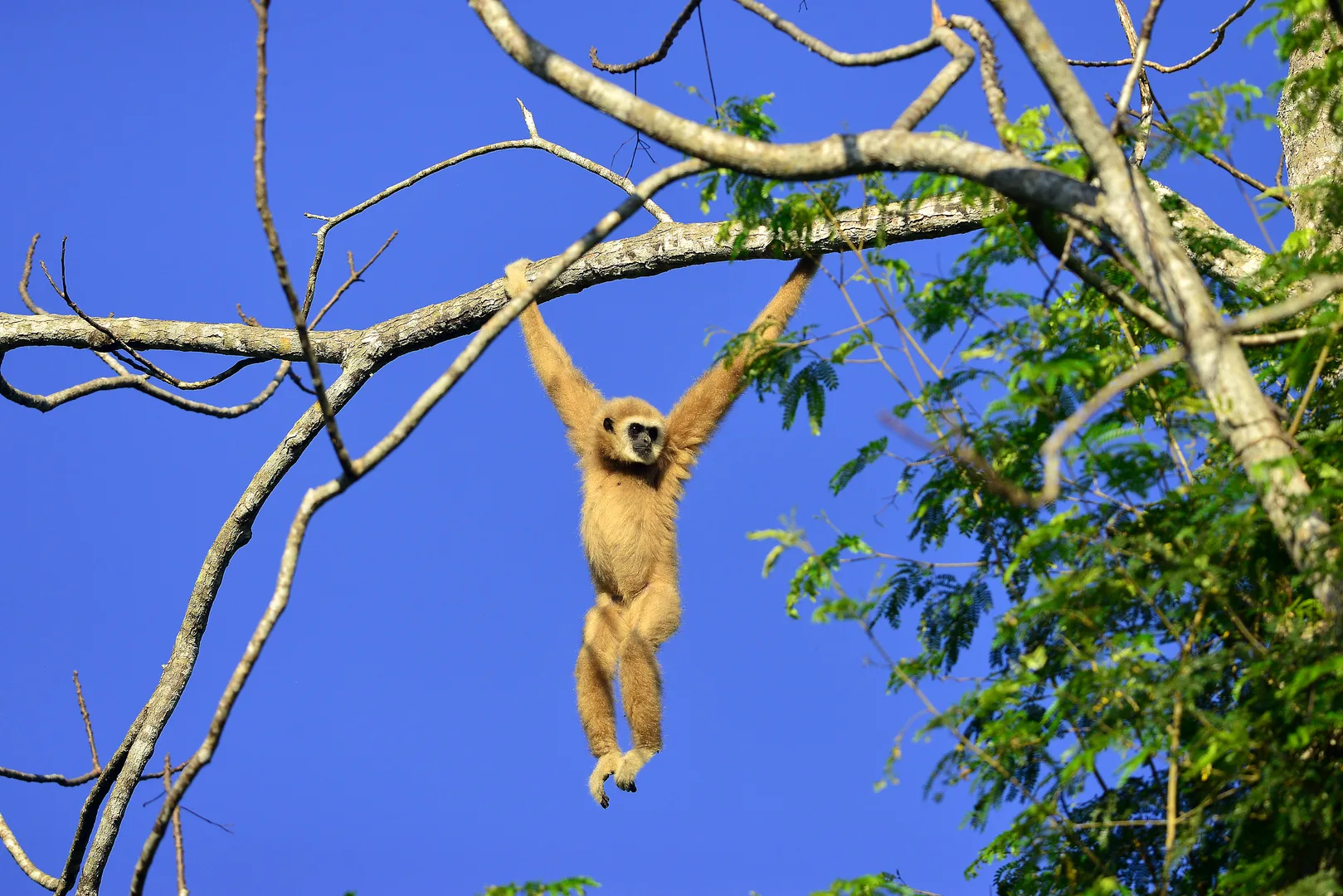
Brachiating, Kaeng Krachan National Park, Thailand
Field
notes
A duet you can hear from a kilometre away
Between sunrise and noon, a bonded pair of lar gibbons sings together, and the song peaks at mid-morning. The duet opens with an introductory call, a series of notes from both partners. Then comes the great call: the female starts it and the male answers. An interlude of male and female notes follows. An average duet lasts 11 minutes and carries up to a kilometre through the forest. Males also sing together at the edges of their home range to chase off intruders.
Learned or inherited? When researchers studied hybrids of lar gibbons and pileated gibbons, the females’ great-calls showed no sign of being learned from their parents and seemed to be under strong genetic control.
Built to swing, slow to breed
Lar gibbons live high in the canopy of tropical rainforest across Southeast Asia, in Indonesia, Laos, Malaysia, Myanmar and Thailand. They are gone from China. Their forelimbs, hands and feet are long, an adaptation for brachiation, which means swinging from branch to branch by the arms. It is their main way of getting around the treetops. They have no tail. Their hands and feet are white, a ring of short pale fur surrounds a bare face, and the coat can be dark (grey to black to brown) or light (cream to light brown).
An adult is 42 to 58 cm long and weighs 4.4 to 7.6 kg, with males the larger sex. Females are mature at around 9 years, gestation lasts 7 months, and a mother has one baby about every 3.5 years. They are mostly monogamous, living in groups of 2 to 6 animals. The AnAge database lists 56 years as the maximum in captivity, an estimate for a wild-born female that died in a zoo.
Picky eaters, early nights
Lar gibbons are mostly fruit eaters, and they are choosy. They taste fruit and accept or reject it by ripeness, then return to the same food sources through the peak season for the ripest pick. Leaves, flowers and insects round out the menu. Eagles, leopards, marbled cats and pythons are listed as potential predators, but no act of predation on a gibbon has been observed. On average, lar gibbons spend fifteen and a half hours a day in their sleeping trees, from several hours before dusk until morning, and they go to them without calling or physical contact on the way, which suits animals trying to stay unnoticed by predators.
The Red List rates the species Endangered. Animal Diversity Web’s 2014 account blamed that status in part on the illegal pet trade in Thailand, in which gibbons are hunted and captured, and called deforestation a growing threat.
Published
Traits
Intel
& FAQ
Guess
first
How big is a Lar Gibbon, really? Slide, lock in, and see what the sources say. Every answer is a figure from this page, quoted from where it came from.
Sources
- 01Hylobates lar. Animal Diversity Web.
- 02AnAge entry for Hylobates lar. Human Ageing Genomic Resources, AnAge.
- 03Brockelman & Geissmann (2020). Hylobates lar. The IUCN Red List of Threatened Species 2020: e.T10548A17967253.
- 04Brockelman & Schilling (1984). Inheritance of stereotyped gibbon calls. Nature.
What the sources say: 38 claims checked word for word against these sources →