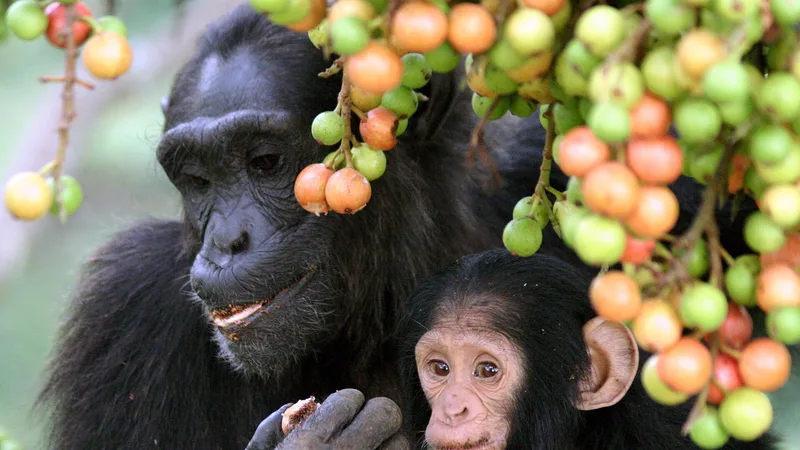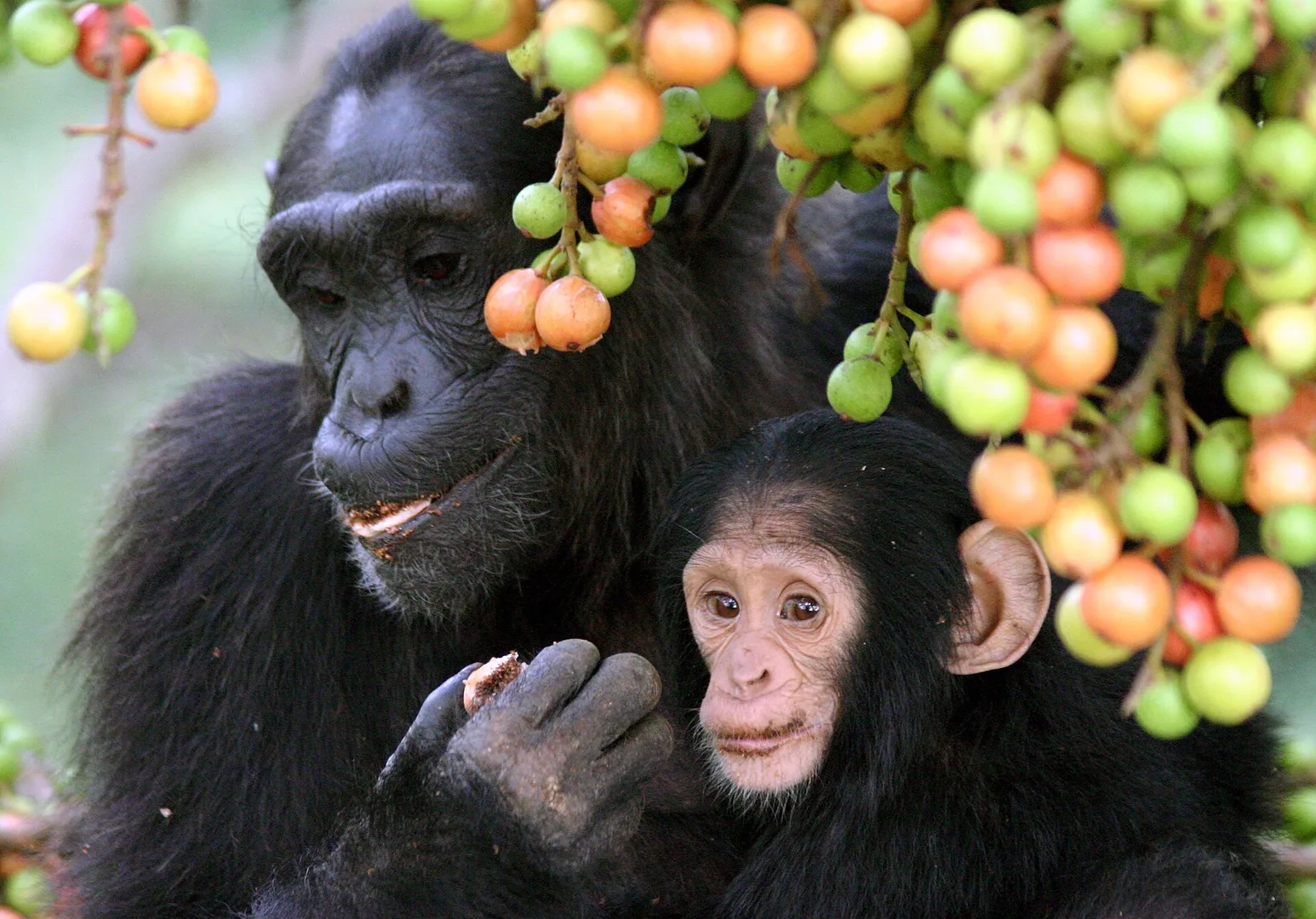
Alpha male chimpanzee in Kibale Forest National Park, Uganda.
Field
notes
An Ape With Local Customs
A chimpanzee (Pan troglodytes) in one forest strips a twig and dips it into a termite mound to fish out the insects inside. In some other populations, chimpanzees crack hard-shelled nuts open with rocks or sticks used as hammers. In 1999, researchers pooled the seven longest-running chimpanzee field studies. They found 39 behaviour patterns, including tool use, grooming and courtship, that are customary or habitual in some communities but absent in others, in cases where they had ruled out the local environment as the explanation. That was far more variation than had been documented for any animal species except humans.
Adult chimpanzees measure about 3 feet (0.9 meters) from head to rump. Females weigh 70 to 100 pounds (32 to 45 kilograms) and males 90 to 120 pounds (40 to 55 kilograms). San Diego Zoo Wildlife Alliance puts the average lifespan at 32 years for males and 40 years for females.
About One DNA Letter in a Hundred
Line up a human genome and a chimpanzee genome, and on average 1.23% of the single DNA letters differ. At most 1.06% are fixed differences that separate the two species. Orthologous proteins, the matching versions of each protein in the two species, are extremely similar: about 29% are identical, and the typical orthologue differs by only two amino acids, one per lineage.
A Second Kind of Difference Insertions and deletions of DNA are fewer in number than single-letter substitutions, but they leave about 1.5% of the euchromatic sequence in each species lineage-specific, found in that lineage alone.
Communities That Patrol Their Borders
Home is a community that can sometimes number as many as 100 chimpanzees, made up of family groups of usually about 6 to 10. The community splits into small parties that come together from time to time, a pattern behaviorists call a fusion-fission society. Males form coalitions, which in both wild and captive groups may let males dominate a third individual they could not dominate by themselves. Males patrol the community’s borders, or raid into a neighboring group’s range, almost entirely in silence, as if they understand that the mission’s success depends on staying covert. Between communities, aggression seems to be the rule: at Gombe and Mahale, larger communities exterminated smaller neighboring ones through brutal attacks between males of the rival groups. It is not all conflict, though. A dominant chimpanzee that has attacked a subordinate often reassures it afterwards.
Food, Medicine and Threats
Chimpanzees eat a wide variety of food, including fruit, leaves, bark, seeds, flowers and insects, and they also hunt other animals such as monkeys and small antelope for meat. When water is scarce, they chew leaves to make them soft and sponge-like, then use them to soak up rainwater inside tree holes. Some observers have noted chimpanzees eating medicinal plants when they are ill or injured. Keeping chimpanzees as illegal pets has caused a decline in their populations, and people also hunt them for bushmeat or to protect their crops. These conditions, plus loss of habitat, have led to the chimpanzee’s Endangered status on the IUCN Red List.
Published Updated
Traits
Intel
& FAQ
Guess
first
How big is a Chimpanzee, really? Slide, lock in, and see what the sources say. Every answer is a figure from this page, quoted from where it came from.
Sources
- 01Chimpanzee. San Diego Zoo Wildlife Alliance.
- 02Pan troglodytes (chimpanzee). Animal Diversity Web, University of Michigan.
- 03The Chimpanzee Sequencing and Analysis Consortium (2005). Initial sequence of the chimpanzee genome and comparison with the human genome. Nature.
- 04Whiten et al. (1999). Cultures in chimpanzees. Nature.
- 05Humle et al. (2016). Pan troglodytes. The IUCN Red List of Threatened Species 2016: e.T15933A129038584.
What the sources say: 52 claims checked word for word against these sources →