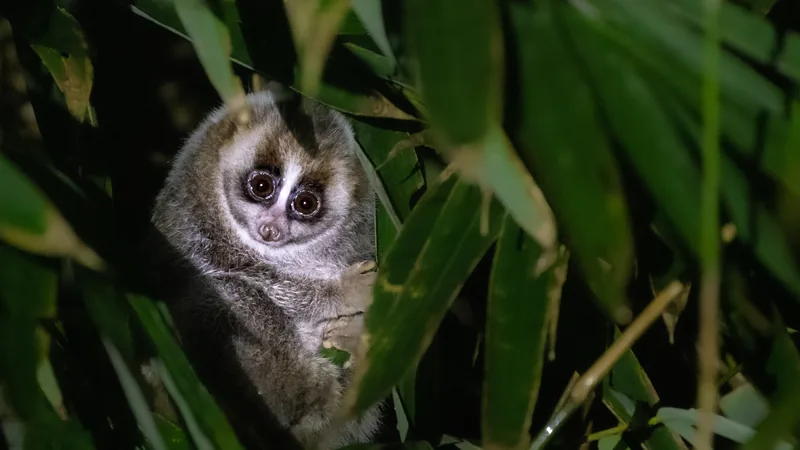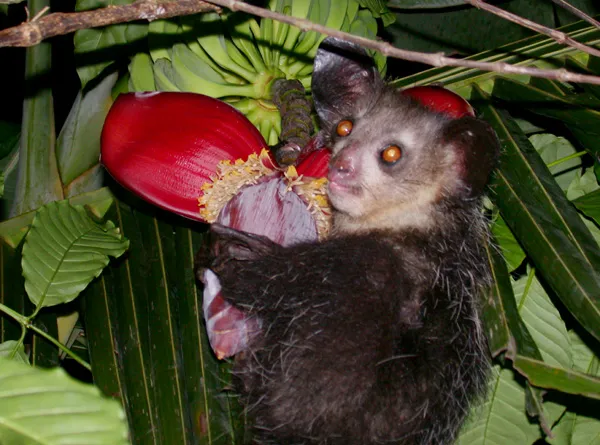
An aye-aye watching from the branches, southeastern Madagascar.
Field
notes
It Taps, Then Listens
Aye-ayes are nocturnal, solitary foragers who spend up to 80% of the night feeding and traveling through the forest canopy. A significant share of their diet is insect larvae (grubs) living inside dead or living trees, and they have evolved a specialized way of finding them, called tap foraging. Walking along a branch, an aye-aye taps the wood continuously and rapidly with its middle finger. It cups its huge ears forward and listens closely to the echoes coming from the tapped tree. When the sound shows it is above an insect tunnel, the aye-aye tears off enormous chunks of bark with its teeth. Then it slides that slender, highly flexible finger into the hole and hooks the grub out with the fingertip.
Odd Fingers, Odd Teeth
Aye-ayes are the world’s largest nocturnal primate, at around 38 centimetres long, with a fluffy tail that is longer than their bodies. An adult weighs 2.5 to 2.8 kilograms. Their fingers are long, and the third finger is thinner than the others. According to a 2005 anatomy study, this middle finger is no longer used for moving around. It works as a probe for finding and pulling out wood-boring larvae, and its phalanges (finger bones) can move both at great speed and independently of each other.
Then there are the teeth. An aye-aye’s incisors (front teeth) are continually growing, which the Duke Lemur Center calls unique among primates, and only their front surface has a coat of enamel.
A Night Animal With a Working Color Gene Some nocturnal primates are colorblind because a gene for a light-sensing pigment, called SWS1, has stopped working. In the aye-aye that gene is intact, and its pigment is most sensitive to light with a wavelength of 406 nanometres, closer to ultraviolet than in most primates. A 2012 study reported that twilight is rich in bluish light, and that twilight and full moonlight are probably bright enough for color vision. The researchers speculate that the gene is an adaptation for twilight, and point to possible blue targets such as scent marks and the brilliant blue arils (seed coverings) of the Ravenala plant.
Diet, Range and Lifespan
The Duke Lemur Center describes the aye-aye’s diet as highly specialized, made up almost entirely of invertebrates with some nuts and seeds. A study published in 1994 found that one wild population ate four main food types: seeds, nectar, fungus and insect larvae. Aye-ayes are also known to raid coconut, lychee and mango plantations. They live along Madagascar’s east coast and in its northwestern forests, in rainforest, deciduous forest and cultivated plantations. The AnAge longevity database lists a maximum lifespan of 32.3 years, for a captive aye-aye reported by the Duke Lemur Center.
Hunted as a Bad Omen
The aye-aye’s population is not dense, so seeing one in the wild is incredibly rare. The main threats to its survival are habitat loss and hunting. Its bizarre appearance has traditionally led many villagers to regard the aye-aye as an evil omen, or fady, that must be killed on sight to avoid bringing bad luck onto an entire village. Aye-ayes are also sometimes killed as crop-threatening pests in agricultural areas. The IUCN Red List assesses the species as Endangered.
Published Updated
Traits
Intel
& FAQ
Guess
first
How big is a Aye-Aye, really? Slide, lock in, and see what the sources say. Every answer is a figure from this page, quoted from where it came from.
Sources
- 01Aye-aye. Duke Lemur Center.
- 02Daubentonia madagascariensis (aye-aye). Animal Diversity Web, University of Michigan.
- 03Sterling et al. (1994). Dietary Intake, Food Composition and Nutrient Intake in Wild and Captive Populations of Daubentonia madagascariensis. Folia Primatologica.
- 04Soligo (2005). Anatomy of the Hand and Arm in Daubentonia madagascariensis: A Functional and Phylogenetic Outlook. Folia Primatologica.
- 05Melin et al. (2012). Why Aye-Ayes See Blue. American Journal of Primatology.
- 06Daubentonia madagascariensis. AnAge: The Animal Ageing and Longevity Database, Build 15, 2023.
- 07Louis et al. (2020). Daubentonia madagascariensis. The IUCN Red List of Threatened Species 2020: e.T6302A115560793.
What the sources say: 47 claims checked word for word against these sources →